
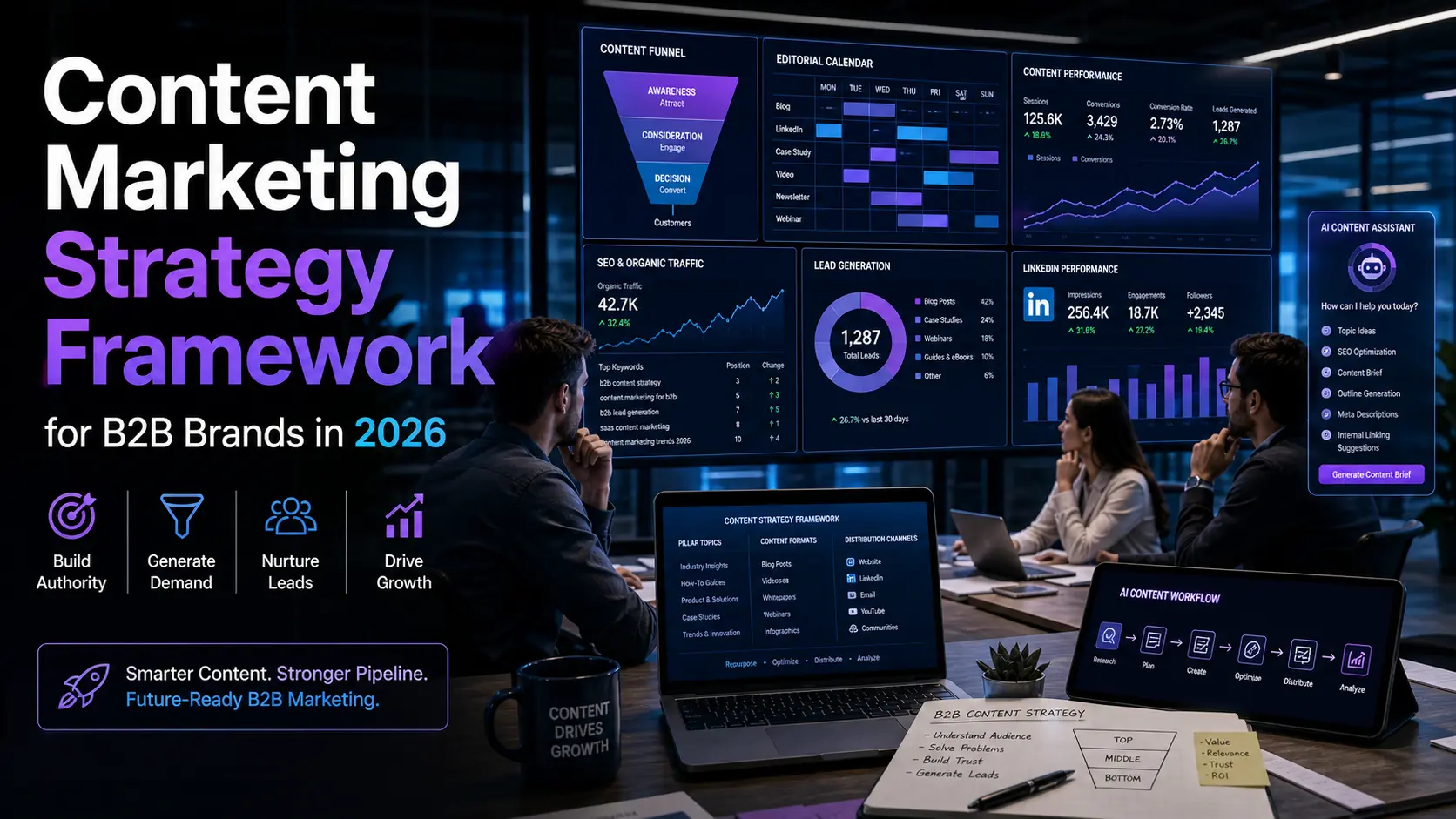
B2B buyers in 2026 consume an average of 13 pieces of content before contacting a vendor. That number has grown steadily over the past five years, and it signals something every marketing team should pay attention to: your content marketing strategy is no longer a nice-to-have. It is the engine that drives pipeline.
Yet most B2B brands still publish blog posts without a clear plan. They create content that sounds good internally but fails to attract, educate, or convert the people who actually make buying decisions. The gap between companies that treat content as a strategic asset and those that treat it as a checkbox keeps widening.
This guide delivers a practical content marketing strategy framework built for B2B brands operating in 2026. You will find a step-by-step process, real metrics to track, and actionable templates you can implement this quarter. Unlike generic advice, this framework connects every piece of content to a specific stage in the buyer journey, so nothing gets created without purpose.
What Is Content Marketing for B2B?
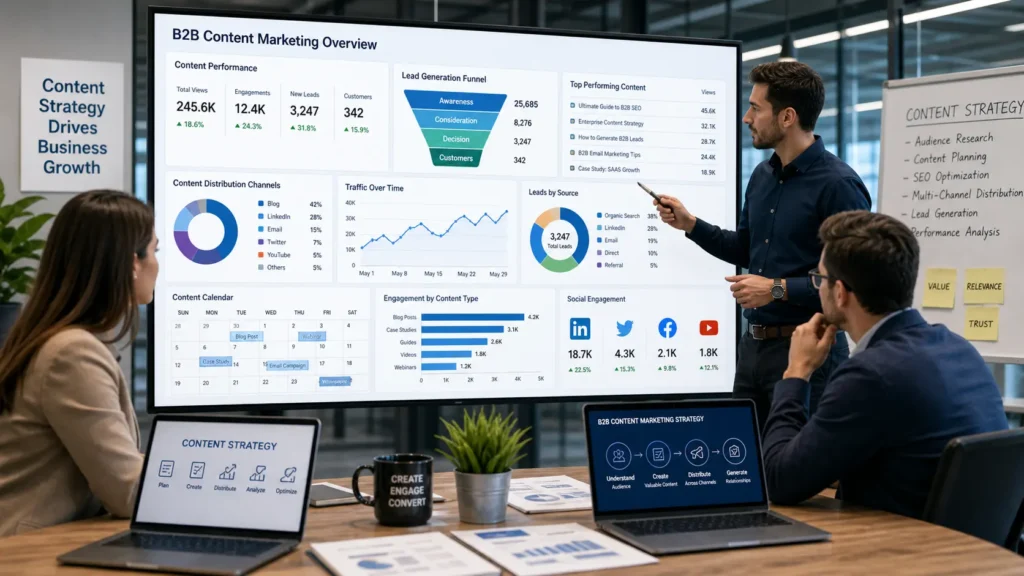
Content marketing for B2B is the practice of creating, publishing, and distributing valuable content to attract and retain a clearly defined business audience. The goal is not immediate sales. Instead, a strong B2B content plan builds trust over time, positions your brand as a credible resource, and guides potential buyers through the decision-making process.
B2B content marketing differs from B2C in several important ways. The sales cycles are longer (often 6 to 18 months). Multiple stakeholders influence buying decisions. The content needs to address technical questions, ROI concerns, and organizational change management, all at once.
A well-executed content marketing strategy turns your website into a 24/7 salesperson who never takes a day off. It answers questions before prospects even think to ask them. It builds the kind of authority that makes competitors irrelevant in the eyes of your ideal customer.
Why B2B Content Marketing Matters in 2026
The B2B landscape has shifted dramatically. Here are four forces making content marketing more important than ever:
- AI-Assisted Research: B2B buyers now use AI tools to shortlist vendors. If your content does not appear in AI-generated summaries and recommendations, you are invisible to a growing segment of decision-makers.
- Privacy-First Advertising: Third-party cookies are gone. Paid acquisition costs continue to rise. Organic content provides a sustainable, compounding channel that does not depend on ad platforms.
- Buyer Self-Service: Gartner research shows that 75% of B2B buyers prefer a rep-free buying experience. They want to research, compare, and evaluate on their own terms, using your content.
- Trust Deficit: Decision-makers are skeptical of vendor claims. Thought leadership content backed by data and genuine expertise cuts through the noise in ways that sales pitches cannot.
Content Funnel Basics: Understanding the Buyer Journey
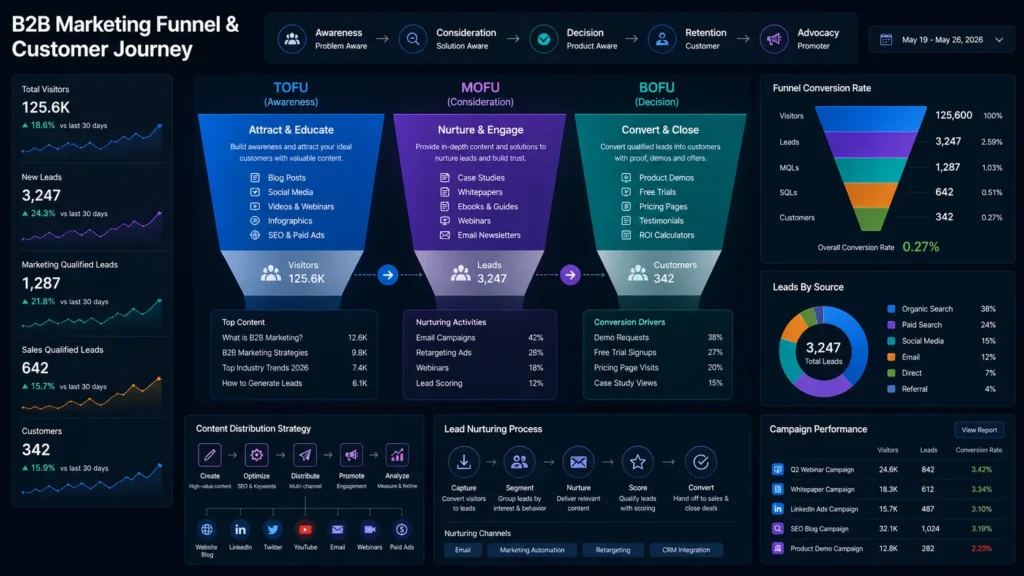
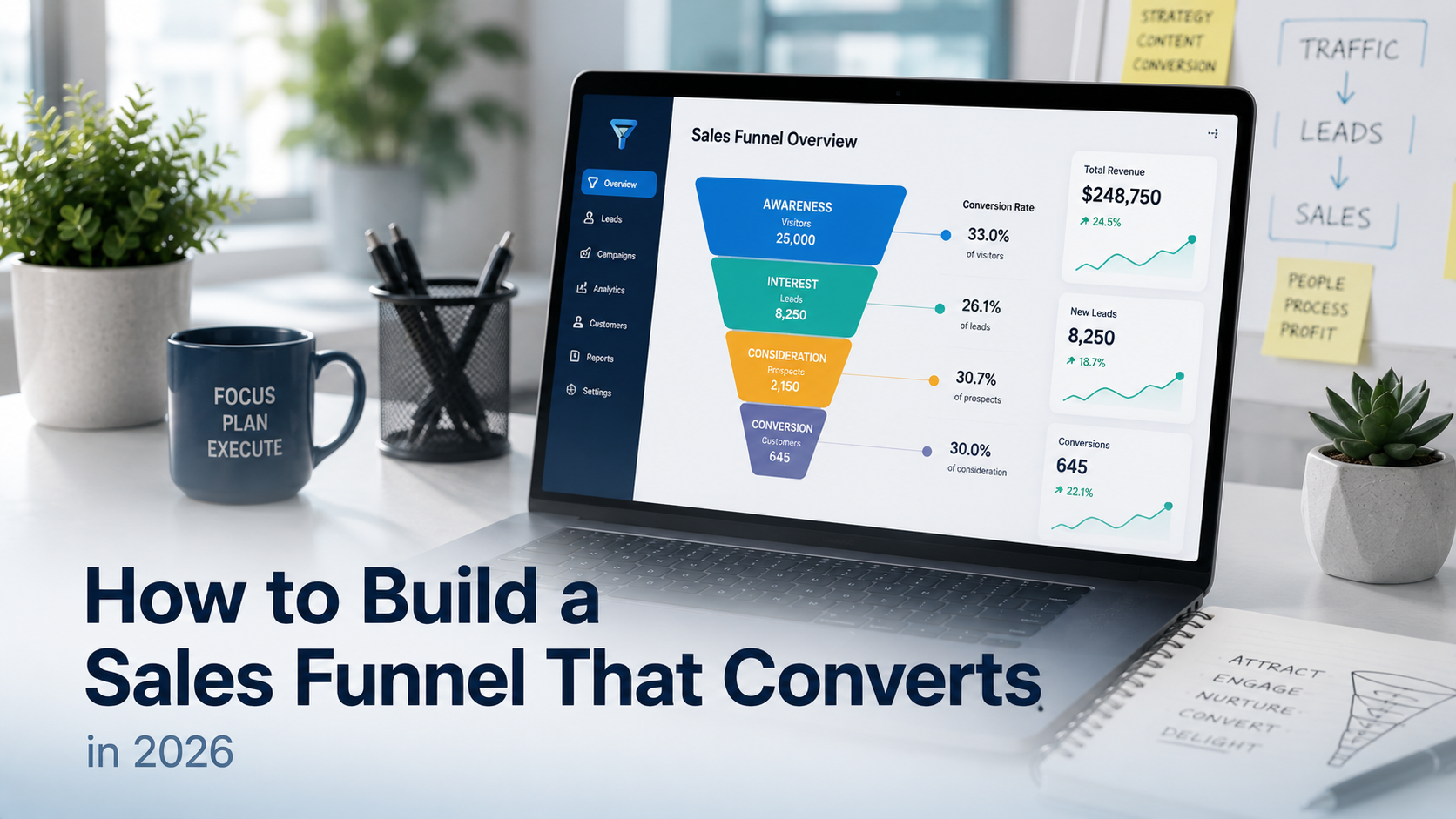
Every effective content marketing strategy maps content to the buyer journey. The content funnel has three stages, and each one requires different content types, messaging, and calls to action.
| Funnel Stage | Buyer Mindset | Content Goal | Best Formats |
| TOFU (Awareness) | “I have a problem” | Educate and attract | Blog posts, infographics, social content, podcasts |
| MOFU (Consideration) | “I need a solution” | Build trust and demonstrate expertise | Whitepapers, case studies, webinars, comparison guides |
| BOFU (Decision) | “I need the right vendor” | Convert and close | ROI calculators, free trials, demos, testimonials |
Most B2B brands over-invest in TOFU content and starve the middle and bottom of the funnel. A balanced content marketing strategy allocates roughly 40% of effort to TOFU, 35% to MOFU, and 25% to BOFU.
The 6-Step Content Marketing Strategy Framework
This framework gives you a repeatable system for planning, creating, and measuring B2B content. Each step builds on the previous one, so follow them in order when setting up your strategy for the first time.
Step 1: Audience Research and ICP Development
Every piece of content you create should be written for a specific person. Not a vague “target audience” but a detailed Ideal Customer Profile (ICP) that includes firmographic and psychographic details.
Start by answering these questions:
- What industries do your best customers come from?
- What is their company size (revenue and headcount)?
- Who are the decision-makers, and who are the influencers?
- What problems keep them up at night?
- Where do they consume content (LinkedIn, industry publications, podcasts, YouTube)?
- What objections do they raise during sales conversations?
Interview your sales team. Review closed-won deal notes. Survey existing customers. The insights you gather here shape every decision that follows.
Create two to three ICP documents. Each one should include a name, title, company profile, goals, challenges, preferred content formats, and the specific questions they ask at each funnel stage. These documents become the foundation of your B2B content plan.
Step 2: Defining Content Pillars
Content pillars are the three to five core topics your brand will own. They should sit at the intersection of what your audience cares about and what your company is uniquely qualified to discuss.
For example, a B2B SaaS company selling project management software might choose these pillars:
- Remote team productivity
- Project management best practices
- Cross-functional collaboration
- Resource planning and capacity management
Each pillar becomes a cluster of content. You will create one comprehensive pillar post (like this one) surrounded by supporting articles, videos, and downloadable resources. This cluster approach signals topical authority to search engines and gives readers a complete resource on each subject.
Your thought leadership strategy should live within these pillars. Every piece of original research, expert interview, and opinion piece should connect back to one of your core topics.
Step 3: Building a B2B Content Calendar
A B2B content calendar transforms your strategy from an idea into a production schedule. Without one, content creation becomes reactive and inconsistent.
Your content calendar should include:
- Publishing dates and deadlines for drafts, reviews, and approvals
- Content type and format (blog, video, case study, whitepaper)
- Target keyword and search intent
- Funnel stage (TOFU, MOFU, or BOFU)
- Content pillar assignment
- Owner and contributors
- Distribution channels and promotion plan
- Status tracking (ideation, drafting, review, published, promoted)
Plan your calendar in 90-day cycles. This gives you enough runway to produce quality content while staying flexible enough to respond to market changes. Review and adjust the calendar monthly based on performance data.
A practical tip: map your calendar to your sales cycle. If deals typically close at the end of each quarter, schedule BOFU content (case studies, comparison guides, ROI analyses) to publish six to eight weeks before those closing windows.
Step 4: The Content Creation Process
Consistent, high-quality content requires a defined production process. Here is a workflow that works for most B2B teams:
- Brief: Create a content brief for every piece. Include the target keyword, audience segment, funnel stage, key points to cover, internal and external sources, and the desired call to action.
- Draft: Write the first draft. Prioritize clarity and accuracy over cleverness. Use short paragraphs, subheadings, and visual breaks to improve readability.
- Review: Have a subject matter expert review for accuracy. Have an editor review for clarity, tone, and SEO optimization.
- Design: Add custom graphics, charts, or screenshots. Visual content increases engagement and makes complex information easier to understand.
- Optimize: Final SEO check. Verify meta title, meta description, internal links, alt text, and schema markup.
- Publish and Promote: Publish on your website and immediately begin distribution (more on this in Step 5).
One critical rule: never publish content that your sales team cannot use. Before hitting publish, ask yourself whether a salesperson could send this article to a prospect and feel confident it would move the conversation forward. If the answer is no, revise it.
Step 5: Distribution Channels That Actually Work
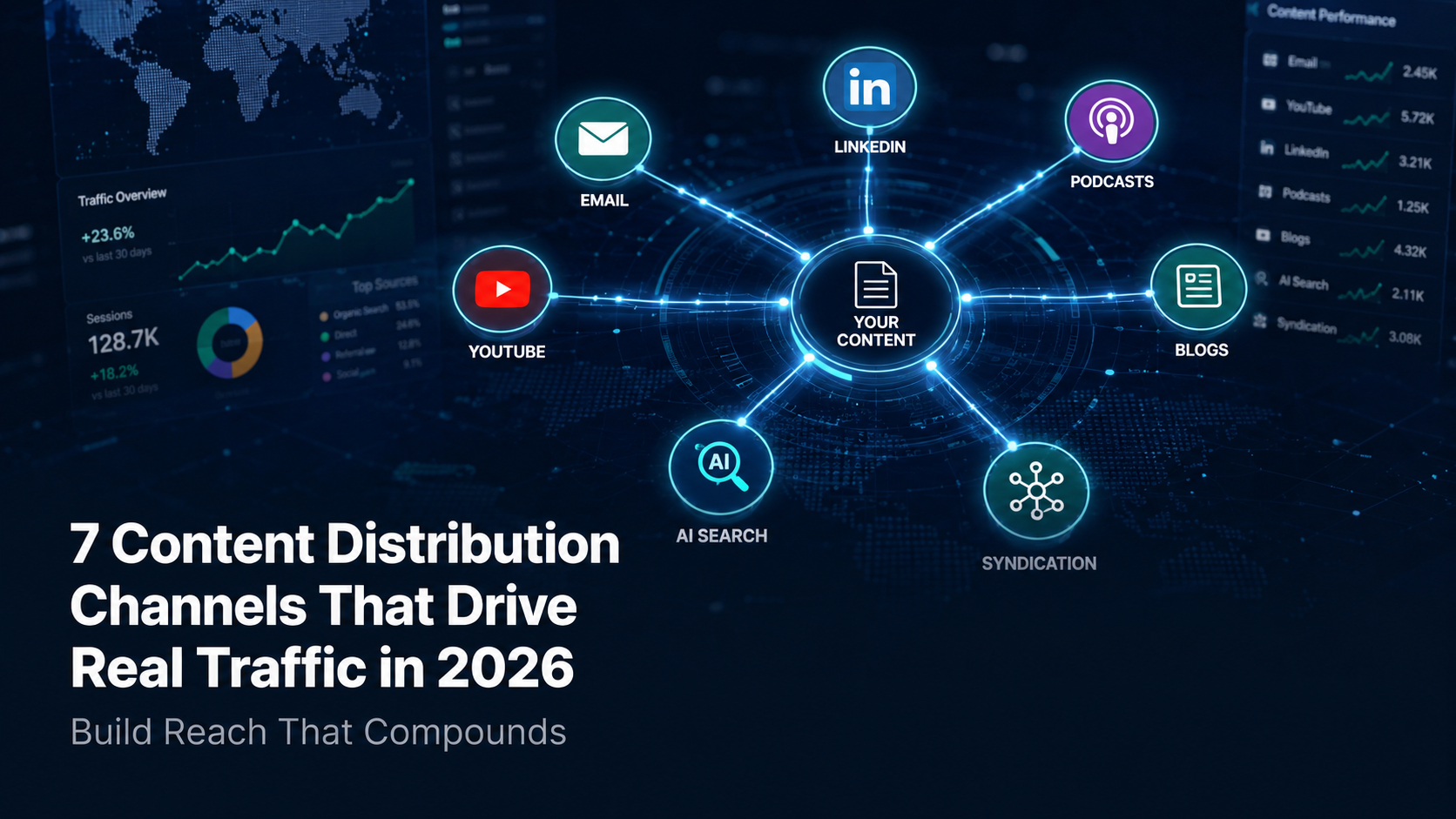
Creating great content is only half the job. Distribution determines whether anyone actually sees it. Here are the B2B content distribution channels that deliver results in 2026:
Owned Channels
- Company blog and resource center
- Email newsletter (segmented by ICP and funnel stage)
- Product documentation and knowledge base
Earned Channels
- Guest posts on industry publications
- Podcast guest appearances
- Media coverage and press mentions
- Customer reviews and testimonials on third-party platforms
Shared Channels
- LinkedIn (the top B2B social platform by a wide margin)
- Industry-specific Slack communities and forums
- Reddit communities relevant to your niche
- YouTube for long-form educational content
Paid Channels
- LinkedIn Sponsored Content and InMail
- Google Search Ads for high-intent BOFU keywords
- Content syndication platforms (use selectively)
- Sponsored newsletter placements in industry publications
The most effective B2B brands follow a 1:5 ratio. For every hour spent creating content, spend five hours distributing and promoting it. Most teams do the opposite, and their content sits unread.
Step 6: Measurement and Optimization
Measuring content marketing ROI is where most B2B teams struggle. The challenge is that content influences revenue across a long sales cycle, and attribution is rarely straightforward.
Here is a practical measurement framework organized by funnel stage:
| Funnel Stage | Key Metrics | Tools |
| TOFU | Organic traffic, keyword rankings, social impressions, bounce rate, time on page | Google Analytics 4, Google Search Console, Semrush |
| MOFU | Email signups, content downloads, webinar registrations, return visitor rate | HubSpot, Marketo, ActiveCampaign |
| BOFU | MQLs, SQLs, demo requests, content-influenced pipeline, content-attributed revenue | CRM (Salesforce, HubSpot), attribution tools (Bizible, Dreamdata) |
Track these metrics monthly. Look for trends, not snapshots. A single month of data rarely tells you enough to make smart decisions. Content marketing compounds over time, so evaluate performance in 90-day windows at minimum.
The formula for calculating content marketing ROI is straightforward: (Revenue attributed to content minus content production costs) divided by content production costs, multiplied by 100. The tricky part is accurate attribution. Use a multi-touch attribution model rather than last-click to get a realistic picture.
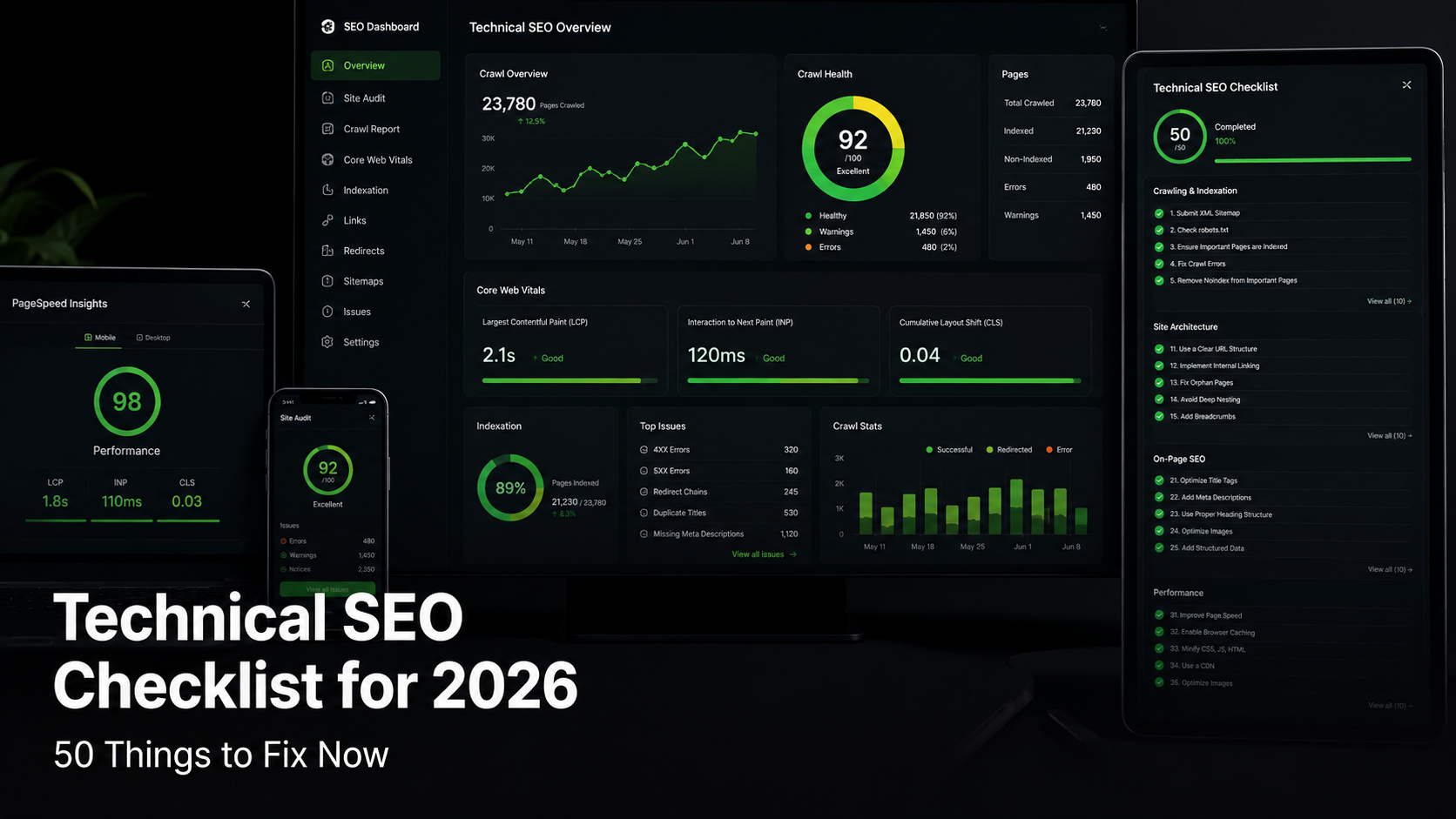
The difference between websites that rank consistently and those that struggle is rarely content quality alone. It is the technical foundation underneath.
Content Types That Drive B2B Leads

Not all content formats perform equally in B2B. Based on 2026 benchmarks, here are the formats that consistently generate qualified leads:
- Original Research Reports: B2B buyers crave data. Publishing proprietary research positions your brand as a primary source and attracts high-quality backlinks.
- Case Studies: Nothing builds trust faster than showing how you solved a specific problem for a real customer. Include concrete numbers (revenue growth, time saved, cost reduced).
- Long-Form Guides and Pillar Posts: Comprehensive resources (like this one) rank well in search, attract links, and serve as cornerstone content for your topic clusters.
- Webinars and Live Events: Interactive formats generate leads and let prospects experience your expertise firsthand. Record them and repurpose the content.
- Comparison and Alternative Pages: BOFU content that captures buyers actively evaluating solutions. These pages convert at significantly higher rates than blog posts.
- Video Content: Short-form explainer videos and long-form tutorials work well on LinkedIn and YouTube. Video is increasingly expected by B2B audiences.
Content Repurposing Strategies for Maximum Reach
Content repurposing is how smart B2B teams multiply their output without multiplying their workload. Every piece of content you create should be repurposed into at least three additional formats.
Here is a practical repurposing workflow:
- Turn a pillar blog post into a LinkedIn carousel, a short video, and an email series
- Convert a webinar recording into a blog post, audiogram clips, and a downloadable PDF summary
- Transform customer interviews into case studies, social proof snippets, and sales enablement one-pagers
- Break an original research report into individual stat graphics, a press release, and a series of LinkedIn posts
- Compile related blog posts into a comprehensive ebook or downloadable guide
The key to effective content repurposing is adapting the format and messaging for each channel. Do not simply copy and paste a blog post into LinkedIn. Rewrite it as a native LinkedIn post that hooks the reader in the first two lines and delivers value in a format that works for that platform.
Measuring Content Marketing ROI: A Practical Approach
Let us get specific about measuring content marketing ROI in 2026. Generic advice tells you to “track engagement.” That is not enough. You need a system that connects content activity to revenue.
The Three-Layer ROI Model
- Layer 1: Activity Metrics: These tell you whether your content engine is running. Track publishing cadence, keyword coverage, content quality scores, and production costs per piece.
- Layer 2: Engagement Metrics: These tell you whether your content resonates. Track organic traffic growth, time on page, scroll depth, social shares, and email click-through rates.
- Layer 3: Revenue Metrics: These tell you whether your content drives business results. Track content-influenced pipeline, content-sourced leads, conversion rates by content type, and customer acquisition cost from organic channels.
Most teams only measure Layer 1 and Layer 2. The companies that win are the ones that build systems to measure Layer 3 and can show their executive team exactly how content contributes to revenue.
Set up proper UTM tracking for every piece of content you distribute. Use your CRM to tag leads by their first content touchpoint. Run quarterly content attribution reports that show which pieces influenced closed deals.
7 Common B2B Content Marketing Mistakes
Avoid these pitfalls that derail even well-funded content programs:
- No documented strategy: Teams that operate without a written content marketing strategy produce scattered, inconsistent content. Document your ICPs, pillars, calendar, and goals.
- Ignoring search intent: Ranking for a keyword means nothing if your content does not match what the searcher actually wants. Analyze the top-ranking pages for every target keyword before writing.
- Creating content for the C-suite ego: Internal stakeholders often push for content that highlights the company. Buyers do not care about your company story. They care about solving their problems.
- Publishing and forgetting: Content needs ongoing promotion, updating, and optimization. Schedule quarterly content audits to refresh outdated pieces and consolidate underperforming ones.
- Neglecting distribution: Great content with zero distribution is invisible content. Build distribution into your content calendar from day one.
- Measuring vanity metrics only: Page views and social likes feel good but do not pay the bills. Connect your metrics to pipeline and revenue.
- Trying to do everything at once: Start with two content pillars and a manageable publishing cadence. Scale after you have proven what works.
Expert Tips for B2B Content Marketing in 2026
These recommendations come from patterns observed across high-performing B2B content programs:
- Invest in AI-assisted workflows, not AI-generated content: Use AI tools to speed up research, generate outlines, and optimize distribution. Keep the writing and strategic thinking human. B2B buyers can spot generic AI content instantly, and it erodes trust.
- Build a subject matter expert (SME) network: Your content is only as credible as the expertise behind it. Develop relationships with internal and external experts who can contribute insights, quotes, and reviews to your content.
- Prioritize content depth over content volume: One comprehensive, well-researched article outperforms ten shallow blog posts. Google and AI search tools increasingly reward content that demonstrates genuine expertise and provides complete answers.
- Create content that sales teams actually use: Meet with your sales team monthly. Ask what questions prospects are asking. Build content that addresses those exact questions. When sales reps voluntarily share your content with prospects, you know your strategy is working.
- Optimize for AI search visibility: Structure your content with clear headings, concise definitions, data-backed claims, and direct answers to common questions. AI search tools pull from content that is well-organized and authoritative.
- Run quarterly content audits: Review every piece of content for accuracy, relevance, and performance. Update statistics, refresh examples, and consolidate thin content. Your existing library is one of your most valuable assets.
- Track content influence, not just content attribution: A prospect may read five blog posts, attend a webinar, and download a whitepaper before requesting a demo. Multi-touch tracking captures the full picture of how content supports the buying journey.
Frequently Asked Questions
What is a B2B content marketing strategy?
A B2B content marketing strategy is a documented plan that outlines how your business will use content to attract, engage, and convert other businesses into customers. It includes audience research, content pillars, a publishing calendar, distribution plans, and measurement frameworks. A strong strategy ties every piece of content to a specific business goal and buyer journey stage.
How do you measure content marketing success?
Content marketing success is measured across three levels: activity metrics (publishing consistency, production costs), engagement metrics (traffic, time on page, downloads), and revenue metrics (leads generated, pipeline influenced, deals closed). The most meaningful measure is content-influenced revenue, which tracks how much closed business was touched by your content during the sales process.
What types of content work best for B2B?
The most effective B2B content formats in 2026 include original research reports, case studies with concrete data, long-form pillar posts, webinars, comparison pages, and short-form video. The best format depends on your audience and funnel stage. TOFU audiences respond well to educational blog posts and videos. MOFU audiences engage with case studies and webinars. BOFU audiences convert with ROI calculators, demos, and detailed comparison content.
How often should a B2B company publish content?
Quality matters more than frequency. Most B2B companies benefit from publishing two to four high-quality pieces per week across different formats. However, one exceptional article per week outperforms five mediocre ones. Start with a cadence you can sustain consistently, then increase as your team and processes mature.
How long does it take for content marketing to show results?
Content marketing typically takes three to six months to show measurable traffic growth and six to twelve months to demonstrate meaningful impact on pipeline and revenue. The compounding nature of content means that results accelerate over time. Companies that commit to a consistent strategy for 12 or more months see dramatically better returns than those that start and stop.
What is the difference between content marketing and content strategy?
Content strategy is the planning phase: defining who you are creating content for, what topics you will cover, and how content supports business goals. Content marketing is the execution: actually creating, distributing, and measuring content. You need both. A strategy without execution produces nothing. Execution without strategy produces random content that fails to drive results.
Ready to Build Your B2B Content Engine?
Building a content marketing strategy that drives real business results takes time, expertise, and commitment. The framework in this guide gives you the structure to get started, but the real work happens when you put it into practice.
If you found this framework useful, explore our other resources on B2B marketing strategy, SEO for SaaS companies, and lead generation best practices. We publish new guides and case studies every week, designed to help B2B marketers turn content into a competitive advantage.
Have questions about implementing this framework for your specific business? We are always happy to share what we have learned. Reach out through our contact page or connect with us on LinkedIn.