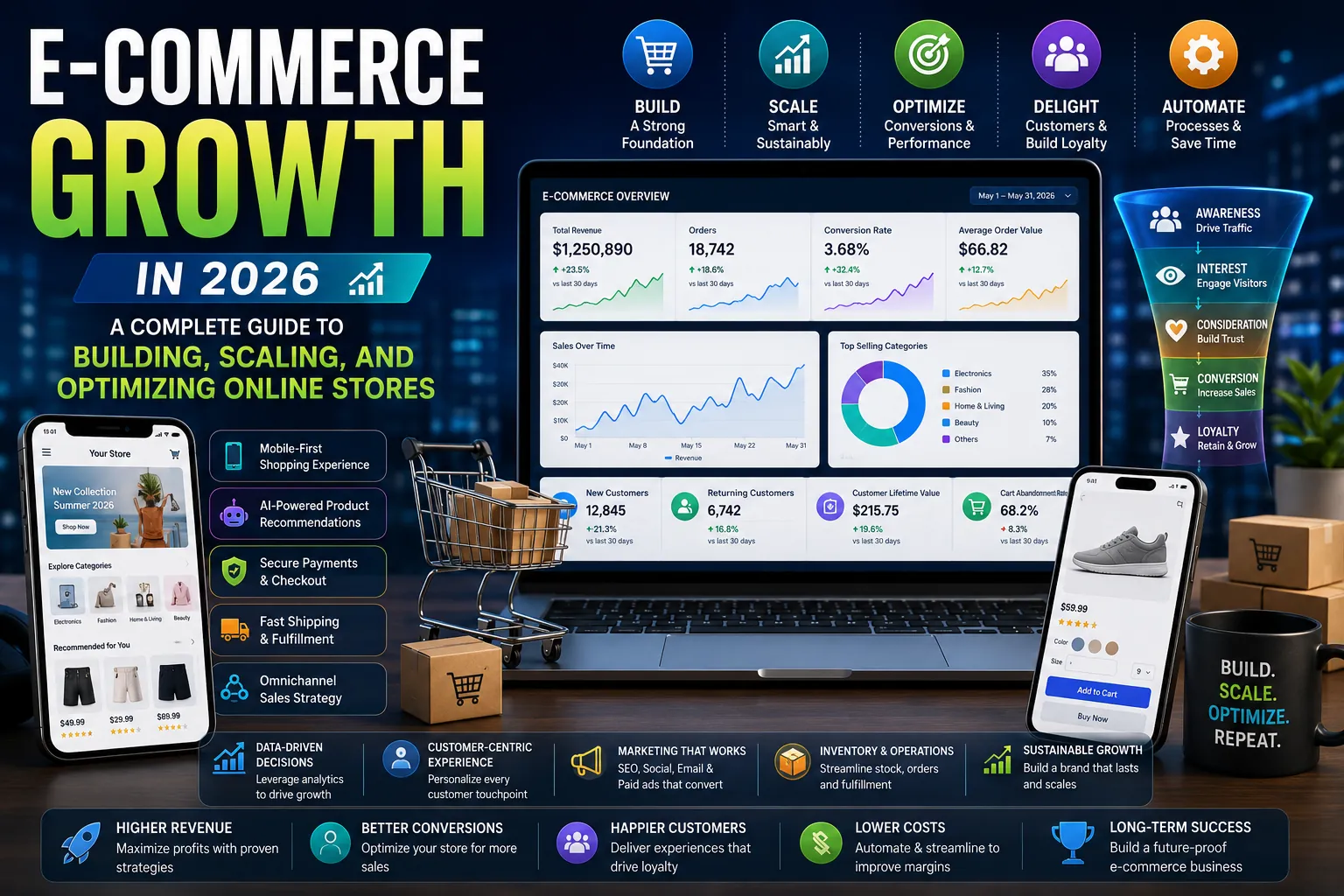
E-commerce in 2026 is no longer a niche channel. It is the default way many consumers buy almost everything. Global e-commerce sales surpassed $7 trillion in 2025 and continue growing at roughly 8 to 10% annually, according to Statista. The opportunity is enormous. The competition is brutal. The difference between e-commerce businesses that compound year after year and those that stall is rarely the product. It is the operational discipline behind the storefront.
This guide covers the complete e-commerce growth picture in 2026: how to choose the right platform, the marketing channels that work, the metrics that matter, the operational systems that scale, and the mistakes that kill margin and momentum. Built for founders, operators, and marketers running stores at any stage from $0 to $50 million in annual revenue.
The 2026 E-Commerce Landscape
Three shifts define e-commerce in 2026. First, paid acquisition costs have continued climbing as Apple privacy changes and Google Privacy Sandbox eroded targeting precision. Customer Acquisition Cost (CAC) on Meta and Google has doubled or tripled for most categories since 2021. Second, AI tools have democratized previously expensive capabilities: product photography, copywriting, customer service, personalization. Third, the line between marketplace and brand store has blurred. Most successful brands now sell through Shopify plus Amazon plus TikTok Shop plus their own DTC site simultaneously.
The winners adapt to each shift. The losers cling to playbooks from 2019 and watch margins compress.
Choosing the Right E-Commerce Platform
The platform decision shapes operational costs, feature availability, integration ecosystem, and ultimately growth ceiling. The four serious choices in 2026.
| Platform | Best For | Starting Cost | Strengths |
|---|---|---|---|
| Shopify | Most DTC brands, $0 to $50M+ revenue | $39 to $399/month | Best ecosystem, fastest setup, strong app marketplace |
| WooCommerce (WordPress) | Content-led brands, full customization | Free (plugin) + hosting | Full control, no platform fees, SEO-friendly |
| BigCommerce | Mid-market and enterprise B2B | $39 to $399+/month | Strong B2B features, lower transaction fees at scale |
| Adobe Commerce (Magento) | Enterprise with custom needs | $22,000+/year | Deep customization, multi-store, complex workflows |
For 90% of e-commerce businesses starting in 2026, Shopify is the right answer. The ecosystem advantage (apps, themes, payment processing, fulfillment integrations) is decisive. WooCommerce makes sense for content-led brands that already have a WordPress site driving organic traffic. BigCommerce and Adobe Commerce are appropriate at enterprise scale where the cost-per-transaction math flips.
The 5 Marketing Channels That Drive E-Commerce Growth in 2026
1. Email and SMS Marketing
Owned-audience channels are the single highest-ROI marketing investment for e-commerce in 2026. Email marketing typically generates 20 to 30% of total e-commerce revenue for well-optimized stores. SMS adds another 5 to 15%. Klaviyo is the dominant platform for both, with Omnisend and Postscript as strong alternatives.
The non-negotiable flows: welcome series, abandoned cart, browse abandonment, post-purchase, win-back, and replenishment for consumable products. Set up these six flows before spending another dollar on paid acquisition.
2. Paid Social (Meta and TikTok)
Meta (Facebook + Instagram) remains the largest paid acquisition channel for most consumer brands. TikTok has become essential for brands targeting under-35 audiences. The creative bar has risen dramatically. Static product photos no longer perform. Native-feeling video content, UGC-style ads, and creator-led content drive most of the conversions in 2026.
3. Google Search and Performance Max
Google Performance Max consolidated Search, Shopping, YouTube, Display, and Discovery into one AI-driven campaign type. For most e-commerce brands, Performance Max is now the default for paid Google traffic. Pair it with proper conversion tracking, strong creative assets, and a healthy negative keyword list.
4. SEO and Content Marketing
Organic search is the slow-compounding channel. It takes 6 to 18 months to generate meaningful traffic but delivers the lowest CAC of any channel once established. Product page SEO, category page structure, content marketing on supporting topics, and structured data all contribute. Most e-commerce brands underinvest here because the ROI shows up later than paid channels.
5. Influencer and Creator Partnerships
Creator-led marketing is increasingly the highest-performing paid channel for many brands. Small and mid-tier creators (10K to 500K followers) typically deliver better ROI than celebrity partnerships. Tools like Aspire, GRIN, and Modash help manage creator relationships at scale.
The Metrics That Actually Matter
| Metric | Healthy Target | Why It Matters |
|---|---|---|
| Customer Acquisition Cost (CAC) | Recovers within 6 to 12 months | Determines paid scaling viability |
| Lifetime Value (LTV) | 3x CAC minimum | True profitability measure |
| Conversion rate | 2 to 4% (varies by category) | Site optimization signal |
| Average Order Value (AOV) | Trending up over time | Influenced by bundles, upsells |
| Repeat purchase rate | 20%+ within 90 days for consumables | Retention strength |
| Email-attributed revenue % | 20 to 35% of total revenue | Owned-channel health |
| Contribution margin | 30%+ on most products | Sustainable unit economics |
Operational Systems That Scale
- Inventory management. Shopify inventory tracking for small stores. Cin7, Stocky, or NetSuite as you scale past $1M.
- Fulfillment. Self-fulfill below $50K/month. 3PL (ShipBob, ShipMonk, Rakuten Super Logistics) above that. FBA when Amazon is a meaningful channel.
- Customer service. Gorgias and Zendesk are the standards. AI agents (Ada, Intercom Fin) handle 30 to 60% of common questions in 2026.
- Analytics. Shopify Analytics for basics. Triple Whale, Northbeam, or Polar for attribution and ad performance.
- Reviews. Yotpo, Okendo, or Judge.me. Reviews drive conversion rate measurably. Set up review collection in the post-purchase flow.
How AI Is Reshaping E-Commerce in 2026
- Product photography. Tools like Pebblely and Flair generate professional product photos from a single phone shot at a fraction of studio cost.
- Product descriptions. Shopify Magic and Klaviyo AI generate optimized descriptions and email copy in seconds.
- Customer service. AI agents resolve 30 to 60% of tickets without human escalation.
- Personalization. Mutiny, Rebuy, and Algolia personalize storefronts based on visitor behavior in real time.
- Creative production. AI tools cut the time to produce ad variations from days to hours.
7 Common E-Commerce Mistakes
- Scaling paid ads before nailing email flows. Email flows recover lost revenue. Without them, paid traffic leaks out the bottom.
- Ignoring contribution margin. Top-line revenue growth without margin discipline kills businesses.
- Building on the wrong platform. Switching platforms at $5M is painful. Pick right early.
- Treating Amazon and DTC as competitors. They are complementary channels with different economics.
- Under-investing in product photography and copy. The two most important conversion drivers on every product page.
- Skipping the post-purchase experience. First-time buyers become repeat buyers through onboarding emails, packaging, and follow-up.
- Not measuring channel attribution. Without attribution, you cannot tell which channels drive growth versus which take credit.
Expert Tips
- Run a 90-day acquisition cohort analysis monthly. Track how each cohort’s LTV unfolds over time. This is the only honest measure of paid acquisition health.
- Test 5 new ad creatives per week minimum. Creative iteration is the highest-leverage paid social activity.
- Build a brand, not just a store. Stores compete on price. Brands compete on emotion, identity, and loyalty.
- Optimize for mobile first. 70%+ of e-commerce traffic is mobile in 2026. Test on actual devices weekly.
- Hold a weekly growth meeting. Marketing, ops, and finance reviewing metrics together once a week prevents siloed decision-making.
Frequently Asked Questions
How much money do I need to start an e-commerce business in 2026?
Realistic minimums: $2,000 to $10,000 for a focused product launch with one to three SKUs. This covers initial inventory, Shopify subscription, basic photography, and modest ad testing budget. Print-on-demand and dropshipping reduce inventory costs but compress margins significantly.
What is a healthy e-commerce conversion rate?
2 to 4% is the typical range for most e-commerce categories in 2026. Conversion rates above 5% are exceptional and usually indicate strong brand affinity or a niche audience. Below 1.5% signals either traffic quality problems or product-market fit issues.
Should I sell on Amazon or my own store?
Both, for most categories. Amazon delivers volume with limited margin. Your own store delivers margin and customer relationship. The right mix depends on your category, brand strength, and operational capability. Most successful brands generate 40 to 70% of revenue from Amazon and the rest from DTC plus other channels.
How long does it take to see e-commerce results?
Paid ads can drive results within days. Email flows compound within 30 to 60 days. SEO takes 6 to 18 months to generate meaningful traffic. Brand building takes 2 to 5 years. The compounding effect across channels is real but requires consistency over years, not weeks.
Build the E-Commerce Business That Compounds
E-commerce in 2026 rewards operational discipline above almost everything else. The product matters. The brand matters. The marketing matters. But the businesses that scale past $1 million, $10 million, $50 million are the ones that built the systems behind the storefront. Email flows. Inventory accuracy. Margin discipline. Channel attribution. Creator partnerships. Customer service excellence. None of it is glamorous. All of it compounds.
For more practical content on direct-to-consumer brands, marketing automation, conversion optimization, and growth experiments, explore the E-Commerce category on PostoryCafe.com.