
Most companies wrote their first hybrid work policy in 2021 or 2022, then watched it fail. The policies were too vague, too rigid, or both. Employees did not know what was expected. Managers enforced inconsistently. The result was confusion, resentment, and turnover.
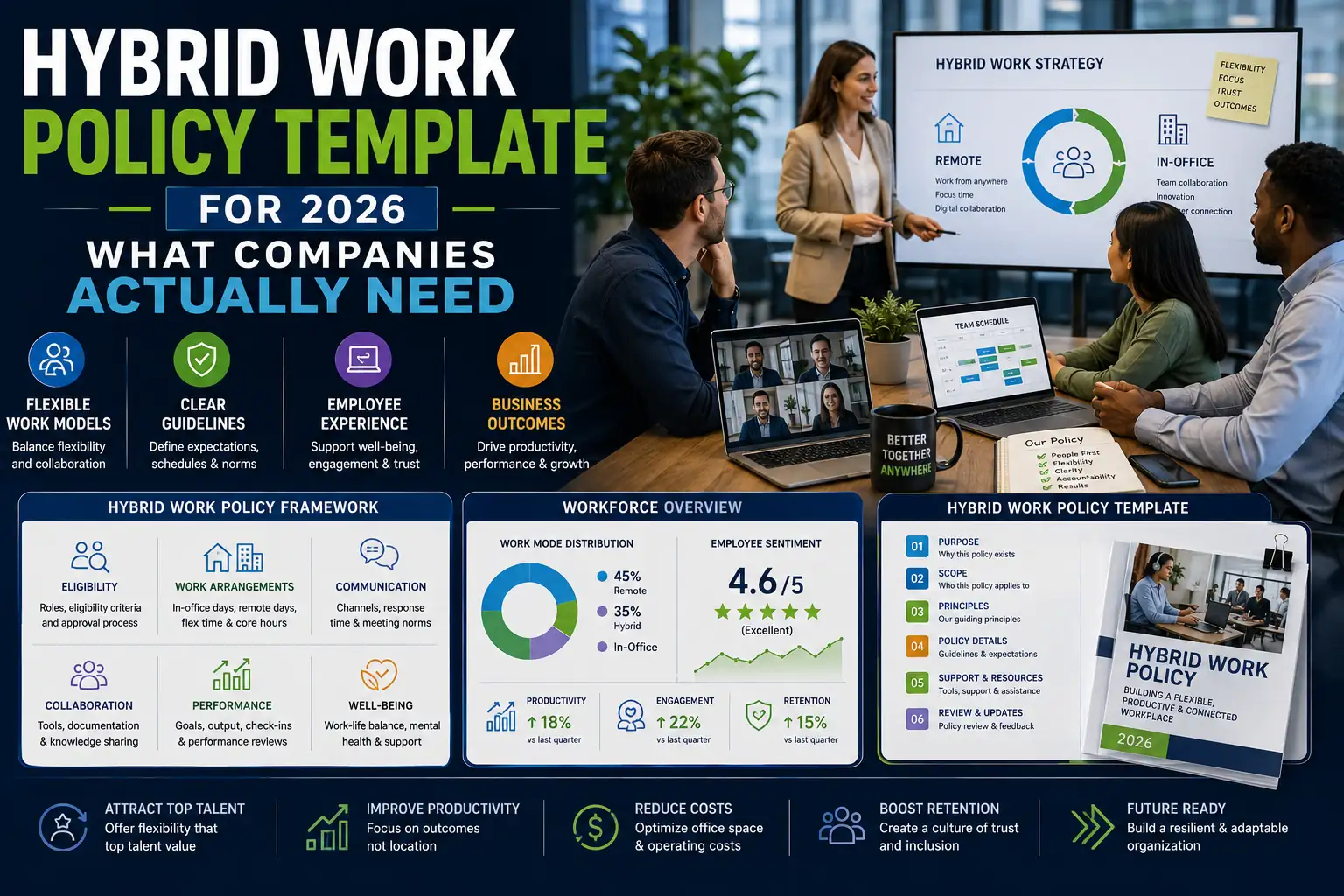
A good hybrid work policy in 2026 is specific, fair, and practical. It tells employees exactly what is expected, gives managers consistent enforcement criteria, and adapts to real life events. This guide provides a template covering the essential sections plus language that actually works in practice.
The 7 Sections Every Hybrid Work Policy Needs
- Eligibility. Which roles can work hybrid, which cannot, and the criteria.
- Schedule expectations. How many days in office, which days, who decides.
- Office attendance tracking. How attendance is measured and what consequences exist.
- Remote work standards. Equipment, home office requirements, security, availability.
- Communication norms. Response times, meeting expectations, async vs sync defaults.
- Equity and inclusion. How to ensure remote employees are not disadvantaged in promotions or recognition.
- Exceptions and accommodations. Process for life events, medical needs, ADA accommodations.
Sample Hybrid Work Policy Template
1. Purpose and Scope
This policy establishes hybrid work expectations for [Company] employees. It applies to all full-time and part-time employees in roles eligible for hybrid arrangements.
2. Eligibility
Roles are eligible for hybrid work when (a) the work can be performed effectively outside the office and (b) the role does not require physical presence for safety, equipment access, or customer-facing requirements. The list of eligible roles is maintained by HR and reviewed quarterly.
3. Schedule Expectations
Hybrid employees are expected to work from the office on Tuesday, Wednesday, and Thursday. Employees may work remotely Monday and Friday subject to manager approval. Specific schedules may vary by team based on collaboration requirements, but core in-office days apply company-wide.
4. Office Attendance
Office attendance is measured by badge swipes or WiFi connection logs. Managers review attendance monthly. Patterns of non-attendance without prior approval may result in a conversation with the manager and, if continued, formal performance discussion.
5. Remote Work Standards
On remote workdays, employees are expected to be available during core business hours (9 AM to 4 PM local time), maintain a productive work environment, secure company data through approved tools, attend scheduled meetings on camera unless excused, and respond to messages and emails in alignment with team SLAs.
6. Communication Norms
Async communication (email, Slack, written documents) is the default for non-urgent matters. Synchronous communication (calls, meetings) is reserved for urgent issues, complex discussions, or relationship-building. Response time expectations: same-day for emails and Slack messages during business hours; within 24 hours otherwise.
7. Equity for Remote Employees
Decisions made in informal conversations should be documented in shared channels. Performance reviews and promotions are based on outcomes, not visibility or attendance patterns beyond the policy minimums. Hybrid meeting protocols ensure remote participants have equal voice.
8. Exceptions and Accommodations
Employees with documented medical needs, family emergencies, or other significant life circumstances may request schedule modifications. Requests are submitted to HR and reviewed within 5 business days. Approved modifications are documented and reviewed annually.
Common Hybrid Policy Mistakes
- Vague schedule expectations. “Some days in the office” creates ambiguity. Specify days.
- No defined consequences for non-compliance. Without consequences, the policy becomes optional in practice.
- Inconsistent enforcement. When managers apply the policy differently, employees lose trust in fairness.
- No equity protections for remote employees. Hybrid teams risk treating in-office employees as more visible and promotable.
- Frequent policy changes. Each change destabilizes employee planning and signals management indecision.
Expert Tips
- Pilot the policy before full rollout. A 90-day pilot with one department surfaces problems before they scale.
- Train managers on enforcement. A policy without manager training produces inconsistency. Run a 60-minute training.
- Survey employees before and after rollout. Measure satisfaction and engagement to know what is working.
- Build flexibility into the framework. Pre-approved flexibility for medical, family, and travel events reduces ad-hoc accommodation requests.
- Document everything. Policy, exceptions, and enforcement decisions should all be in writing for legal protection.
Frequently Asked Questions
How many days in office is most common in 2026?
Three days per week (typically Tuesday through Thursday) is the most common pattern, used by roughly 40% of companies with hybrid policies. Two days per week is second most common at around 25%. Four or five days has been increasing among large enterprises.
Can a company require everyone to come back five days a week?
Yes, in most jurisdictions and in the absence of specific contract terms. However, doing so usually triggers turnover among employees who joined under different expectations. The legal right exists; the operational consequences are real.
How should we handle exceptions?
Define a clear exception process: who reviews requests, what documentation is required, what timeline for response. Common exception categories: medical, family caregiving, ADA accommodations, temporary travel, and team-specific operational needs.
Build a Policy That Works in Practice
A hybrid work policy is not a legal document to file and forget. It is a working agreement between the company and its employees that needs to be specific, consistently enforced, and revisited as circumstances change.
For the broader picture on remote work culture, hybrid models, and the future of distributed teams, read our pillar: The Future of Remote Work in 2026. More work guides live on PostoryCafe.com.