
Choosing between a Roth IRA and a Traditional IRA is one of the most consequential financial decisions a person makes. The choice shapes your tax bill across the next 30 to 40 years. Yet most people make it casually, often based on incomplete advice.
This guide walks through the differences between the two accounts, the math that determines which is better for your situation, and the specific strategies that maximize value across changing income and tax circumstances.
The Core Difference Explained Simply
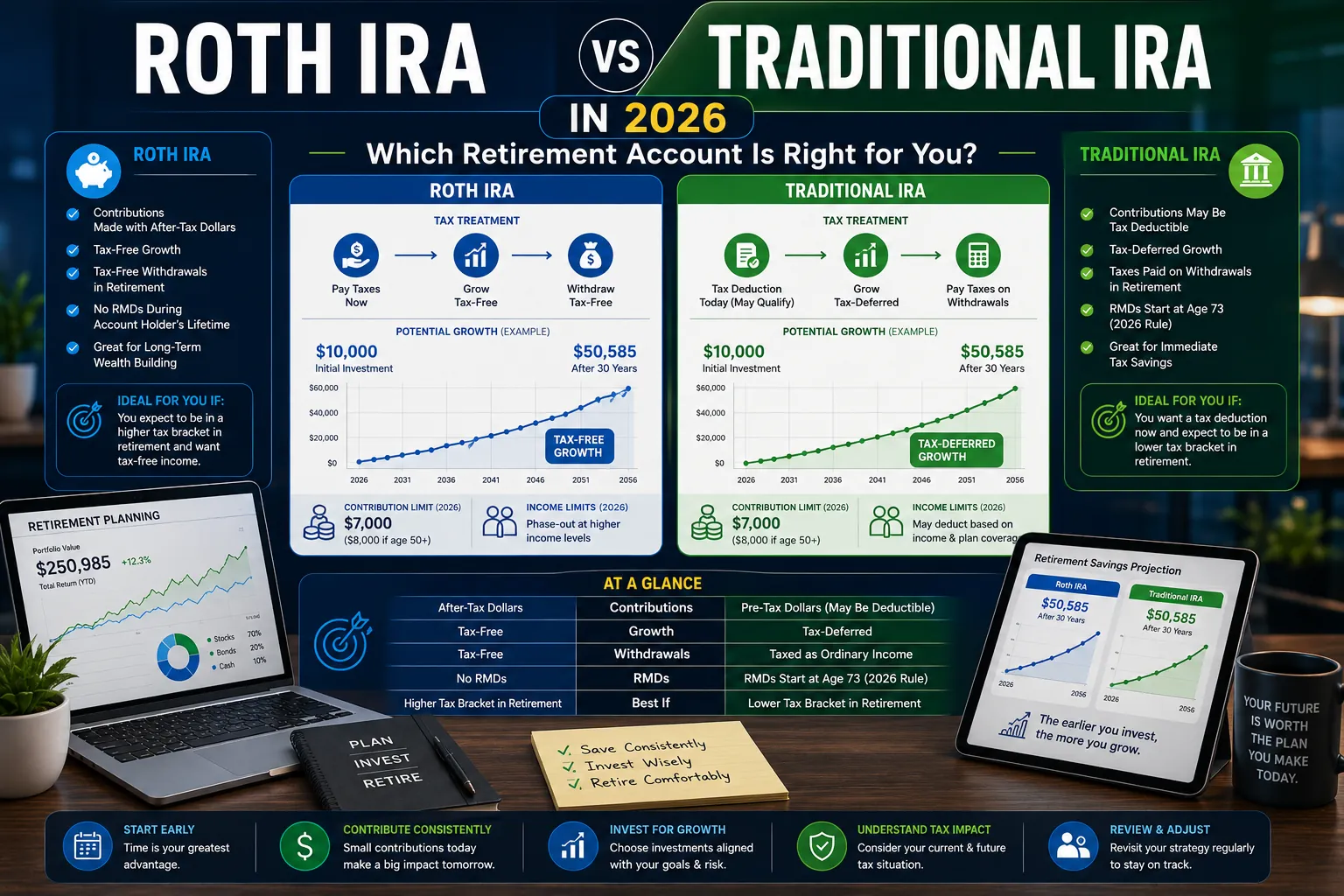
Both Roth and Traditional IRAs let your investments grow tax-deferred. The difference is when you pay the taxes.
With a Traditional IRA, you contribute pre-tax dollars (or get a tax deduction), the money grows tax-deferred, and you pay ordinary income tax on withdrawals in retirement. Tax break now, tax bill later.
With a Roth IRA, you contribute after-tax dollars, the money grows tax-free, and qualified withdrawals in retirement are completely tax-free. Tax bill now, tax-free later.
The key insight: which is better depends on whether your tax rate is higher now or higher in retirement.
2026 IRA Contribution Limits and Rules
| Rule | Roth IRA | Traditional IRA |
|---|---|---|
| 2026 contribution limit (under 50) | $7,500 | $7,500 |
| 2026 contribution limit (50+) | $8,500 (with catch-up) | $8,500 (with catch-up) |
| Income limit (single) | $165,000 MAGI | Deduction phaseout if covered by 401(k) |
| Income limit (married joint) | $246,000 MAGI | Deduction phaseout if covered by 401(k) |
| Required minimum distributions | None during your lifetime | Required starting age 73 |
| Withdrawal of contributions before 59.5 | Anytime, no penalty | 10% penalty on earnings |
| Estate planning value | Strong (no taxes for heirs) | Lower (heirs pay income tax) |
When the Roth IRA Wins
- You expect to be in a higher tax bracket in retirement than you are today.
- You are early in your career with low income and decades of growth ahead.
- You want flexibility (contributions can be withdrawn anytime without penalty).
- You want to avoid required minimum distributions in retirement.
- You expect significant assets and want better estate planning outcomes.
For most workers under 35 earning under $100,000, the Roth IRA is mathematically better in expected value.
When the Traditional IRA Wins
- You expect to be in a lower tax bracket in retirement than you are today.
- Your current marginal tax rate is high (32% or more federal).
- You want the immediate tax deduction to fund other savings or investments.
- You are nearing retirement and have a known higher income now.
The Backdoor Roth IRA Strategy
High earners exceed the income limits for direct Roth IRA contributions. The backdoor Roth allows them to contribute anyway.
- Make a non-deductible contribution to a Traditional IRA.
- Convert that contribution to a Roth IRA shortly after.
- Pay any taxes owed on conversion (minimal if done quickly with no other Traditional IRA balances).
The backdoor Roth is currently legal in 2026 but periodically threatened by proposed legislation. High earners should consult a CPA before executing, especially with existing Traditional IRA balances (the pro-rata rule complicates the math).
Roth Conversion Strategy
A Roth conversion takes money from a Traditional IRA, pays the taxes today, and moves it to a Roth IRA where future growth is tax-free. The strategy makes sense in years where your taxable income is unusually low (sabbatical, between jobs, early retirement).
Filling lower tax brackets with Roth conversions during low-income years can save tens of thousands in lifetime taxes for high-asset retirees.
Where to Open an IRA
- Vanguard, Fidelity, Charles Schwab. The big three. Free trades, low expense ratio index funds, no account minimums.
- Robo-advisors (Wealthfront, Betterment). Automated portfolio management for hands-off investing. 0.25% annual fee.
- Avoid commission-based advisors and high-fee mutual fund families. They underperform index funds dramatically over long periods.
6 Common IRA Mistakes
- Not contributing at all. The biggest mistake by far. Even partial contributions compound powerfully over decades.
- Choosing based on incomplete tax math. Run the actual numbers using your current and projected retirement tax brackets.
- Holding cash inside the IRA instead of investing. An IRA is a tax wrapper. The investments inside determine your returns.
- Forgetting the spousal IRA. A non-working spouse can contribute based on the working spouse’s income.
- Withdrawing early without understanding penalties. Roth contributions can be withdrawn anytime, but earnings have rules.
- Not contributing the full amount. $7,500 per year compounds to over $1 million across a 35-year career at historical stock returns.
Expert Tips
- Contribute early in the year. January contributions get a full year of tax-deferred growth versus April-of-next-year contributions.
- Automate monthly contributions. $625/month dollar-cost averages into the market and removes the willpower battle.
- Use target-date funds for simplicity. Vanguard and Fidelity target-date funds rebalance automatically based on retirement age.
- Run the conversion math during low-income years. Career breaks, sabbaticals, and early retirement are conversion opportunities.
Frequently Asked Questions
Can I contribute to both a Roth and Traditional IRA in the same year?
Yes, but the combined contribution cannot exceed the annual limit ($7,500 in 2026, $8,500 if 50+). You can split between both.
What is the income limit for a Roth IRA in 2026?
Single filers: full contribution up to $165,000 MAGI, phased out by $180,000. Married filing jointly: full up to $246,000 MAGI, phased out by $256,000. Above the limits, use the backdoor Roth strategy.
Should I prioritize 401(k) or IRA?
Capture employer 401(k) match first (free money). Then max your IRA. Then return to 401(k) up to its limit. Then taxable accounts.
Are Roth IRA earnings ever taxed?
No, when you take qualified distributions in retirement (after age 59.5 and 5 years of having had the account). Non-qualified withdrawals of earnings face income tax plus a 10% penalty.
Pick One and Start Today
The Roth versus Traditional decision matters less than the decision to contribute at all. Whichever you choose, automate contributions, invest in low-cost index funds, and stay consistent for decades. The math takes care of the rest.
For the foundational view on budgeting, debt, savings, and investing, read our pillar: Personal Finance in 2026: A Complete Guide. More finance guides live on PostoryCafe.com.