
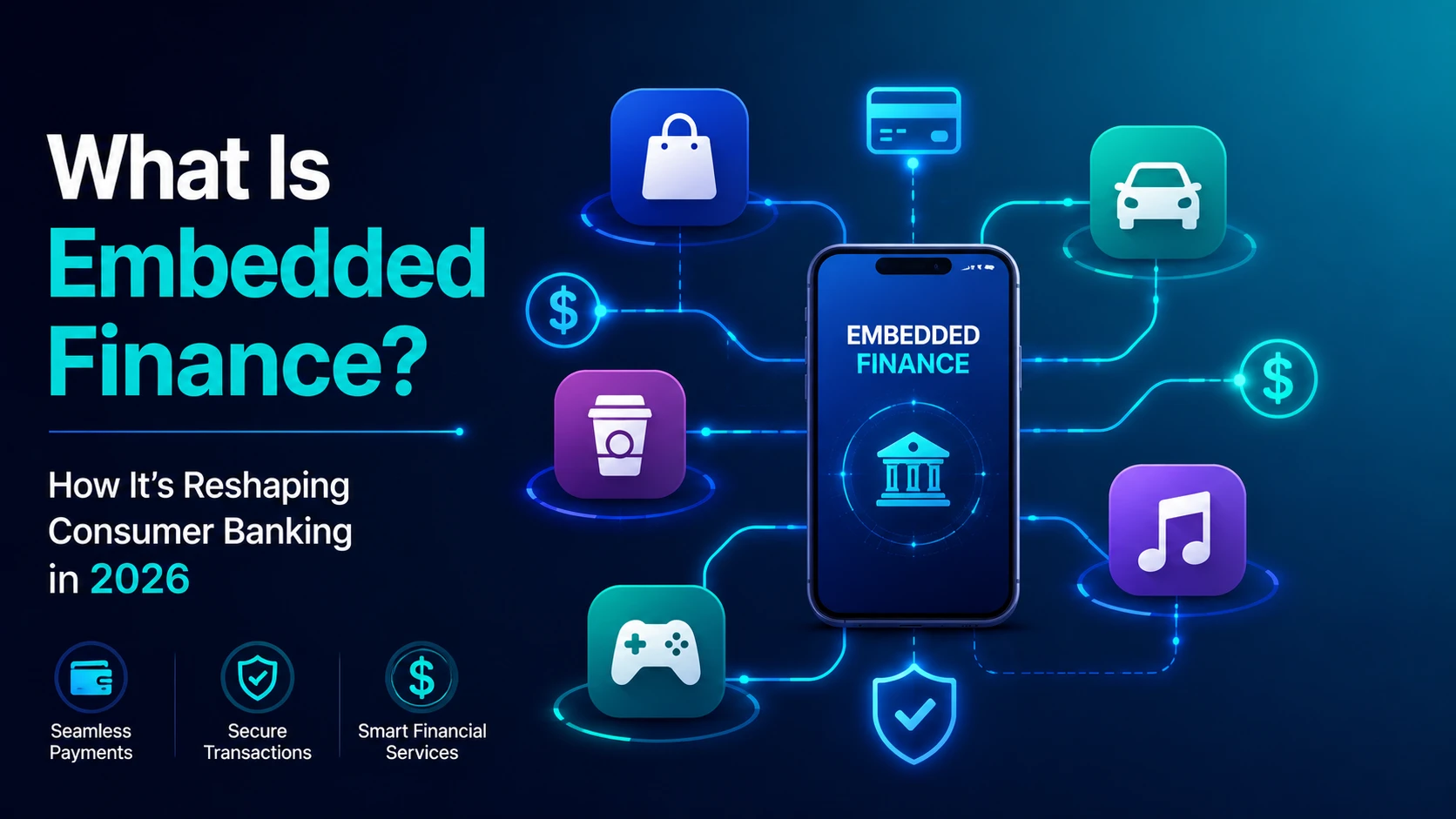
Ten years ago, you went to a bank to get a loan. Today, your Shopify dashboard offers you working capital in 30 seconds. Uber lets you earn, spend, and save from inside a rideshare app. Apple quietly built a consumer lending business into the iPhone.
None of these are banks. All of them are doing banking.
This shift has a name: embedded finance. It is one of the most important fintech trends of 2026, and it is quietly pulling millions of consumer banking moments out of traditional banks and into the apps people already use every day.
This guide explains what embedded finance really is, how the technology works beneath the surface, and why it matters for founders, product leaders, and everyday consumers. You will see real examples, a clear view of the tools involved, and the mistakes most teams make on their first attempt.
What Is Embedded Finance? A Plain-English Definition
Embedded finance is the integration of financial services (payments, loans, cards, insurance, investing) directly into non-financial products. Instead of sending users to a bank, an app delivers the banking experience itself.
You are already using it. When you pay through a rideshare app without opening a wallet, that is embedded payments. When a marketplace offers a seller instant cash based on sales volume, that is embedded lending. When checkout shows you a buy-now-pay-later option on a dress, that is embedded credit.
The core idea is simple. Finance becomes a feature inside another product rather than a destination of its own.
How Embedded Finance Differs From Traditional Banking
Traditional banking requires you to leave your current task, go to a bank (physical or digital), start a new account, wait for approvals, and then come back. Embedded finance collapses all of that into a single click inside the app you were already using.
Here is how the two approaches compare.
| Factor | Traditional Banking | Embedded Finance |
| Where the service lives | A separate bank or banking app | Inside the app the user already uses |
| Onboarding time | Days to weeks | Seconds to minutes |
| User context | Generic (bank does not know the use case) | Contextual (the host app knows exactly what you need) |
| Data signals for underwriting | Credit score, income docs | Real-time behavioral and transaction data |
| Who owns the relationship | The bank | The host brand (Shopify, Uber, Apple) |
| Licensing burden | Full banking license required | Licensed partner handles the regulated parts |
The 2026 Market: How Big Is Embedded Finance?
Research firms agree on the direction even when they disagree on the decimals. Bain estimates the embedded finance opportunity (revenue for platforms and enablers combined) will pass $320 billion globally by the end of 2026. Juniper Research projects embedded payments alone will clear $2.5 trillion in transaction value this year.
The consumer side is leading the charge. EY surveys show that over 60% of consumers now prefer to access financial products from non-bank brands they already trust, up from roughly 40% just four years ago. Younger users are even more comfortable. For Gen Z, the distinction between a bank and a non-bank app barely exists.
The takeaway: the line between “tech company” and “financial company” is vanishing, and the shift is happening faster on the consumer side than on the enterprise side.
The 6 Core Building Blocks of Embedded Finance
Embedded finance is not a single product. It is a stack of interlocking pieces that every implementation pulls from. Understanding these blocks helps you see exactly where value gets created (and where risk hides).
1. Banking APIs
A banking API is a developer interface that lets a non-bank send and receive data with a regulated financial institution. Think of it as the plumbing. Every embedded finance feature (card issuance, ACH transfers, account balances) flows through APIs.
Plaid, Stripe, Finicity, and TrueLayer built the first wave. In 2026, the ecosystem includes dozens of specialized providers focused on niches like payroll data, rental income verification, or cross-border stablecoin settlement.
2. Banking as a Service (BaaS)
BaaS is where a licensed bank rents out its regulatory infrastructure to non-banks. The fintech builds the product and owns the customer relationship. The partner bank holds the deposits, issues the cards, and handles the compliance work.
Companies like Unit, Treasury Prime, and Synapse (before its collapse) pioneered this space. After the 2023 and 2024 BaaS turmoil in the US, the market consolidated around better-capitalized providers with stronger sponsor bank relationships and real compliance teams.
In 2026, BaaS providers fall into three tiers: full-stack platforms (Unit, Treasury Prime, Solaris in Europe), card-only specialists (Marqeta, Lithic), and vertical-specific platforms that serve specific industries like healthcare, real estate, or creator economies.
3. Embedded Payments
Embedded payments put checkout inside whatever experience the user is already in. Stripe, Adyen, and Checkout.com dominate, but every platform from Shopify to TikTok Shop now operates as a payment facilitator underneath.
The 2026 shift worth noting: real-time payment rails like FedNow (US) and UPI (India) are making instant, low-cost transfers the norm. This kills a lot of legacy revenue for card networks, and embedded finance platforms have been fastest to adopt the new rails.
4. Embedded Lending
Embedded lending is where a non-bank offers a loan at the point of need. Buy-now-pay-later at checkout (Klarna, Affirm, Afterpay), merchant cash advances inside commerce platforms (Shopify Capital, Square Loans), and invoice financing inside accounting software (QuickBooks Capital) all fall here.
Because the lender has real-time data on the borrower’s business or spending, approval rates and default rates both improve compared to traditional underwriting. Shopify, for example, reports that Capital default rates sit noticeably below comparable small business loan products because the platform sees every sale as it happens.
5. Embedded Insurance
Insurance is getting embedded too, often in ways users barely notice. Booking a flight on a travel site? The trip insurance offer is embedded insurance. Ordering a phone on a device marketplace? So is the screen protection plan.
Companies like Cover Genius and Qover have built APIs that let any app offer tailored policies at the right moment. The conversion difference between offering insurance in context (at checkout) versus cold outreach is massive.
6. Embedded Investing
Embedded investing is the newest category. Platforms like DriveWealth and Alpaca let non-brokerage apps offer stock and ETF trading through APIs. Cash App, Revolut, and MercadoLibre all plugged investing into their consumer apps using this infrastructure.
Fractional shares, crypto, and tokenized treasuries are all showing up inside apps that started life as payment wallets or social platforms.
How Embedded Finance Is Reshaping Consumer Banking (Real Examples)
The fastest way to understand embedded finance is to see it working in products you may already use. Three examples show the pattern clearly.
Shopify Capital: Credit Built Into Commerce
Shopify Capital is a lending product for merchants selling on Shopify. No application forms, no bank visits. Eligible sellers see an offer in their Shopify admin panel: “You are pre-approved for $15,000.” They accept with one click, and the money hits their linked account within days.
Repayment happens automatically. Shopify takes a percentage of daily sales until the advance is repaid. If sales slow down, repayment slows down. The merchant carries less risk and Shopify gets paid predictably.
No traditional bank could match this model because no traditional bank sees the merchant’s daily sales the way Shopify does. Context is the edge.
Uber Wallet: A Bank Inside a Rideshare App
Uber’s driver app includes Uber Wallet, which acts as a checking account, debit card, and earnings management tool. Drivers get paid instantly after each trip, can spend directly from the wallet using a debit card, and even earn cashback at gas stations.
For many drivers (particularly in markets with limited banking access), this is their primary financial account. Uber built none of the underlying banking infrastructure. Green Dot Bank provides the regulated parts. Uber just built the experience that matters to its users.
Apple Pay Later and Apple Cash
Apple is the quiet giant of embedded consumer finance. Apple Pay handles tap-to-pay. Apple Cash enables peer-to-peer transfers. Apple Pay Later (launched in 2023 and expanded significantly by 2026) offers short-term installment loans with zero interest.
These features live inside Wallet, which sits behind the lock screen on over a billion iPhones. Apple built its own lending subsidiary to own the underwriting, but partners with Goldman Sachs and other institutions for different pieces of the stack.
The result: users who have never stepped into a bank branch now borrow, save, and spend through financial products designed by a consumer tech company.
4 Fintech Trends Driving Embedded Finance in 2026
If you want to understand where embedded finance is going next, watch these four trends closely.
1. AI-Driven Personalization at the Point of Need
The first wave of embedded finance just offered financial products inside apps. The 2026 wave uses AI to decide exactly what to offer, to whom, and when.
A food delivery app might push a savings nudge the day after a large paycheck. A freelancer platform might offer a tax-withholding feature the moment an invoice is paid. Every offer feels less like a sales pitch and more like a helpful feature.
2. Vertical BaaS: Industry-Specific Embedded Finance
Generic BaaS platforms are losing ground to vertical-specific providers. Platforms focused on healthcare (Weave), real estate (Stake), creators (Stir), and freelancers (Found) all offer embedded finance infrastructure tuned for the regulatory and workflow quirks of their industries.
The advantage is depth. A healthcare-focused BaaS provider already understands HIPAA. A real estate one already handles escrow. Industry-specific platforms ship faster because they are not solving everything at once.
3. Stricter Regulation After the BaaS Shakeout
The 2023 and 2024 collapses of several BaaS middleware providers (Synapse being the most visible) forced US regulators to tighten expectations. In 2026, sponsor banks perform deeper due diligence, maintain stronger liquidity reserves, and supervise fintech partners more actively.
For founders, this means slower partnerships but more durable ones. The era of launching a neobank in 90 days is over. Expect 6 to 9 months of compliance and legal work even for relatively simple products.
4. Real-Time Payments and Stablecoin Settlement
FedNow in the US crossed a tipping point in late 2025. By 2026, real-time payment volume is growing over 80% year-over-year. UPI continues to dominate India. Brazil’s Pix is now the default payment method for the country.
Stablecoin settlement rails (particularly for cross-border B2B) are also moving out of pilot stage and into production. Embedded finance platforms that support these rails can offer faster, cheaper movement than traditional bank wire transfers.
Business and Consumer Benefits: A Side-by-Side Look
Embedded finance only works when both sides of the market win. Here is how value flows.
| For the Host Business | For the End Consumer |
| New revenue streams (interchange, interest, subscription fees) | Financial services inside the app already used daily |
| Higher user retention and lifetime value | Faster onboarding (seconds instead of days) |
| Richer data for personalization and product decisions | Contextual offers that feel useful, not spammy |
| Deeper brand trust as a full-service platform | Often better rates because of data-driven underwriting |
| Reduced user friction at monetization moments | No need to juggle multiple apps for related tasks |
5 Common Embedded Finance Mistakes (And How to Avoid Them)
Most failed embedded finance launches share the same handful of mistakes. Learning from them upfront saves months of rework.
- Underestimating compliance load. Founders expect BaaS partners to “handle compliance.” Partners handle the regulated parts, but the fintech is still responsible for KYC, dispute resolution, transaction monitoring, and consumer disclosures. Budget a dedicated compliance hire before launch, not after.
- Choosing the wrong BaaS partner. Picking a platform on price alone leads to outages, frozen accounts, and angry customers. Check the partner’s sponsor bank relationships, capital position, and history of customer escalations. A slightly more expensive partner with a track record is worth it.
- Treating finance like a side feature. Embedded finance requires ongoing operational attention (card disputes, fraud alerts, regulatory reporting). Teams that drop it on the same engineer who builds product features end up with service-level issues that damage brand trust.
- Ignoring unit economics. Card interchange alone rarely pays for a full banking product. Model your revenue assumptions (interchange, interest, float, fees) against real customer behavior before you commit. Most successful embedded finance products use multiple revenue streams, not one.
- Skipping the consumer protection story. Your users do not know the difference between your brand and your sponsor bank. When something goes wrong, they call you. Build customer support playbooks and transparent disclosures so that confusion never turns into regulatory complaints.
Expert Tips for Launching Embedded Finance the Right Way
These recommendations come from patterns seen across teams that actually shipped embedded finance products and survived their first year.
- Start with one product, not a suite. Teams that launch a wallet, cards, loans, and investing all at once rarely nail any one of them. Pick the single highest-value embedded financial product for your users and ship that first.
- Invest early in your fraud and risk tooling. A clean launch can attract fraudsters within days. Real-time transaction monitoring, device fingerprinting, and velocity limits should be live from day one, not a future sprint.
- Keep the money path separate from the product path. Your finance operations team needs reconciliations, dispute queues, and regulatory reporting. Do not force them into your product management tool. Treat finance ops like a first-class function.
- Plan for a sponsor bank change. Even good partnerships eventually end. Architect your integration so that switching banks is painful but possible, not impossible. Keep customer data, ledger, and identity records in your own systems.
- Prioritize user trust communications. Clearly explain who holds the money, who is FDIC insured (and up to what amount), and what happens if your partners change. Most users have never thought about these questions. Giving honest answers up front builds surprising loyalty.
Frequently Asked Questions
What is embedded finance in simple terms?
Embedded finance is when financial services show up inside apps that are not banks. When you pay a rideshare driver without opening a wallet app, accept a loan offer inside your e-commerce dashboard, or tap a debit card issued by a tech company, you are using embedded finance. The bank is still there legally, but the customer experience belongs to a non-bank brand.
How does embedded finance actually work behind the scenes?
A non-bank company partners with a licensed bank (directly or through a Banking as a Service platform). The bank handles the regulated activities (holding deposits, issuing cards, originating loans) while the non-bank builds the user experience and owns the customer relationship. APIs connect the two sides so data flows in both directions in real time.
For a user tapping “pay” in an app, the payment request actually travels through multiple layers (the app, a BaaS middleware provider, a card network, a partner bank) in under two seconds, but the user sees one smooth experience.
Is embedded finance safe and properly regulated?
Yes, when structured correctly. The regulated financial products (deposit accounts, loans, payment processing) still sit with licensed institutions that follow banking laws. In the US, consumer deposits are FDIC insured up to the standard limit when held at the partner bank.
The risks appear in the middleware layer and in how non-bank brands describe the service to users. The 2024 Synapse collapse showed that a middleware failure can disrupt access to funds temporarily. Regulators responded with tighter oversight, stronger capital rules, and better customer disclosure requirements. In 2026, a well-structured embedded finance product from a reputable brand is no more risky than using a traditional bank.
Which companies are the biggest embedded finance players in 2026?
On the infrastructure side, Stripe, Adyen, and Marqeta dominate payments and card issuance. Unit and Treasury Prime lead US BaaS for deposits and accounts. Solaris and ClearBank are strong in Europe. Affirm, Klarna, and PayPal lead consumer-facing embedded lending.
On the brand side, Shopify, Apple, Uber, Amazon, and MercadoLibre are the largest consumer-facing embedded finance providers globally, though the list grows every quarter as more platforms plug in financial products.
Can small businesses offer embedded finance too?
Yes, though the barrier is higher than most founders expect. Modern BaaS platforms let a company with as few as 10,000 active users offer a functional card or account product. But real success usually requires 100,000 plus users, dedicated compliance staff, and a clear thesis on how financial services improve the core product. For most small businesses, offering embedded payments (through Stripe Connect or similar) is a better starting point than a full banking product.
The Future of Consumer Banking Is Already Here
Embedded finance is not a prediction about the future of banking. It is a description of what is already happening. The apps people use for groceries, rides, work, and shopping are slowly absorbing the functions of a checking account, a credit card, and an investment platform.
For traditional banks, the question is no longer whether this shift will happen. It is whether they will power it (as sponsor banks and infrastructure providers) or watch their customers drift into experiences they cannot compete with.
For everyone else (founders, product leaders, marketers, investors, consumers), embedded finance is worth understanding because it quietly reshapes how money moves. Where finance lives, who controls the customer relationship, and what data drives every credit decision are all being rewritten right now.
If this guide helped you make sense of where consumer banking is heading, explore more of our fintech and business coverage on PostoryCafe.com. We publish new guides and explainers every week.