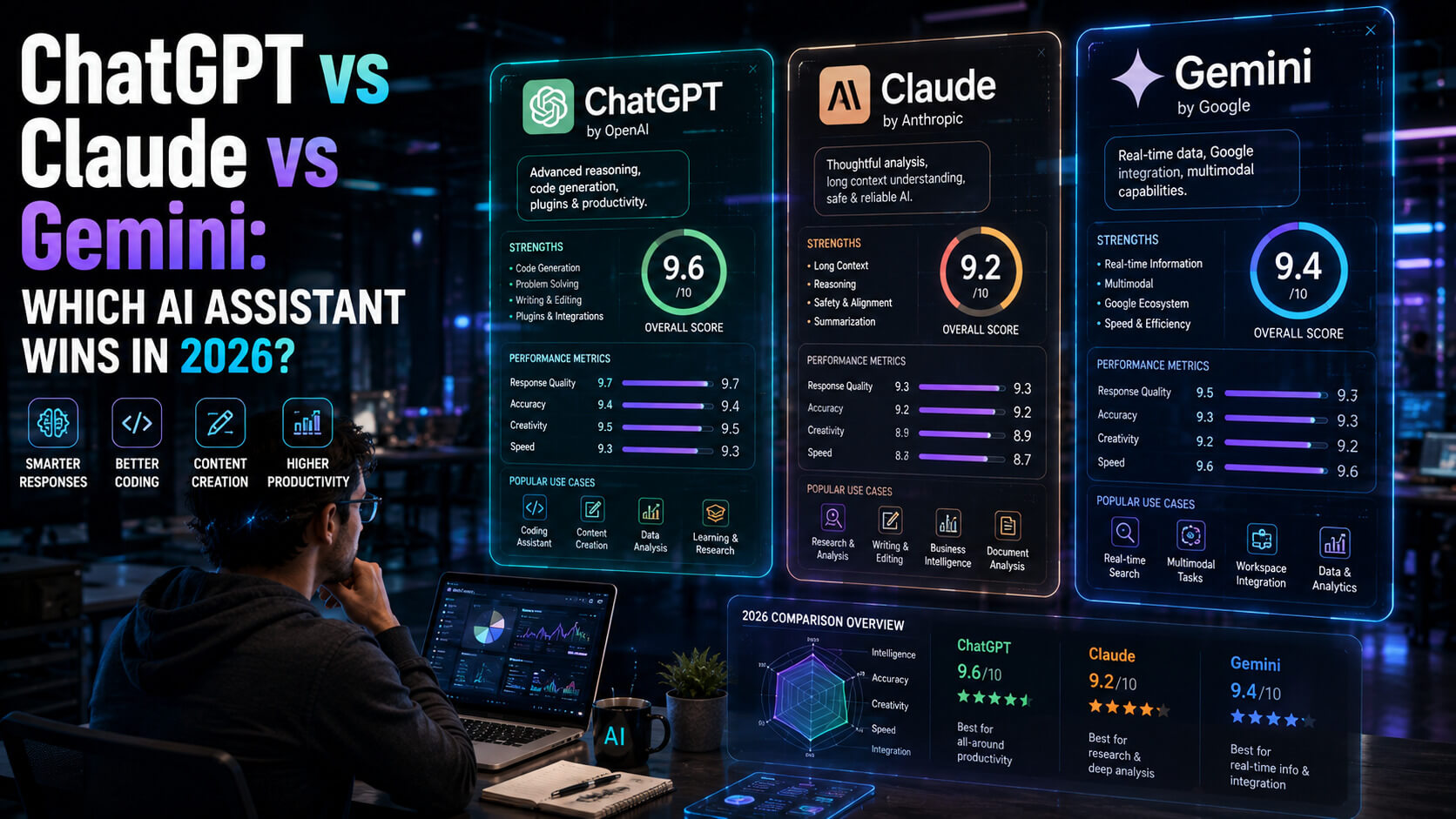

OpenAI’s ChatGPT passed 400 million weekly active users in February 2026, according to OpenAI’s own disclosure. Anthropic’s Claude processed more than 50 billion tokens per day across enterprise deployments by mid-2026, while Jasper AI reported over 100,000 paying business subscribers. The AI writing market, valued at 1.8 billion US dollars in 2025 by Grand View Research, is now the most crowded software category in content marketing, with more than 80 distinct tools competing for attention.
The gap between the best and worst AI writing tools in 2026 is not marginal. Factual accuracy, tone consistency, long-form coherence, and plagiarism risk vary significantly across platforms. This guide evaluates the top seven tools by output quality across specific tasks, pricing transparency, and which type of writer or business each one actually serves best.
How AI Writing Tools Differ in 2026
Most AI writing tools in 2026 run on one of three underlying models: OpenAI’s GPT-4o or o3, Anthropic’s Claude 3.5 or 3.7 Sonnet, or Google’s Gemini 1.5 Pro. The front-end interface, tone presets, template libraries, and SEO integrations are product layers built on top. Knowing the underlying model matters because GPT-4o excels at creative variation and short-form copy, Claude 3.7 Sonnet demonstrates stronger performance on long-form analytical content and factual precision, and Gemini 1.5 Pro processes longer context windows (up to one million tokens) useful for document summarisation.
Pricing structures diverged significantly in 2026. Jasper AI moved to a seat-based model at $49 per seat per month for teams. Copy.ai released a free tier capped at 2,000 words per month. ChatGPT Plus remains at $20 per month with GPT-4o and o3 access. Claude Pro at $20 per month offers higher output ceilings and access to Claude’s extended context window. Writesonic undercut competitors with a $19 per month plan including GPT-4o turbo access and built-in plagiarism checking.
Top AI Writing Tools Compared
ChatGPT (OpenAI)
ChatGPT in 2026 is the most versatile AI writing tool available, capable of shifting between creative fiction, technical documentation, marketing copy, and conversational scripts within a single conversation. OpenAI’s custom GPT feature, available to Plus and Team subscribers, allows marketers to create brand-voice-tuned writing assistants without coding. The primary limitation is factual reliability on recent events unless web search is enabled, and output can feel generic when prompts are not sufficiently specific.
Claude (Anthropic)
Claude 3.7 Sonnet is the strongest performer for long-form content requiring consistent tone and factual accuracy across 3,000-plus words. A 2026 blind evaluation by The Prompt Report rated Claude highest among six models for content that matched a specified editorial voice across a 2,500-word article. Its 200,000-token context window allows users to feed in an entire brand style guide and have it applied consistently throughout long outputs. Claude is weaker than ChatGPT at creative brainstorming and short punchy copy variants.
Jasper AI
Jasper targets marketing teams and agencies through its Brand Voice feature, which learns from uploaded brand documents and applies consistent tone across all outputs. It integrates directly with Surfer SEO for real-time keyword optimisation within the editor, a workflow advantage that standalone models lack. At $49 per seat per month, it is the most expensive option here and is only cost-justified for teams producing high volumes of SEO-targeted content where the Surfer integration delivers measurable ranking benefit.
Copy.ai
Copy.ai’s 2026 positioning focuses on sales and go-to-market teams through its GTM AI Platform, which generates outreach sequences, follow-up emails, and LinkedIn content at scale. Its workflow automation features allow sales managers to input product information once and generate personalised outreach variants for different buyer personas automatically. The free tier is genuinely useful for individuals; the $49 per month Pro plan targets teams running outbound sales campaigns.
Writesonic
Writesonic’s Chatsonic feature combines GPT-4o with real-time web access, making it one of the few AI writing tools that can accurately reference news published within the last 48 hours without hallucinating. Its Article Writer 6.0 generates 2,500-word SEO articles with automatic internal link suggestions and a readability score. At $19 per month for the Chatsonic plan, it offers the best combination of real-time web capability and document-length output at its price point.
Comparison: AI Writing Tools at a Glance
| Tool | Best For | Price/Month | Underlying Model | Long-Form Quality |
| ChatGPT Plus | Versatile, creative | $20 | GPT-4o / o3 | Good |
| Claude Pro | Long-form, factual accuracy | $20 | Claude 3.7 Sonnet | Excellent |
| Jasper AI | SEO teams | $49/seat | GPT-4o + Surfer | Very Good |
| Copy.ai Pro | Sales outreach | $49 | GPT-4o | Good |
| Writesonic | Real-time news content | $19 | GPT-4o + web | Very Good |
| Gemini Advanced | Long context tasks | $19.99 | Gemini 1.5 Pro | Good |
| Rytr | Budget quick drafts | $9 | GPT-3.5 | Average |
Which AI Writing Tool Should You Choose?
Content marketers and SEO professionals who publish more than 20 articles per month get the clearest return from Jasper AI, specifically because of the Surfer SEO integration that reduces the editing cycle on keyword-optimised content. The per-seat cost is justified when the alternative is a separate Surfer subscription at $89 per month alongside a standalone AI tool.
Freelance writers and solo bloggers get the most utility from ChatGPT Plus or Claude Pro at $20 per month each. Claude’s superior long-form coherence makes it the better default for articles above 2,000 words; ChatGPT’s creative range and image generation (via DALL-E 3) makes it the better all-around daily writing companion. Many professional writers subscribe to both and switch between them by task type.
Sales teams running high-volume outbound campaigns benefit most from Copy.ai’s GTM workflows. The tool’s ability to generate 500 personalised email variants from a single product brief eliminates manual writing at scale and integrates with Salesforce and HubSpot for direct sequence deployment.
Frequently Asked Questions: Best AI Writing Tools 2026
What is the best AI writing tool in 2026?
Claude Pro and ChatGPT Plus are the best AI writing tools in 2026 for most individual writers and content teams, each at $20 per month. Claude excels at long-form factual content and maintaining editorial voice over 3,000-plus words. ChatGPT offers broader creative range and built-in image generation. Jasper AI is the top choice for SEO content teams needing Surfer integration at scale.
Can AI writing tools replace human writers in 2026?
AI writing tools in 2026 replace first-draft production for routine content types including product descriptions, email templates, and social media posts. They do not replace human writers for investigative reporting, expert opinion, nuanced brand voice execution, or content requiring verified firsthand experience. Most professional content operations use AI for speed and humans for editorial quality control and original insight.
How much do AI writing tools cost in 2026?
AI writing tool pricing in 2026 ranges from free (Copy.ai, limited tier) to $19 to $20 per month for individual subscriptions including ChatGPT Plus, Claude Pro, and Writesonic. Team and enterprise plans from Jasper AI start at $49 per seat per month. Annual billing typically reduces the monthly cost by 20 to 30 percent across most platforms.
Do AI writing tools produce plagiarism-free content?
AI writing tools generate original text statistically unlikely to match existing published content word for word, but they can produce phrases and sentence constructions very similar to their training data. Writesonic and Jasper include built-in plagiarism checkers. For high-stakes content including academic submissions or legally sensitive materials, running AI output through Copyscape or Turnitin before publication remains a necessary step.
What are the risks of using AI writing tools in 2026?
The primary risks of AI writing tools in 2026 are factual hallucination (especially for recent events), loss of distinct brand voice through over-reliance on default outputs, and potential Google penalties for thin AI-generated content lacking original expertise signals. Tools with web search access like Writesonic and ChatGPT (with browsing enabled) reduce hallucination risk. E-E-A-T signals from human expert authorship remain critical for Google rankings in 2026.
Which AI writing tool is best for SEO content in 2026?
Jasper AI is the strongest AI writing tool for SEO content in 2026 due to its native Surfer SEO integration, which provides real-time keyword density guidance and content score feedback within the editor. For teams without a Surfer subscription, Writesonic’s Article Writer 6.0 generates SEO-structured articles with automatic heading optimisation and internal link suggestions at a lower price point.
Choose Your Tool by the Output You Actually Need
The single most useful frame for choosing an AI writing tool in 2026 is not feature lists but output type. If you produce mostly short-form marketing copy in variations, Copy.ai or ChatGPT serves you well. If you write long-form analytical content requiring factual consistency, Claude is the correct default. If your team’s primary goal is ranking on Google at scale, the Jasper-Surfer combination has a measurable workflow advantage.
Avoid subscribing to three tools simultaneously on the assumption that coverage is better than depth. Most professional writers who report the highest productivity gains from AI in 2026 use one primary tool deeply, with occasional use of a second for specific task gaps, rather than rotating between five platforms with shallow familiarity in each.