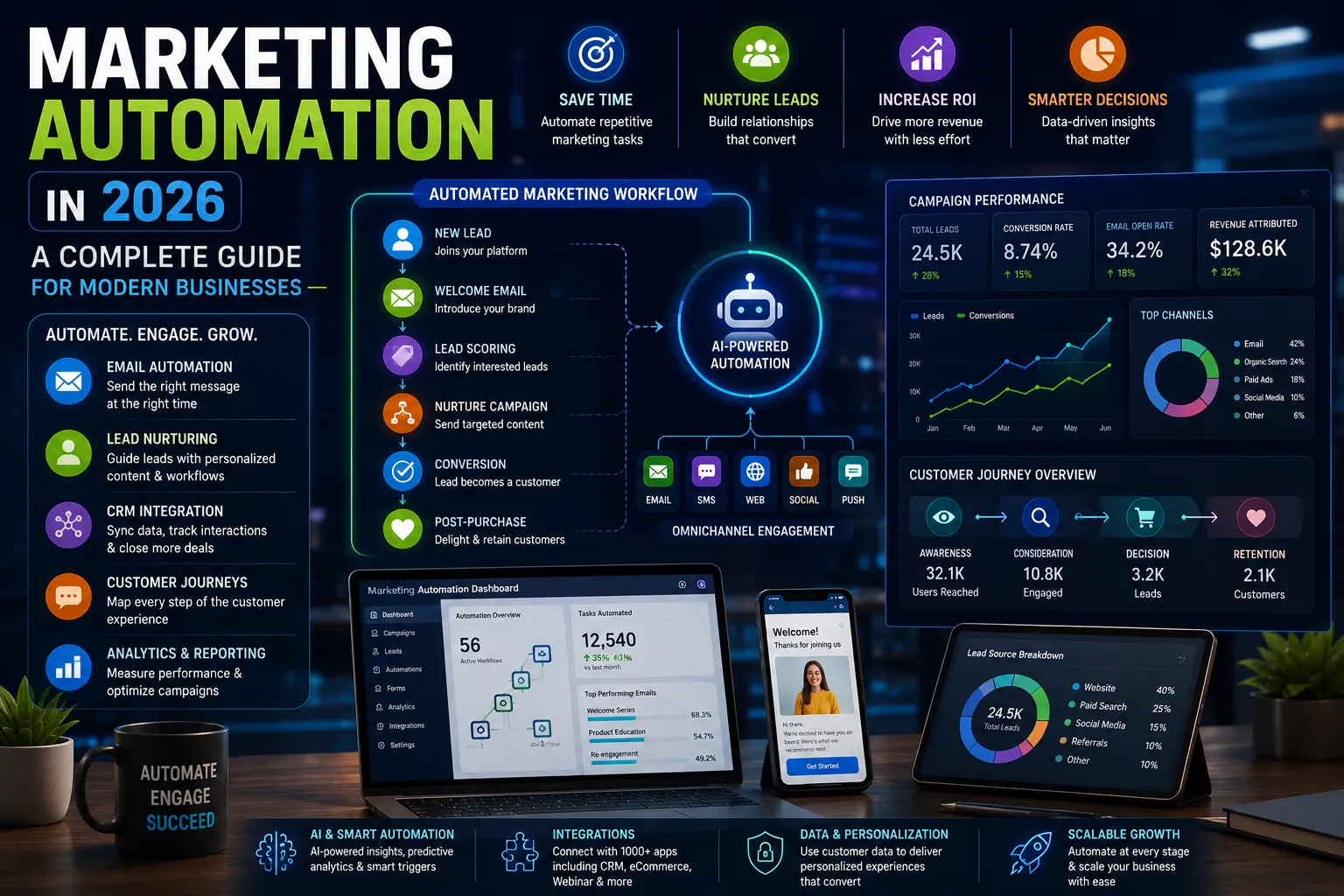
Marketing automation in 2026 is no longer a luxury reserved for enterprise teams. It is essential infrastructure for any business that wants to grow without scaling headcount linearly. The right automation lets a 10-person company run campaigns that 50-person teams ran a decade ago. The wrong automation creates expensive complexity nobody can maintain.
The landscape has changed significantly. AI tools have absorbed many tasks that previously required dedicated automation platforms. Privacy laws have reshaped how data flows. Customer journey orchestration has become more sophisticated. Choosing the right approach in 2026 requires understanding both what tools can now do and which jobs still need human judgment.
This guide covers the complete marketing automation picture in 2026: what it actually is, the workflows that drive real results, platform choices for different business sizes, and the mistakes that turn automation projects into expensive failures.
What Is Marketing Automation?
Marketing automation is software that runs repetitive marketing tasks (sending emails, segmenting audiences, scoring leads, triggering follow-ups, personalizing content) without requiring human action for each individual instance. Define a workflow once, then let software run it for thousands automatically.
In 2026, marketing automation has expanded beyond email. The category now includes AI-driven content generation, dynamic website personalization, behavioral triggers across web and mobile, automated ad optimization, and predictive customer journey orchestration.
The 2026 Marketing Automation Landscape
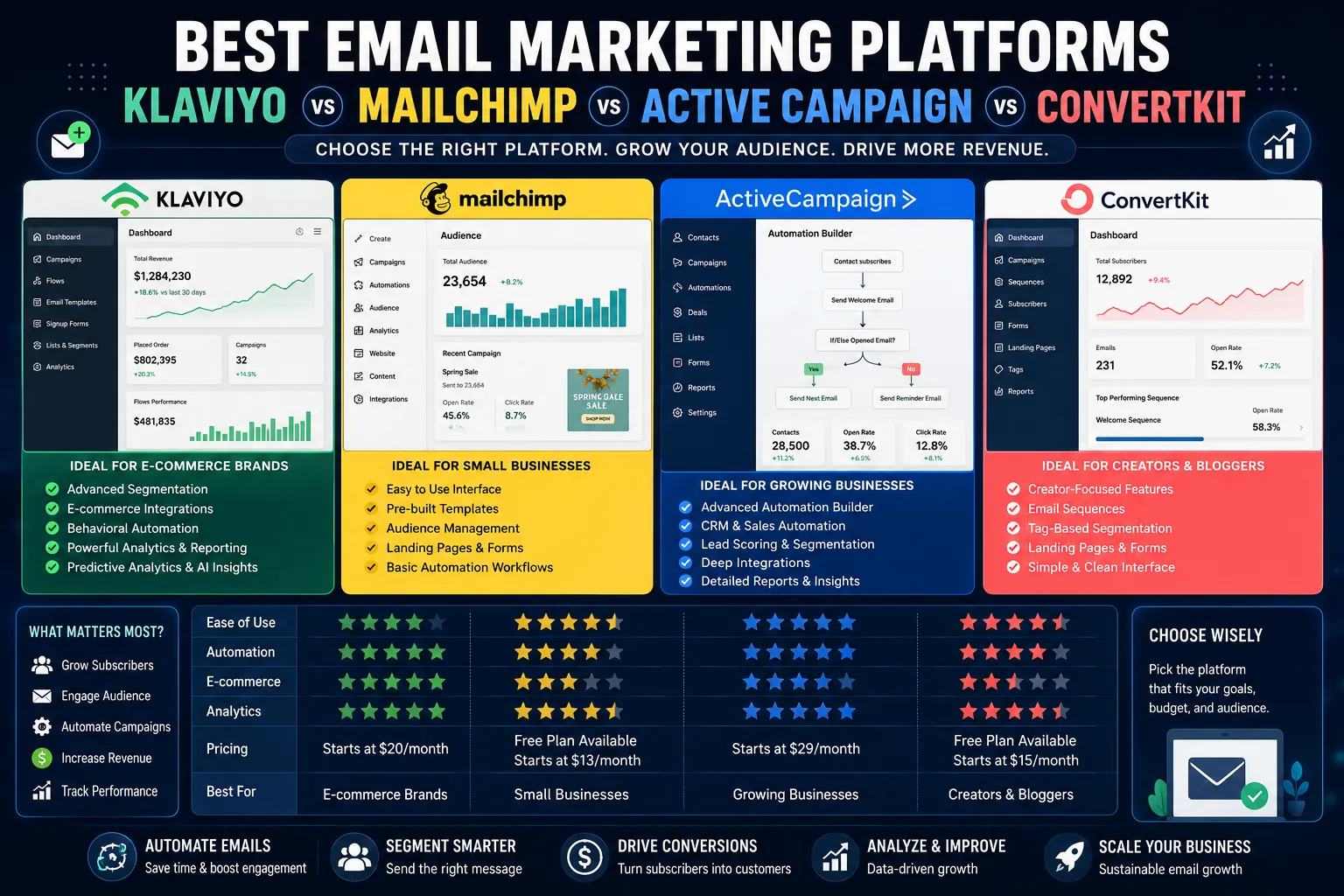
Three forces shape marketing automation in 2026. AI integration has become the default across HubSpot, Marketo, ActiveCampaign, Klaviyo, and Customer.io. Privacy regulations have weakened cookie-based tracking, making first-party data the foundation of legitimate strategy. The line between marketing, sales, and customer success automation has blurred into unified Customer Engagement Platforms.
The 6 Core Workflows Every Business Should Automate
1. Welcome and Onboarding Sequences
A 3 to 5-email welcome series introduces your product, sets expectations, and drives early activation. For SaaS products, this often increases trial-to-paid conversion by 20 to 40%, making it the highest-leverage automation available.
2. Lead Nurturing for Sales Pipelines
Most leads are not ready to buy on first contact. Nurturing sequences deliver educational content, case studies, and timely offers over weeks until they are ready. Modern platforms score leads based on behavior and trigger sales handoff at the right moment.
3. Abandoned Cart and Browse Recovery
For e-commerce, abandoned cart recovery delivers some of the highest ROI in marketing automation. A simple 2 to 3-email sequence typically recovers 8 to 15% of lost cart revenue with minimal ongoing maintenance.
4. Customer Re-Engagement and Win-Back
Customers who stop engaging are early churn signals. Automated re-engagement campaigns save customers who would otherwise drift away silently. For subscription businesses, this often produces 5 to 10% retention improvement.
5. Behavioral Trigger Messaging
Trigger-based messages are sent in response to specific user actions: completing a milestone, hitting a usage threshold, going dormant. Contextual messages perform dramatically better than scheduled campaigns because they reach the user when the topic is genuinely relevant.
6. Customer Lifecycle Stage Transitions
Different content suits different stages. New customers need education. Active customers need expansion offers. At-risk customers need retention attention. Lifecycle automation routes the right content to the right segment automatically.
Marketing Automation Platforms by Business Size
| Business Size | Best Platform | Approximate Cost | Why It Fits |
|---|---|---|---|
| Solopreneurs / tiny teams | ConvertKit, MailerLite, Beehiiv | Free to $50/mo | Simple, focused on email |
| Small e-commerce | Klaviyo, Omnisend | $45 to $300/mo | E-commerce-specific automation |
| B2B SaaS startups | Customer.io, ActiveCampaign | $100 to $500/mo | Behavior-driven flows |
| Mid-market B2B | HubSpot Marketing Hub | $800 to $3,600/mo | All-in-one CRM and marketing |
| Enterprise B2B | Marketo Engage, Salesforce Marketing Cloud | $2,500 to $15,000+/mo | Deep customization |
| Enterprise B2C | Braze, Iterable | Custom pricing | Multi-channel mobile + email |
How AI Is Changing Marketing Automation
- AI-generated email copy and subject lines. Built into HubSpot, Klaviyo, and most modern platforms. Saves hours of writing time.
- Send-time optimization. AI predicts the best send time per recipient based on engagement patterns. Improves open rates by 10 to 25%.
- Predictive lead scoring. ML models score leads based on behavior and firmographic similarity. More accurate than rule-based scoring.
- Generative dynamic content. Email and landing page content varies per recipient. Mutiny, Optimizely, and HubSpot Smart Content lead this category.
- Conversational AI for inbound. Chatbots that qualify leads, book meetings, and answer common questions before human handoff.
Privacy and Consent in 2026
- Consent for marketing communications. Explicit opt-in is required in most jurisdictions. Pre-checked boxes do not count.
- Right to deletion. Customers can request deletion within statutory timeframes.
- Data processing agreements. Required when platforms handle customer data on your behalf.
- Cookie consent. Required for tracking before explicit consent.
Building automation on first-party data (data customers explicitly share with you) rather than third-party tracking has become the only sustainable strategy. Tools dependent on third-party cookies have lost effectiveness as Apple, Google, and Mozilla strengthened restrictions.
Marketing Automation ROI Benchmarks
| Workflow Type | Typical Impact |
|---|---|
| Welcome / onboarding sequence | 20 to 40% improvement in trial-to-paid conversion |
| Abandoned cart recovery (e-commerce) | 8 to 15% recovery of lost cart revenue |
| Lead nurturing | 20 to 50% improvement in MQL-to-SQL conversion |
| Re-engagement / win-back | 5 to 10% retention improvement |
| Behavioral trigger campaigns | 3 to 5x higher engagement vs scheduled |
| Send-time optimization | 10 to 25% open rate improvement |
7 Common Marketing Automation Mistakes
- Buying the platform before defining workflows. Software cannot fix unclear strategy. Map the customer journey first.
- Over-automating without personalization. Generic robotic emails perform worse than fewer personal communications.
- Building too many flows at once. Start with two or three high-value workflows. Get them working well, then expand.
- Ignoring deliverability. Modern automation requires SPF, DKIM, DMARC authentication, list hygiene, and engagement-based sending.
- Not measuring beyond opens and clicks. Track downstream conversion metrics (signups, sales, retention).
- Treating automation as set-and-forget. Workflows degrade. Quarterly reviews prevent decay.
- Skipping consent and privacy basics. Risks legal action, platform suspension, brand damage.
Expert Tips
- Start with one high-impact workflow. Launch a welcome sequence or abandoned cart flow first. Prove value, then expand.
- Document every workflow. Visual flowcharts prevent the spaghetti automation that complex systems become.
- Test with a small audience first. Send the workflow to a small segment for a week before scaling.
- Audit unsubscribe rates and complaints. Spikes signal workflows that have become annoying.
- Use AI to draft, humans to refine. AI is excellent for first drafts but benefits from human review for tone and accuracy.
Frequently Asked Questions
Which marketing automation platform is best in 2026?
No single platform fits every business. Klaviyo for e-commerce, HubSpot for mid-market all-in-one, Customer.io for B2B SaaS behavioral flows, Marketo or Salesforce for enterprise, ConvertKit or MailerLite for solopreneurs. Match the platform to your specific situation rather than chasing trends.
How much should I expect to pay?
Solopreneurs: $0 to $50/month. Small businesses: $50 to $500/month. Mid-market: $1,000 to $5,000/month. Enterprise: $10,000+/month. Costs scale with business size and complexity.
Does marketing automation actually work?
Yes, when done well. Industry benchmarks consistently show 20 to 40% conversion improvements from welcome sequences, 8 to 15% revenue recovery from abandoned carts, and 20 to 50% improvement in lead quality from nurturing campaigns.
How long does setup take?
A first workflow: 1 to 2 weeks. Complete infrastructure with multiple workflows: 2 to 6 months. Enterprise implementations: 6 to 12 months. Start small and expand rather than building everything at once.
What is the difference between marketing automation and CRM?
A CRM stores customer information and tracks sales activities. Marketing automation executes marketing workflows based on that data. Many platforms (HubSpot, Salesforce, Zoho) bundle both functions. Smaller businesses can start with one and add the other as needs grow.
Build the Marketing Engine That Compounds
Marketing automation in 2026 is an opportunity for businesses of every size. The tools have democratized capabilities that previously required enterprise budgets. AI integration has reduced the manual labor required. Privacy regulations have forced cleaner, more sustainable practices that build long-term customer trust.
Pick a platform that fits your size. Start with two or three high-impact workflows. Measure results. Refine continuously. Within 6 to 12 months, you will have a marketing engine that produces business outcomes without scaling headcount linearly.
For more practical content on content strategy, customer acquisition, and growth marketing, explore the Marketing category on PostoryCafe.com.