
A content calendar is the operational engine of a content marketing strategy. Without one, content production becomes reactive, inconsistent, and unaligned with business goals. With a well-built calendar, every piece of content has a purpose, a deadline, an owner, and a distribution plan before a single word is written.
This guide walks through building a practical content calendar that B2B marketing teams actually use, covering the planning process, the tools, the frequency debates, and the rhythms that keep production consistent over time.
Why Most Content Calendars Fail
Most content calendars start as ambitious spreadsheets and end as abandoned tabs. The failures follow predictable patterns: too many fields nobody fills in, topics chosen without keyword research, no owner assigned to each piece, no distribution plan attached to each topic, and no process for reviewing performance and iterating.
A working content calendar is simple enough to maintain weekly, specific enough to guide actual production, and flexible enough to absorb the reality that plans change. The best ones have 8 to 12 fields per row, not 30.
Step 1: Anchor to Your Content Pillars
Every calendar entry should belong to one of your 3 to 5 content pillars. Pillars are the broad topic areas your brand owns: cloud infrastructure, fintech regulation, B2B sales strategy. Each pillar generates clusters of supporting content that all link back to a foundational guide.
Before building the calendar, make sure your pillars are defined. A content calendar without pillars is a list of random topics, not a strategy.
Step 2: Define Your Publishing Cadence
Cadence debates can eat more time than the content itself. A practical framework for B2B:
- Small teams (1 to 2 content people): 2 long-form posts per month, 8 to 12 LinkedIn posts per week total, 1 newsletter per week.
- Mid-size teams (3 to 5 people): 4 to 6 long-form posts per month, 15+ LinkedIn posts per week, 1 newsletter per week, 1 monthly webinar.
- Large teams (6+ people): 8 to 12 long-form posts per month, daily LinkedIn, weekly newsletter, monthly webinar, bi-monthly research report.
One exceptional long-form piece per week outperforms five mediocre ones. Commit to a cadence you can sustain for 6+ months, not the cadence you aspire to for a week.
Step 3: Build the Calendar Structure
The minimum viable fields for each content calendar row:
| Field | Purpose | Notes |
|---|---|---|
| Publish date | Scheduling anchor | Work backwards from publish to set draft deadlines |
| Title / working title | Content identity | Finalize after keyword research |
| Content pillar | Topic authority tracking | Map to one of 3 to 5 pillars |
| Content type | Format (blog, video, webinar) | Determines production requirements |
| Funnel stage | TOFU / MOFU / BOFU | Ensures balanced funnel coverage |
| Target keyword | SEO foundation | Include volume and difficulty |
| Owner | Accountability | Writer, subject matter expert, editor |
| Status | Pipeline visibility | Idea / Brief / Draft / Review / Published |
| Distribution plan | Channel-by-channel promotion | LinkedIn, newsletter, email, paid |
| Performance notes | Learning loop | Add 30 and 90-day traffic and conversion data |
Step 4: Fill the Calendar With the Right Mix
A healthy B2B content calendar balances three types of content across the funnel.
- 40% TOFU (Top of Funnel): Educational content targeting informational keywords. Drives organic traffic and brand awareness.
- 35% MOFU (Middle of Funnel): Comparison guides, deep dives, case studies. Builds trust with buyers evaluating solutions.
- 25% BOFU (Bottom of Funnel): ROI calculators, implementation guides, competitor comparisons. Converts informed buyers.
Most B2B brands over-index on TOFU and neglect MOFU and BOFU. The middle and bottom of the funnel drive the revenue.
Step 5: Run a 90-Day Calendar Cycle
Plan content in 90-day cycles. Long enough for intentional strategic themes. Short enough to incorporate performance data. Each cycle should include:
- Review of previous cycle performance (traffic, leads, conversion rates by piece).
- Keyword research refresh identifying new opportunities or shifts in search volume.
- Identification of 2 to 3 pillar pieces to prioritize.
- Distribution calendar mapped to launches, events, and company milestones.
- Resource planning (writing, design, video, distribution).
Best Content Calendar Tools in 2026
- Notion: best for teams that combine content calendar with editorial documentation. Database views (calendar, table, kanban) cover most workflow needs.
- Airtable: strongest filtering and automation for high-volume publishing teams. More powerful than Notion for complex workflows.
- Google Sheets: simplest option. Works well for teams under 4 people with disciplined maintenance habits.
- HubSpot Content Hub: integrated calendar for teams running content inside HubSpot. Best when SEO, CRM, and content are managed in one place.
- CoSchedule: dedicated editorial calendar tool with social scheduling integration. Strong for teams managing multiple social channels.
Content Calendar Maintenance Habits
- Weekly 30-minute editorial review. Update statuses, resolve blockers, confirm next week’s publishing queue.
- Monthly content performance review. Pull traffic, lead, and engagement data. Flag underperforming pieces for update.
- Quarterly calendar reset. Rebuild the next 90 days based on performance insights and strategic priorities.
- Annual content audit. Full review of every published piece. Update, consolidate, or retire as needed.
5 Common Content Calendar Mistakes
- Planning without keyword data. Topics chosen on gut feel often have zero or near-zero search volume.
- No owner per piece. Unassigned content does not get written.
- Missing the distribution column. Content without a promotion plan reaches nobody outside your existing audience.
- Over-stuffing the calendar. 12 posts per month with 2-person team produces 12 low-quality posts. 4 posts produced well beats 12 rushed.
- Ignoring the performance loop. A calendar that does not incorporate what is working repeats the same mistakes indefinitely.
Expert Tips
- Build the brief before assigning. Every calendar entry should have a 1-page content brief before going to a writer.
- Batch similar content. Block time for 4 to 8 LinkedIn posts in one session rather than writing one per day.
- Map to sales cycle timing. If deals close in Q4, BOFU content should publish in Q2 and Q3 when buyers research.
- Repurpose systematically. Every pillar piece should generate at least 3 derivative pieces (LinkedIn carousel, email segment, social quote cards).
Frequently Asked Questions
How far ahead should I plan my content calendar?
90 days of confirmed topics with 30 days of confirmed briefs and assignments. Planning beyond 90 days wastes effort because priorities shift. Less than 30 days of confirmed assignments creates production bottlenecks.
How often should I publish new content?
Consistency matters more than frequency. One well-researched piece per week outperforms five thin pieces. Most B2B brands reach optimal returns at 2 to 4 long-form pieces per month combined with weekly shorter distribution content (LinkedIn posts, newsletters).
Should I use AI to fill the content calendar?
AI is excellent for generating topic ideas, drafting briefs, and suggesting keyword clusters. It is less reliable for identifying topics that specifically fit your brand’s unique perspective. Use AI to accelerate ideation, but validate each topic against keyword research and strategic priorities.
The Calendar Is a Tool, Not a Plan
A content calendar converts a content strategy into a production schedule. It only works when the strategy behind it is sound: clear pillars, keyword-backed topics, balanced funnel coverage, and a distribution plan per piece. Build the strategy first, then build the calendar around it.
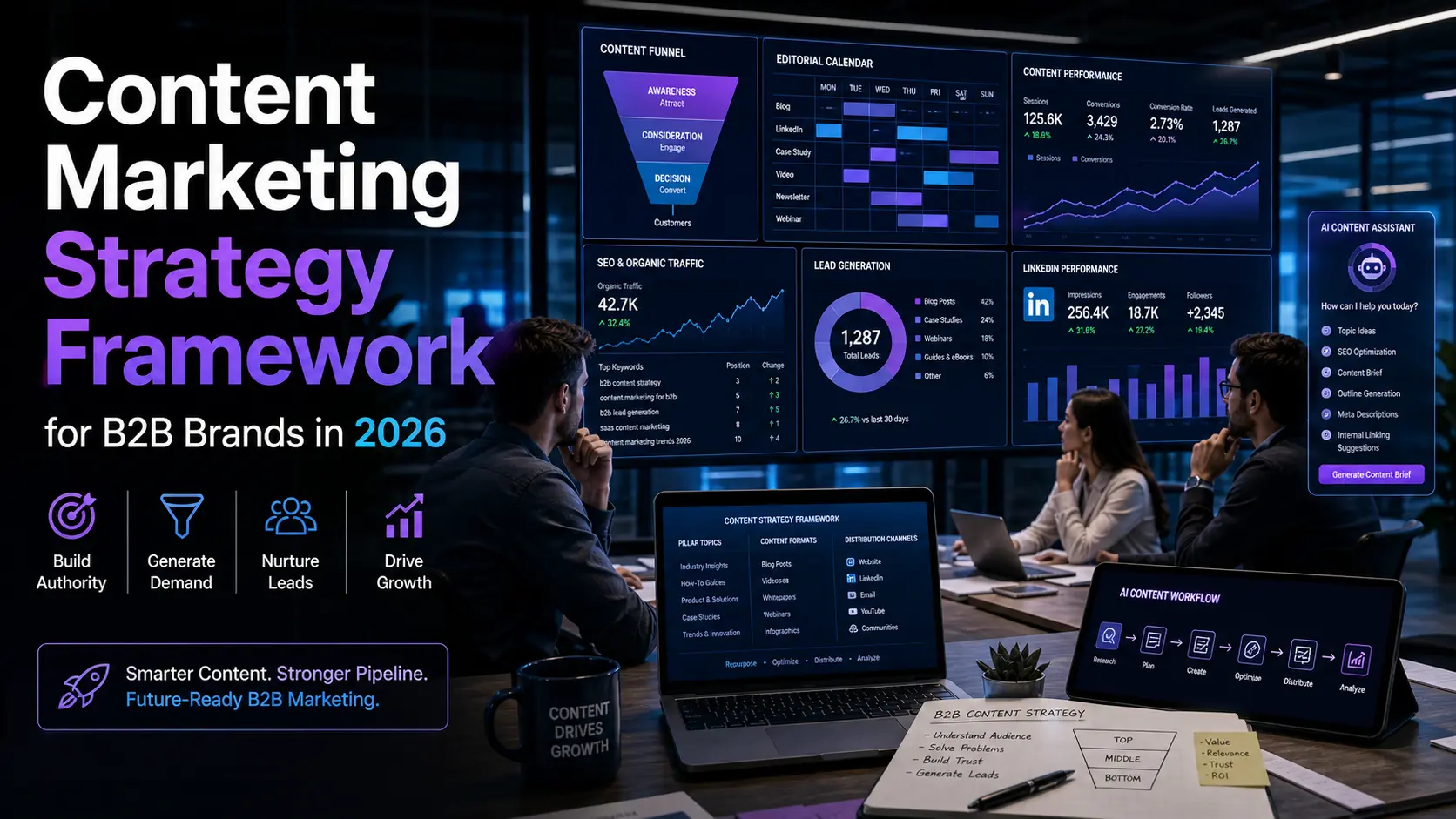
For the complete B2B content marketing framework covering strategy, audience research, distribution, and measurement, read our pillar: Content Marketing Strategy Framework for B2B Brands in 2026. More content guides live on PostoryCafe.com.