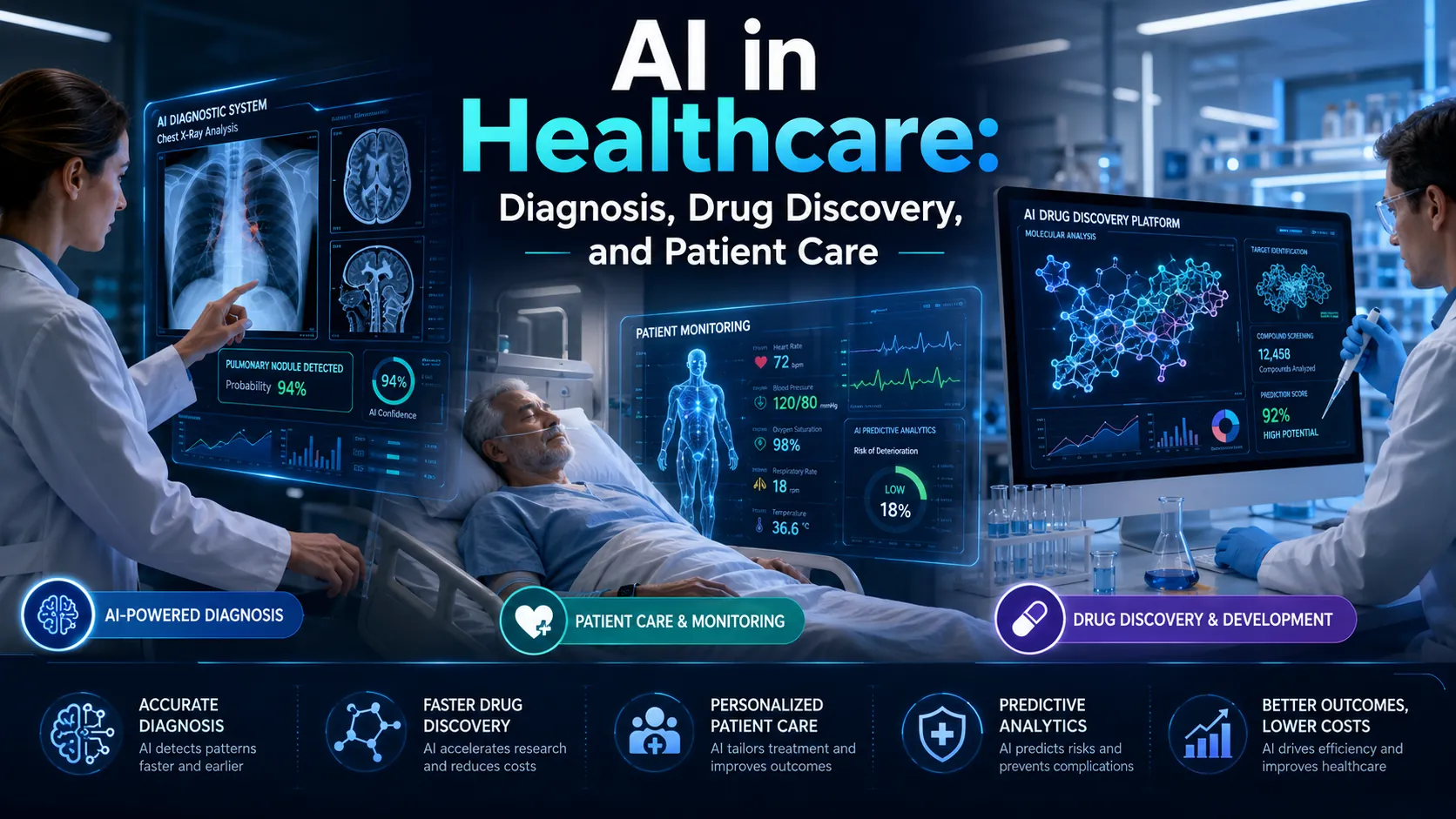
Artificial intelligence in healthcare has moved past the pilot-project phase. In 2026, AI tools read radiology scans alongside radiologists, flag sepsis risk in hospital patients before clinical symptoms appear, help drug companies identify novel drug candidates in months instead of years, and free physicians from two hours of documentation burden per shift.
The healthcare AI market surpassed $45 billion in 2026 according to Precedence Research, growing at roughly 37% annually. The FDA cleared more than 950 AI-enabled medical devices by the end of 2025, up from under 100 before 2020. This is no longer a technology story. It is a healthcare delivery story.
This guide covers where AI is making the most real clinical difference in 2026, where limitations remain honest, and what both patients and clinicians should actually expect from AI in their care.
The 5 Areas Where AI Is Having the Biggest Healthcare Impact
1. Medical Imaging and Radiology AI
AI-assisted radiology is the most mature clinical application in healthcare AI. Deep learning models from Google Health, Aidoc, Radiology Partners, Vis.ai, and Annalise read CT scans, MRIs, X-rays, and mammograms to flag abnormalities for radiologist review.
The evidence base is strong enough to change practice. Google’s DeepMind system detects over 50 eye diseases from retinal OCT scans at accuracy matching that of expert ophthalmologists in published clinical studies. Mammography AI tools from iCAD and Transpara have demonstrated higher cancer detection rates with lower false positive rates compared to single-reader human review. Several UK NHS trusts now use AI-assisted mammography as a second reader in national screening programs.
The primary benefit is reducing missed findings during high-volume reading. Radiologists reading hundreds of studies per shift miss a measurable percentage of findings due to fatigue. AI flags potential findings for human review, functioning as a second set of eyes that does not tire.
2. Hospital Early Warning and Sepsis Prediction
Sepsis kills over 270,000 Americans and 11 million people globally per year. Many of those deaths are preventable with earlier antibiotic administration. The challenge: early sepsis often looks like any other ill patient, and clinical teams managing dozens of patients simultaneously struggle to identify who is deteriorating.
Epic Systems, the dominant EHR in the United States, includes AI-powered sepsis prediction that continuously monitors patient vitals, lab values, nursing assessments, and medication records to alert clinical teams when a patient’s trajectory matches early sepsis patterns. Hospitals using this tool report significant reductions in time-to-treatment for sepsis.
Similar tools exist for cardiac deterioration, ICU early warning, and post-surgical complication risk. The 2025 rollout of AI-powered deterioration alerts across all 6,000+ Epic hospitals has made real-time AI risk stratification effectively standard of care for hospitalized patients in the US.
3. Drug Discovery Acceleration
The traditional drug development pipeline takes 10 to 15 years and costs an average of $2 billion. AI is compressing both timelines and costs in specific stages of that pipeline.
Insilico Medicine used AI to design a novel drug candidate for idiopathic pulmonary fibrosis and advance it through Phase II clinical trials in under 3 years. Recursion Pharmaceuticals uses AI to process millions of cellular images per week to identify drug candidates that human researchers would take years to find through traditional screening. BenevolentAI used AI-driven drug repositioning to identify baricitinib as a potential COVID-19 treatment, which was subsequently validated in clinical trials.
AlphaFold from DeepMind solved the protein folding problem in 2021 and provided its database freely to researchers. By 2026, over 200 million protein structures are in the AlphaFold database, accelerating research on drug targets, disease mechanisms, and molecular biology across thousands of labs worldwide.
4. AI-Powered Clinical Documentation
US physician burnout from documentation burden is a genuine healthcare workforce crisis. The average US physician spends 2 hours on documentation for every hour of patient care. Much of this involves typing narrative notes from memory after patient encounters, a task that pulls physicians away from clinical work and contributes to burnout.
AI medical scribes (Nuance DAX, Abridge, Nabla, Suki) listen to physician-patient conversations and automatically draft structured clinical notes. The physician reviews and approves rather than creating the note from scratch. Early adopter data from major health systems shows that AI documentation reduces after-hours charting by 50 to 70% while maintaining or improving note completeness.
This may be the most immediately impactful healthcare AI application in 2026 because it directly addresses the documented burnout crisis without requiring changes to clinical decision-making.
5. Personalized Oncology and Genomics
AI systems from Tempus, Flatiron Health, and Foundation Medicine analyze tumor genomics, treatment histories, and population-level outcomes to generate personalized treatment recommendations for cancer patients. At major cancer centers, oncologists use these tools to surface matching clinical trials, identify relevant drug sensitivities, and predict response to specific chemotherapy regimens based on genomic profile.
Liquid biopsy companies (Grail, Guardant Health) use AI to detect cancer from blood samples by analyzing circulating tumor DNA. Grail’s Galleri test, which screens for over 50 cancer types from a single blood draw, represents one of the most ambitious AI-enabled clinical applications in deployment in 2026.
Where AI Healthcare Still Falls Short
An honest view of healthcare AI in 2026 requires naming the limitations alongside the progress.
- Bias in training data. AI models trained on historically non-representative patient populations perform worse for underrepresented groups. Published studies show lower accuracy for darker skin tones in dermatology AI, and gender bias in certain cardiovascular AI applications.
- Regulatory approval lag. FDA clearance takes 12 to 24 months for novel AI medical devices, meaning promising tools often reach patients years after the underlying research is published and validated.
- Clinical integration is harder than development. Even cleared AI tools often sit unused because they require EHR integration, clinical workflow redesign, and physician training that institutions have not invested in.
- Liability frameworks are incomplete. When an AI system contributes to a wrong clinical decision, current law does not clearly establish accountability. The legal frameworks are still developing.
- Generalization across care settings. An AI model validated at an academic medical center may not perform identically at a rural community hospital with different patient populations, equipment, and workflows.
What Patients Should Know
- AI assists clinicians, it does not replace them. Every FDA-cleared AI medical tool in deployed clinical use is reviewed by a licensed clinician before any action is taken. Patients are not receiving AI-only diagnoses.
- You can ask about AI in your care. Patients have a right to understand how clinical decisions about their care are made. If a facility uses AI in reading your imaging or predicting your risk, asking about it is appropriate and will typically be welcomed.
- AI can reduce missed diagnoses. Radiology AI consistently catches findings that fatigued radiologists miss during high-volume sessions. This is a patient safety benefit, not just an efficiency one.
- Wearable AI data is already in your care. Apple Watch heart data, continuous glucose monitor readings, and smartwatch sleep data are now regularly incorporated into clinical decisions for patients who share that data with their care teams.
Frequently Asked Questions
Is AI replacing doctors in 2026?
No. AI is automating specific, well-defined tasks within medicine while clinical judgment, patient relationships, ethical decisions, and complex reasoning remain with physicians. The evidence from every major healthcare AI deployment is consistent: AI serves as an augmentation tool that helps clinicians work faster, more accurately, and with less fatigue. US physician employment reached record levels in 2025.
Which AI tools are most widely used in hospitals?
Epic’s AI-embedded predictive tools reach more patients than any standalone AI product because of Epic’s dominant EHR market share. Radiology AI from Aidoc, Viz.ai, and Annalise are widely deployed in imaging departments. Nuance DAX and Abridge lead in AI clinical documentation. Tempus and Flatiron are the most broadly adopted oncology AI platforms.
How accurate are medical AI systems?
Accuracy varies by application and AI system. FDA-cleared AI devices must demonstrate safety and effectiveness in clinical studies before approval. For well-validated applications like diabetic retinopathy detection and mammography AI, published performance data shows accuracy competitive with specialist physicians. For newer applications like behavioral health AI or multi-modal risk stratification, evidence is still accumulating. Always ask your clinical team about the validation evidence behind any AI system being used in your care.
AI Is a Tool, Not a Transformation on Its Own
Healthcare AI in 2026 is doing real work in real hospitals with real patients. The benefits in earlier diagnosis, faster drug discovery, reduced physician burnout, and more personalized treatment are documented and meaningful. The limitations in bias, equity, integration, and liability are equally real and require ongoing attention from developers, regulators, and health systems.
For the broader picture on wearable health technology, remote patient monitoring, and connected care tools, read our pillar: Digital Health Revolution: How Wearable Tech Is Saving Lives in 2026. More health technology content lives on PostoryCafe.com.