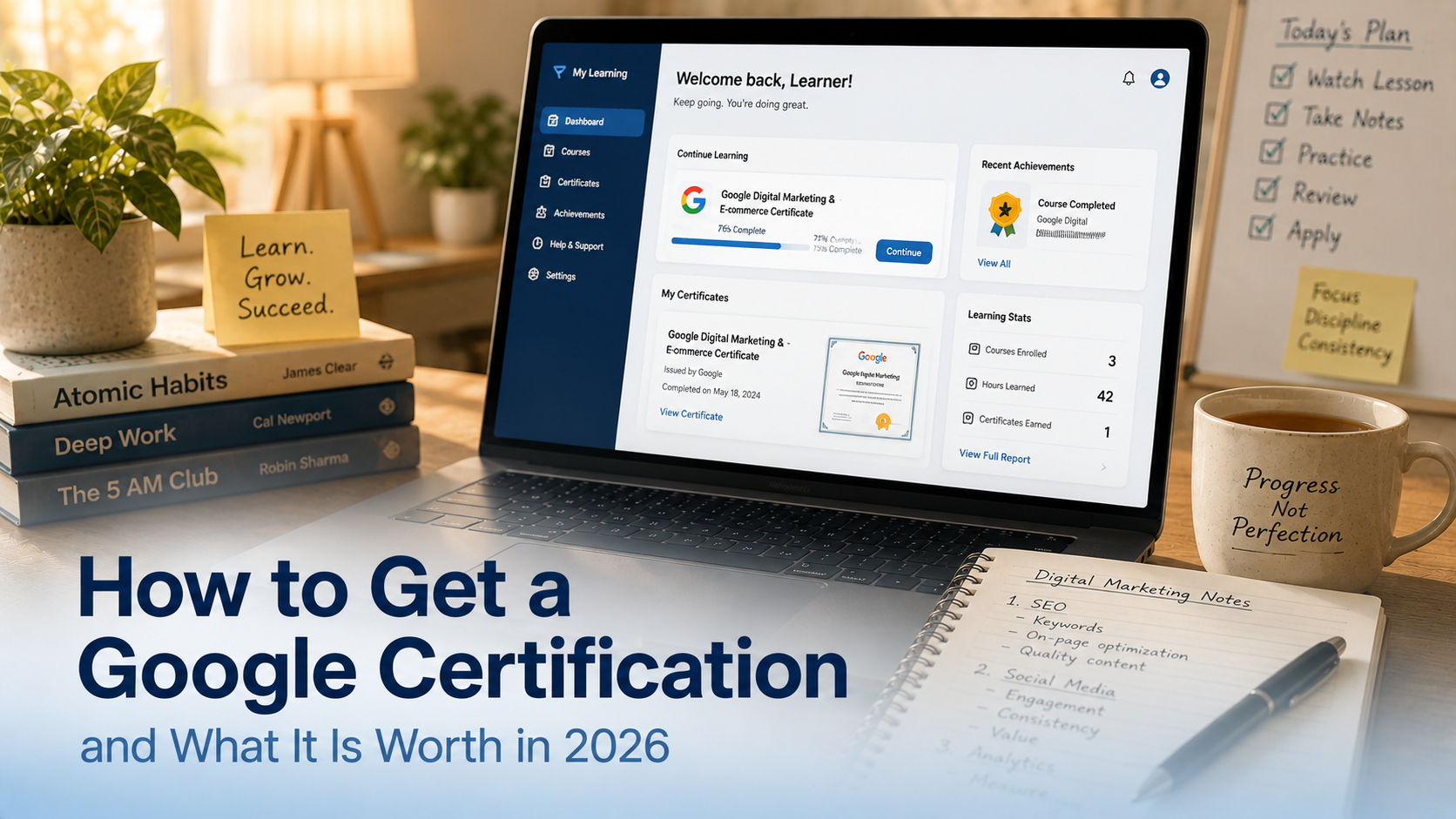
More than 2.3 million learners have enrolled in a Google Career Certificate since the program launched, according to Coursera’s 2025 impact report, and 75 percent of graduates report a positive career outcome, a new job, a promotion, or a raise, within six months of completion. The reality behind that headline number is more nuanced: only three of the eight current tracks, Cybersecurity, Advanced Data Analytics, and IT Support, currently offer the clearest payback against 2026 job market demand, while others like Digital Marketing face growing saturation.
Google Career Certificates are self-paced online programs hosted on Coursera, costing about 49 dollars a month and typically completed in three to six months of part-time study, with no prior degree or experience required. This guide breaks down what each track actually costs, how long it realistically takes, and which ones deliver measurable salary outcomes in 2026 based on Bureau of Labor Statistics projections and Coursera’s own outcomes data.
How the Program Actually Works
Eight tracks are currently live: IT Support, Data Analytics, Project Management, UX Design, Digital Marketing and E-commerce, Android Development, Cybersecurity, and Advanced Data Analytics, each delivered through a series of courses averaging around 10 hours of study per week. Completing a certificate grants access to the Google Career Certificates Employer Consortium, a group of over 150 companies including Deloitte, T-Mobile, and Walmart that commit to considering certificate graduates for entry-level roles, plus free access to CareerCircle for one-on-one coaching and interview preparation.
Pricing runs on a Coursera monthly subscription, roughly 49 dollars a month, meaning the total cost depends entirely on how quickly you complete the coursework; the average six-month pace lands around 294 dollars total, though studying more intensively can meaningfully cut that cost.
Which Certificates Deliver the Best Salary Outcomes
| Certificate | Entry Salary Range | BLS Growth Outlook | 2026 Market Reality |
| Cybersecurity | $55,000 – $80,000 | 33% growth through 2034 (highest of any track) | Demand outstrips qualified candidates |
| Advanced Data Analytics | $70,000 – $95,000 | Strong, adjacent to data science demand | Best for those with existing analytics background |
| IT Support | $45,000 – $70,000 | High job volume, 295,000+ open US positions | Increasingly needs pairing with CompTIA A+ |
| Data Analytics (foundational) | $55,000 – $75,000 | Still strong but market is more saturated | Original early-adopter track, now more competitive |
| UX Design | $60,000 – $85,000 | Moderate, requires strong portfolio | Saturated; portfolio work now expected beyond the cert |
| Digital Marketing & E-commerce | $45,000 – $65,000 | Moderate, high competition | Most saturated track, lowest differentiation on its own |
What Actually Makes These Certificates Work
Reddit and Quora discussions of Google certificates converge on a consistent theme: certificates work best as stepping stones rather than standalone qualifications, and graduates who pair the certificate with a real project, an interactive Tableau dashboard for the Data Analytics track, or a deployed app for Android Development, land jobs meaningfully faster than those relying on the credential alone. Former Google employees quoted in industry coverage have been candid that the program mainly benefits people without other credentialing options, a fair characterization: someone with a computer science degree gains little from also holding an IT Support certificate, while a career-changer from retail or hospitality gains a real, structured entry point.
The 2024 NACE survey found 87.4 percent of employers say they would hire a candidate with a strong online certificate at the same salary as one with a traditional degree, a figure that has climbed for five consecutive years and reflects a genuine, ongoing shift in how hiring managers evaluate non-degree credentials, particularly in technical entry-level roles.
Choosing the Right Track for Your Situation
Career changers coming from administrative, retail, or customer service roles with zero technical background consistently do best starting with IT Support, since it requires no prior knowledge and directly maps to a large, currently open job market. Anyone already comfortable with spreadsheets and basic data work should consider skipping straight to Data Analytics, while those specifically drawn to the fastest-growing, least-saturated market in 2026 should weigh Cybersecurity most heavily given its documented 33 percent BLS growth projection through 2034, the highest of any track in the program.
Combining certificates strategically outperforms taking any single one in isolation for many career paths: pairing Google IT Support with a free SQL or cloud fundamentals course suits someone moving from operations into tech-adjacent roles, while pairing Google Digital Marketing with a Meta Social Media Marketing certificate and a free HubSpot content marketing credential helps digital marketers demonstrate cross-platform fluency that commands stronger salaries than a single-platform background.
Newer AI-Focused Certificates Worth Knowing About
Google AI Essentials and Google Prompting Essentials, both shorter and lighter than the full Career Certificates, offer truly useful supplementary AI fluency that strengthens any primary certificate rather than functioning as a standalone career-launching credential on their own. The Google AI Professional Certificate, aimed at teaching practical AI application skills across any industry regardless of prior technical experience, has emerged as one of the more forward-looking additions to the program precisely because it addresses skills increasingly expected across roles that have nothing directly to do with traditional IT.
For learners who already hold one of the foundational certificates, IT Support, Data Analytics, or Project Management, layering an AI Essentials course on top signals current relevance to employers without requiring an entirely separate multi-month commitment, a truly efficient way to keep an existing credential from feeling dated as AI skills become more universally expected across job descriptions.
Google IT Automation with Python, a more technical track building on the foundational IT Support certificate, has specifically been named among the strongest 2026 additions for learners wanting to move beyond entry-level help desk work toward automation-focused roles that increasingly command higher starting salaries in the 55,000 to 75,000 dollar range.
Frequently Asked Questions: Google Certifications
Q: How much does a Google Career Certificate actually cost? A: Roughly 49 dollars a month through Coursera, with most learners completing a certificate in three to six months, putting the total cost in the range of 150 to 300 dollars depending on pace.
Q: Which Google certificate has the best job outlook in 2026? A: Cybersecurity currently offers the strongest outlook, with the Bureau of Labor Statistics projecting 33 percent growth for information security analyst roles through 2034, the highest growth rate of any track in the program.
Q: Do employers actually recognize Google Career Certificates? A: Yes to a meaningful degree; over 150 companies participate in Google’s hiring consortium, and a 2024 NACE survey found 87.4 percent of employers say they would hire a certificate holder at the same salary as a traditional degree holder.
Q: Is the Google IT Support certificate still worth getting in 2026? A: It remains a genuine entry point, though increasingly the floor rather than the ceiling; many successful graduates pair it with a CompTIA A+ or Security+ certification to stand out in a more competitive applicant pool.
Q: How long does it take to complete a Google Career Certificate? A: Most learners complete a certificate in three to six months studying about 9 to 11 hours per week, though the self-paced format allows faster completion for those able to dedicate more time.
Q: Do Google certificates replace a college degree? A: Not entirely; they provide job-ready skills for specific entry-level roles faster and cheaper than a degree, but a degree still carries broader recognition for career paths requiring formal academic credentials.
Making the Certificate Actually Pay Off
The certificate itself is only the first half of the equation; graduates who add a real project, network within the employer consortium, and frame their certificate work like an actual job entry on a resume see meaningfully stronger outcomes than those who simply list the credential and wait. For more on evaluating other online learning paths, browse our full education section. Choose the track that matches both current market demand and your own existing background, then treat the six months of study as the floor of your job search preparation, not the ceiling.
Looking to grow your own reach? Postorycafe is a guest posting platform that welcomes writers across every niche covered here. Submit your guest posting pitch today and get your work in front of a global audience.