Ten years ago, online learning meant grainy YouTube tutorials and a handful of academic platforms most people had never heard of. Today, online courses are a $400 billion industry. Working adults upskill on lunch breaks. Career switchers earn certificates that real employers respect. High school students take university-level classes from professors who never knew their names.
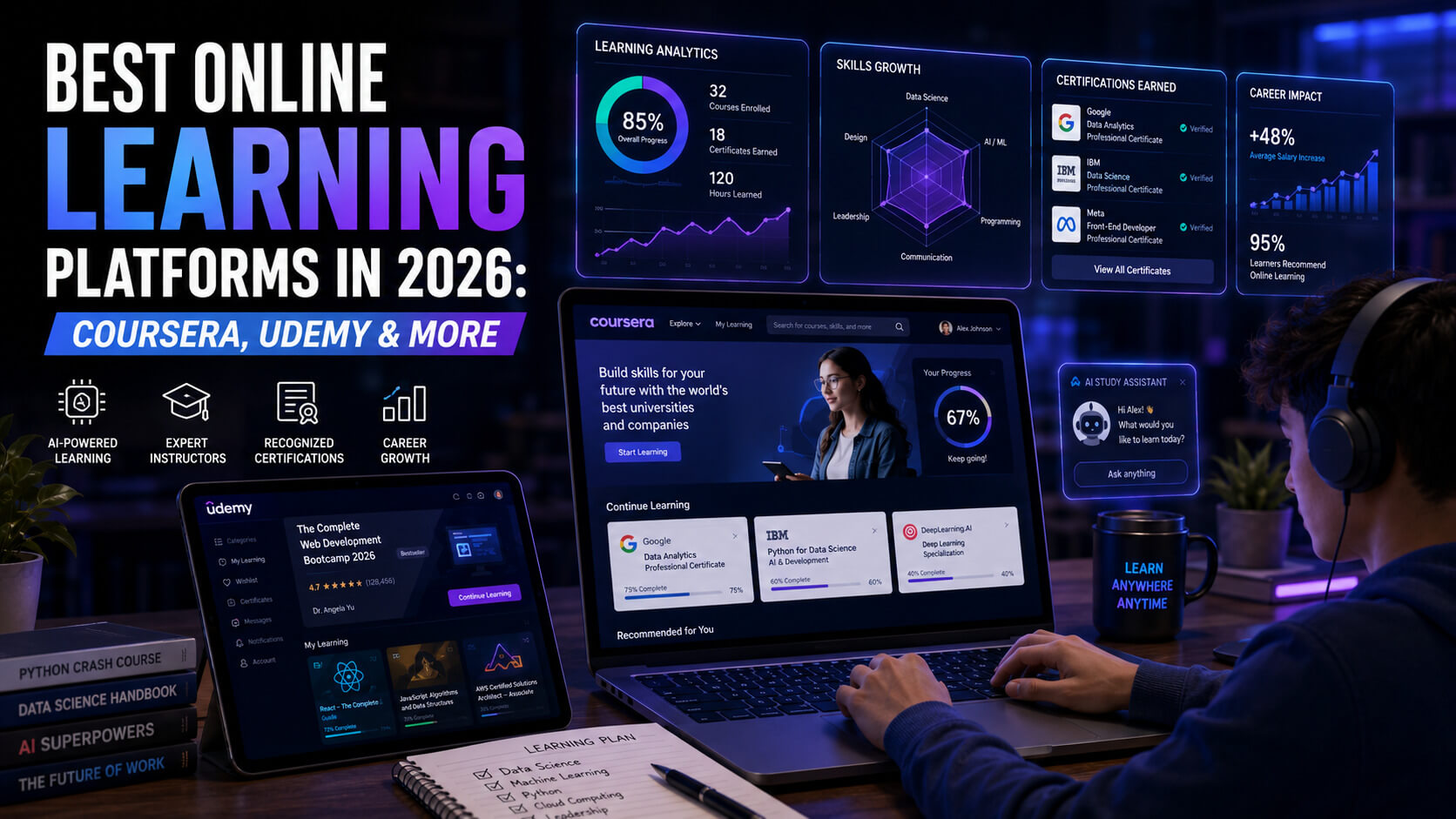
But the platform you choose matters more than ever. Coursera and edX deliver structured university content. Udemy is a sprawling marketplace of self-paced courses. Skillshare leans creative. Pluralsight focuses on tech. LinkedIn Learning ties professional development to job profiles. Each has strengths and weaknesses, and the wrong choice can waste real money.
This guide compares the best online learning platforms in 2026 across price, certifications, course quality, and which type of learner each one fits. By the end, you will know exactly which platform deserves your time and budget.
How to Choose the Right Online Learning Platform
The best platform depends on what you are trying to do. Three questions cut through most of the noise.
Are You Learning for Credentials or for Skill?
Credentials matter for career change and resume signal. Skill matters when you need to do a specific job. Different platforms serve each goal better.
How Structured Do You Need the Experience to Be?
Self-paced marketplaces (Udemy, Skillshare) work for self-directed learners. Cohort-based programs and university partnerships (Coursera, edX) provide structure that helps people who struggle to finish self-directed work.
What Is Your Real Budget?
Some platforms offer free tiers strong enough to learn most subjects. Others charge $50 to $250 per month. Premium degree programs run $10,000 to $25,000.
1. Coursera: University-Quality Content for Working Adults
Coursera partners with over 300 universities and companies (Stanford, Yale, Google, IBM, Meta) to deliver structured online courses, professional certificates, and full degree programs. Course quality is consistently strong, with real assignments, peer reviews, and often direct interaction with instructors.
Best For
- Career switchers seeking respected credentials
- Working professionals upskilling in technical fields (data science, AI, cloud computing)
- Anyone who values university-grade rigor and structure
Pricing
Many courses are free to audit. Coursera Plus ($59 per month or $399 per year in 2026) provides unlimited access to most courses and Specializations. Professional Certificates run $39 to $79 per month per program. Online Master’s degrees range from $9,000 to $25,000.
Standout Features
- Google’s Professional Certificates (data analytics, IT support, project management, UX design) are widely recognized by employers and have clear job-placement support.
- Coursera Coach (their AI-powered tutor, launched in 2024) provides on-demand help inside courses.
- Real degree programs from accredited universities give Coursera a credibility edge competitors cannot match.
Where It Falls Short
- Free auditing has been restricted in recent years.
- Some Specializations feel padded with filler content.
- The platform structure can feel bureaucratic compared to leaner marketplaces.
2. Udemy: The Marketplace for Practical Skills
Udemy is the largest course marketplace in the world, with over 220,000 courses and 70 million learners in 2026. Anyone can publish a course, and quality varies wildly. The best Udemy courses are surprisingly excellent. The worst are unwatchable.
Best For
- Self-directed learners who want a specific skill quickly
- Budget-conscious students (frequent sales bring courses to $10 to $20)
- Practical, project-based learning (web development, Excel, design tools, marketing)
Pricing
Individual course prices range from $20 to $200, but Udemy runs frequent sales that drop most courses to $10 to $20. Udemy Personal Plan ($30 per month) gives access to 12,000+ top courses. Udemy Business serves teams at $360 per user per year.
Standout Features
- Lifetime access to purchased courses
- The largest catalog of niche topics anywhere
- Many courses are taught by industry practitioners rather than academics, giving them practical relevance university courses sometimes lack.
Where It Falls Short
- Quality is inconsistent.
- Certificates carry less weight with employers than Coursera or LinkedIn Learning credentials.
- Without filters, the marketplace can feel overwhelming.
- Always check recent reviews and the instructor’s teaching history before buying.
3. LinkedIn Learning: Professional Development Built Into Your Profile
LinkedIn Learning (formerly Lynda.com) offers over 21,000 courses focused on business, technology, and creative skills. Its strongest advantage is direct integration with LinkedIn profiles, making completed courses visible to recruiters and employers.
Best For
- Professionals building visible upskilling on LinkedIn profiles
- Corporate L&D programs (LinkedIn Learning is widely adopted in Fortune 500 companies)
- Soft skills, leadership, and business communication training
Pricing
$39.99 per month, often included free with LinkedIn Premium ($29.99 per month) or Premium Career and Business plans. Many users access it free through their employer or library card.
Standout Features
- Course recommendations based on your LinkedIn profile and career goals
- Direct skill assessment integration
- Strong catalog of business soft-skill courses (negotiation, executive presence, communication) that competitors do not match
Where It Falls Short
- Weaker for deep technical skills compared to Coursera or Pluralsight
- Less project-based learning
- Some courses feel overly polished but light on substance
4. Skillshare: For Creative Learners
Skillshare focuses on creative skills: illustration, design, photography, writing, music, animation, and content creation. Most courses run 30 to 90 minutes and emphasize project-based learning.
Best For
- Designers, illustrators, photographers, and creative hobbyists
- Content creators learning new skills (video editing, podcasting, graphic design)
- Anyone who learns best through short, project-driven courses
Pricing
Skillshare Premium runs $32 per month or $168 per year in 2026. Free trials are common. No individual course purchases.
Standout Features
- High-quality creative instructors (many are working professionals with real portfolios)
- Project-driven structure encourages students to actually produce work
- Active community of fellow creatives sharing projects and feedback
Where It Falls Short
- Limited certifications or career-focused credentials
- Weaker for technical or business skills
- Some categories feel thin compared to dedicated platforms in those niches
5. Pluralsight: Deep Technical Skills
Pluralsight focuses on developer, IT, cybersecurity, and data professional skills. Course quality is consistently high because all instructors are vetted industry experts. Skill IQ assessments measure your level before and after each learning path.
Best For
- Software developers and engineers
- IT operations, cloud, and DevOps professionals
- Cybersecurity specialists and aspiring practitioners
Pricing
- Standard plan: $29 per month or $299 per year
- Premium plan: $45 per month
- Team plans for businesses: $399 to $579 per user per year
Standout Features
- Hands-on labs and sandboxes for AWS, Azure, Google Cloud, and Kubernetes
- Direct cybersecurity certification prep (CISSP, CEH, CompTIA)
- Skill measurement tools that produce real before-and-after data on your competency
Where It Falls Short
- Narrow focus means it is not a fit for non-technical learners
- More expensive than Udemy for similar self-paced learning
- Less variety of teaching styles than larger marketplaces
6. edX: Free University Courses With Optional Credentials
edX, founded by Harvard and MIT and now owned by 2U, partners with major universities to deliver free auditing of high-quality courses. Optional verified certificates and MicroMasters programs lead toward real graduate credit.
Best For
- Learners who want university-quality content for free
- Students considering full graduate study and wanting a low-risk preview
- Anyone seeking academic depth in computer science, business, or sciences
Pricing
- Course auditing is largely free
- Verified certificates cost $50 to $300
- MicroMasters programs cost $1,000 to $3,000
- Full online Master’s degrees range from $10,000 to $25,000
Standout Features
- Genuinely free auditing remains broader than on competing platforms
- Many MicroMasters credits transfer to actual university degree programs
- Strong foundation for fields like computer science, statistics, and management
Where It Falls Short
- User experience feels less polished than Coursera
- Course catalog is smaller
- Mobile experience is less refined than commercial competitors
7. Khan Academy: Free, World-Class K-12 and Foundational Learning
Khan Academy remains the strongest free option for K-12 learners and adults filling gaps in math, science, and economics fundamentals. Its 2024 launch of Khanmigo, an AI tutor built on GPT models, made the platform even more capable.
Best For
- K-12 students and parents supporting them
- Adults reviewing math, science, or economics fundamentals
- Test prep (SAT, AP courses, GMAT, LSAT in some areas)
Pricing
- Free for the core platform
- Khanmigo (the AI tutor) costs around $4 per month as a suggested donation to support the nonprofit
Standout Features
- Genuinely free, nonprofit-funded, with no ads
- Khanmigo offers AI tutoring with strong Socratic methodology rather than answer-spitting
- Best math and statistics catalog of any free platform
Where It Falls Short
- Limited career-focused content
- Few business or creative subjects
- Not a fit for graduate-level or specialized professional skills
Comparison Table: All 7 Platforms at a Glance
| Platform | Best For | Starting Price | Strongest Subject Areas |
|---|---|---|---|
| Coursera | Career credentials and degrees | Free audit / $59/mo | Tech, business, university degrees |
| Udemy | Self-paced practical skills | $10 to $200 per course | Programming, marketing, Excel, design |
| LinkedIn Learning | Professional development | $39.99/mo | Soft skills, leadership, business |
| Skillshare | Creative skills | $32/mo | Design, illustration, photography |
| Pluralsight | Tech and IT depth | $29/mo | Software, cloud, cybersecurity |
| edX | Free university content | Free / $50 to $300 cert | Computer science, business, sciences |
| Khan Academy | Free K-12 and foundations | Free | Math, science, economics, test prep |
Which Platform Should You Choose?
Use this quick decision framework to pick the best fit for your goal.
For a Career Change
- Coursera (Google or Meta Professional Certificates)
- edX MicroMasters
For a Quick Practical Skill
- Udemy during a sale
- Pluralsight for tech-specific topics
For Visible Professional Growth
- LinkedIn Learning, especially if your job market searches LinkedIn for talent
For Creative Work
- Skillshare leads
- Pair it with YouTube tutorials for niche software training
For Technical Depth (Software, Cloud, Cybersecurity)
- Pluralsight is hard to beat
- Coursera Specializations from Google or AWS are strong alternatives
For Free Learning That Still Respects Your Time
- edX (university courses)
- Khan Academy (foundational skills)
6 Common Mistakes Online Learners Make
Buying Courses Without Finishing Them
Course completion rates on most platforms are below 15%. The platform you actually finish is better than the prestigious one you abandon.
Choosing Platforms Based on Hype Rather Than Fit
A trending course on AI is worthless if your real goal is improving Excel skills for your current job. Match the platform to your real outcome.
Subscribing to Too Many Platforms
One active subscription you actually use beats four you ignore. Cancel what you do not open weekly.
Treating Certificates as Guarantees
Certificates help but rarely substitute for demonstrated skill. Always pair learning with portfolio work or real projects.
Ignoring Free Options
Khan Academy, edX free auditing, and high-quality YouTube channels cover most foundational learning. Pay for premium platforms only after free options are exhausted.
Skipping the Practical Work
Watching videos creates the illusion of learning. Real skill comes from building, writing, coding, or designing. Every learning plan should include hands-on output.
Expert Tips for Getting Real Results From Online Courses
Set a Specific Outcome Before Enrolling
“I want to learn data analysis” is too vague. “I want to build three real dashboards in Tableau by June” is actionable.
Block Time on Your Calendar
Self-paced courses fail without scheduled time. Two 45-minute slots per week consistently beats one rushed marathon session per month.
Take Notes by Hand or in Your Own Document
Just watching videos retains roughly 10% of the material. Active note-taking pushes retention above 50%.
Build Something With Each Major Lesson
Apply what you learned within 48 hours, even on a small scale. Knowledge that goes unused fades quickly.
Find One Accountability Partner
A coworker, friend, or community member who is also learning the topic dramatically improves completion rates. Discussing what you learn locks it into memory.
Update Your LinkedIn or Portfolio After Every Meaningful Course
This is what turns hours of learning into real career value.
Frequently Asked Questions
Which Is the Best Online Learning Platform in 2026?
There is no single best platform. Coursera is the strongest choice for career-changing credentials and degree programs. Udemy wins for self-paced, budget-friendly practical skills. LinkedIn Learning fits professionals building visible career growth. Skillshare leads for creative subjects. Pluralsight is the choice for technical depth. edX and Khan Academy provide the strongest free options.
The right platform depends on your specific goal, learning style, and budget.
Are Online Learning Certificates Worth Anything to Employers?
Yes, but quality varies. Certificates from recognized programs (Google Professional Certificates on Coursera, Microsoft and AWS certifications, university-issued credentials on edX) carry meaningful weight in hiring.
Generic completion certificates from random courses on smaller platforms carry little. The most respected credentials in 2026 combine recognized brand names with demonstrated skill, often through real projects or portfolio work.
Coursera vs Udemy: Which One Should I Pick?
Pick Coursera if you want structured learning, university-quality content, and credentials that signal credibility to employers.
Pick Udemy if you want cheap, on-demand access to practical skills, especially niche software or quick how-to topics.
Many professionals use both: Coursera for core upskilling and Udemy for occasional specific skills they need quickly.
Are There Genuinely Good Free Online Courses?
Yes.
- edX offers free auditing of courses from Harvard, MIT, and other major universities.
- Khan Academy provides high-quality K-12 and foundational learning at no cost.
- Coursera allows free auditing on many courses.
- YouTube channels like 3Blue1Brown, freeCodeCamp, and CS50 produce university-level content for free.
The free learning landscape in 2026 is strong enough that most foundational skills can be built without paying anything.
How Do I Stay Motivated to Finish Online Courses?
Three habits separate finishers from quitters:
- Schedule specific time slots on your calendar
- Set a measurable outcome (a project, certification, or job application date)
- Find an accountability partner or community
Most failed online courses fail not because the content was bad but because life filled the time the learner intended to use. Treating learning as a calendar commitment rather than a hopeful intention is the single biggest predictor of completion.
Pick a Platform and Start Today
The best online learning platform in 2026 is the one you actually use. All seven platforms in this guide produce real results for the right learners. The wrong choice is the one you subscribe to and never open.
Pick a single goal: a career skill, a certification, a creative project, or filling a knowledge gap. Match it to the platform that fits best. Schedule your first three sessions on your calendar before you finish reading this. Show up for them, and the rest gets easier.
For more on how AI tutors and adaptive learning are reshaping education, read our pillar: The Rise of EdTech: How AI Tutors Are Personalizing Learning in 2026. More learning and career guides live on PostoryCafe.com.