
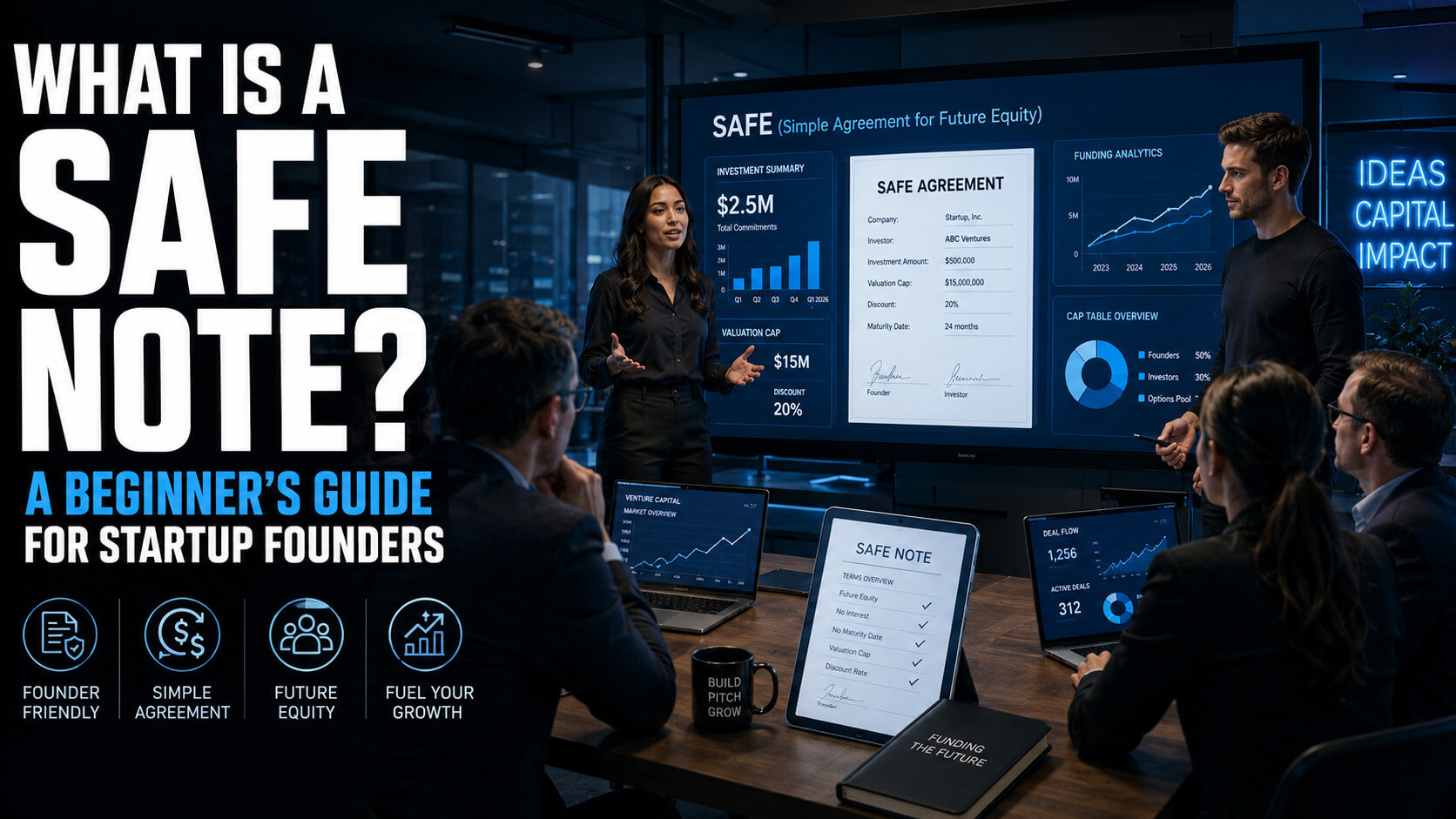
The Simple Agreement for Future Equity, known as a SAFE, is the most common instrument for early-stage startup fundraising in 2026. Y Combinator introduced it in 2013 to replace the complexity of convertible notes with a cleaner, more founder-friendly structure.
Most founders encounter SAFEs for the first time in the middle of a fundraise, which is the worst possible moment to learn the basics.
This guide explains:
- What a SAFE is
- How SAFE conversion works
- What the key terms mean
- How to negotiate them
- What mistakes to avoid before signing one
What Is a SAFE Note?
A SAFE is an agreement where an investor gives a startup money today in exchange for the right to receive equity later, usually during a future priced round like a Series A.
Unlike a convertible note:
- A SAFE is not debt
- It does not accrue interest
- It has no maturity date
- The investor cannot demand repayment
Instead, the investor receives a contractual right to convert the investment into equity under predefined terms.
Why Founders Use SAFEs
SAFEs became dominant because they are:
- Faster to close
- Cheaper legally
- Simpler to understand
- More founder-friendly than convertible notes
Most negotiations focus on just a few terms instead of lengthy financing documents.
How a SAFE Converts: Simple Example
Imagine:
- An investor puts in $250,000
- The SAFE has a $5 million post-money valuation cap
- The startup later raises a Series A at a $20 million valuation
Because the SAFE cap is $5 million, the investor converts as if the company were worth $5 million instead of $20 million.
That means:
- They receive shares at a much cheaper effective price
- They get more ownership for taking earlier risk
Basic Post-Money SAFE Math
Ownership percentage at conversion:
- Investment amount ÷ valuation cap
In this example:
- $250,000 ÷ $5,000,000 = 5%
That 5% later gets diluted by the Series A and option pool, but the SAFE investor still entered at a far better price than later investors.
The 4 SAFE Terms Every Founder Must Understand
1. Valuation Cap
The valuation cap determines the maximum valuation at which the SAFE converts.
Important Rule
- Lower caps benefit investors
- Higher caps benefit founders
Typical 2026 SAFE Cap Ranges
| Stage | Typical SAFE Cap |
|---|---|
| Early pre-seed | $3M to $6M |
| Strong pre-seed | $6M to $10M |
| Seed stage | $8M to $25M |
| Elite AI/deep-tech founders | Often above $20M |
The cap directly affects future dilution.
2. Discount Rate
A discount gives SAFE investors a cheaper share price during the future priced round.
Example
A 20% discount means:
- SAFE investors pay $0.80
- New investors pay $1.00
Important Detail
If a SAFE includes both:
- A valuation cap
- A discount
The investor uses whichever produces the better price.
3. Pro-Rata Rights
Pro-rata rights allow SAFE investors to invest more money in future rounds to maintain their ownership percentage.
Why Investors Want This
It lets them:
- Avoid dilution
- Continue backing successful companies
Why Founders Usually Accept It
Strong investors staying involved is often beneficial.
4. MFN (Most Favored Nation) Clause
MFN clauses protect early investors if later SAFE investors receive better terms.
Example
If:
- Early SAFE investor signed at a weaker deal
- Later investor gets a lower cap
The MFN investor can adopt the better terms automatically.
Important Warning
MFN clauses can create complications when multiple SAFE rounds stack together.
Types of SAFEs Used in 2026
| SAFE Type | How It Works | Best For |
|---|---|---|
| Post-Money SAFE | Ownership percentage known upfront | Most modern pre-seed rounds |
| Cap Only SAFE | Converts at capped valuation only | Clean angel rounds |
| Discount Only SAFE | Converts at discounted future price | Advisor or bridge situations |
| Cap + Discount SAFE | Investor chooses better conversion price | Investor-friendly deals |
| Uncapped MFN SAFE | No cap, MFN protection only | Temporary bridge financing |
Why Post-Money SAFEs Became Standard
Y Combinator updated the SAFE structure in 2018 to use post-money valuation caps.
Main Advantage
Founders can model dilution more accurately upfront.
Most sophisticated investors now expect post-money SAFEs by default.
SAFE vs Convertible Note
| Factor | SAFE | Convertible Note |
|---|---|---|
| Debt? | No | Yes |
| Interest accrues? | No | Yes |
| Maturity date? | No | Usually 18–24 months |
| Legal complexity | Lower | Higher |
| Founder-friendly? | More | Less |
| Investor protection | Lower | Higher |
| Typical use | Pre-seed / seed | Bridge rounds |
When Convertible Notes Still Make Sense
Convertible notes still appear in:
- Bridge financing
- Down-round situations
- Later-stage companies where investors want debt protections
But SAFEs dominate most early-stage fundraising today.
Understanding SAFE Dilution Before Signing
The most expensive SAFE mistake founders make is failing to model dilution.
The Problem
Multiple SAFEs issued at different caps create a “SAFE stack.”
When all convert simultaneously:
- Founder ownership can shrink far more than expected
Example of SAFE Stack Risk
A startup raises:
- $500K SAFE at $4M cap
- $500K SAFE at $5M cap
- $500K SAFE at $6M cap
Later, the company raises a Series A at $20M.
Each SAFE converts differently, creating layered dilution before Series A investors even enter.
Best Practice
Always model ownership outcomes at:
- $15M Series A
- $20M Series A
- $30M Series A
before signing additional SAFEs.
Tools Founders Use for SAFE Modeling
Popular Options
- Carta
- Pulley
- Spreadsheet cap table models
Even basic modeling prevents major surprises later.
How to Negotiate SAFE Terms
Start With the YC Post-Money SAFE
It is:
- Free
- Standardized
- Widely accepted
- Founder-friendly
Use Comparable Deals for Your Cap
Research:
- Crunchbase
- PitchBook
- AngelList
to benchmark current market caps.
Keep Terms Consistent
Avoid offering wildly different terms to investors in the same round.
Why It Matters
Different terms create:
- MFN complications
- Investor tension
- Extra legal complexity
Push Back on Extreme Discounts
Discounts above 20% become unusually dilutive.
Always Get Legal Review
Even standard SAFE templates can include:
- Side letters
- Custom provisions
- Special investor rights
Typical Cost
- $500 to $2,000 for attorney review
Almost always worth it.
5 Common SAFE Mistakes
Not Modeling Dilution
Every SAFE locks in future ownership.
Setting the Cap Too Low
Low caps can:
- Hurt future fundraising
- Signal weak confidence
- Create excessive dilution
Stacking Too Many SAFEs
Large SAFE stacks create messy cap tables.
Warning Zone
More than $2M to $3M in SAFEs without a priced round often becomes problematic.
Accepting Non-Standard Terms Blindly
Custom clauses can quietly create major restrictions later.
Treating SAFE Investors Like Passive Investors
SAFE investors are future shareholders.
Keep them informed and engaged.
Expert Tips for Founders Raising SAFEs
Close Investors Quickly
Momentum matters in fundraising.
Understand Pro-Rata Math Before Offering It
Large pro-rata rights can reduce room for future investors.
Use SAFEs as a Bridge, Not a Permanent Strategy
SAFEs work best as temporary financing before a priced round.
Maintain a Live Cap Table
A current cap table becomes essential once serious fundraising begins.
Frequently Asked Questions
What Is the Difference Between a SAFE and a Convertible Note?
A SAFE:
- Is not debt
- Has no maturity date
- Does not accrue interest
A convertible note:
- Is debt
- Accrues interest
- Includes repayment risk if conversion never happens
What SAFE Valuation Cap Should I Use?
Typical 2026 ranges:
- First-time founders: $3M to $6M
- Strong teams with traction: $6M to $12M
- Hot AI/deep-tech startups: sometimes much higher
Comparable deals matter more than generic averages.
Is the YC SAFE Template Free?
Yes.
Y Combinator publishes SAFE templates publicly for free use.
Most early-stage US startup financings now use versions of those templates.
SAFEs Are a Tool, Not a Fundraising Strategy
Used properly, SAFEs help founders raise capital quickly with minimal friction.
Used carelessly, they create:
- Dilution surprises
- Cap table problems
- Difficult Series A negotiations
The difference comes down to:
- Modeling
- Discipline
- Clear communication with investors
A SAFE investor is not temporary money. They are an early long-term partner in your company.
For the full startup fundraising playbook, including pitch decks, outreach strategy, and seed negotiation tactics, read our pillar: How to Raise Seed Funding in 2026. More startup and venture content lives on PostoryCafe.com.