
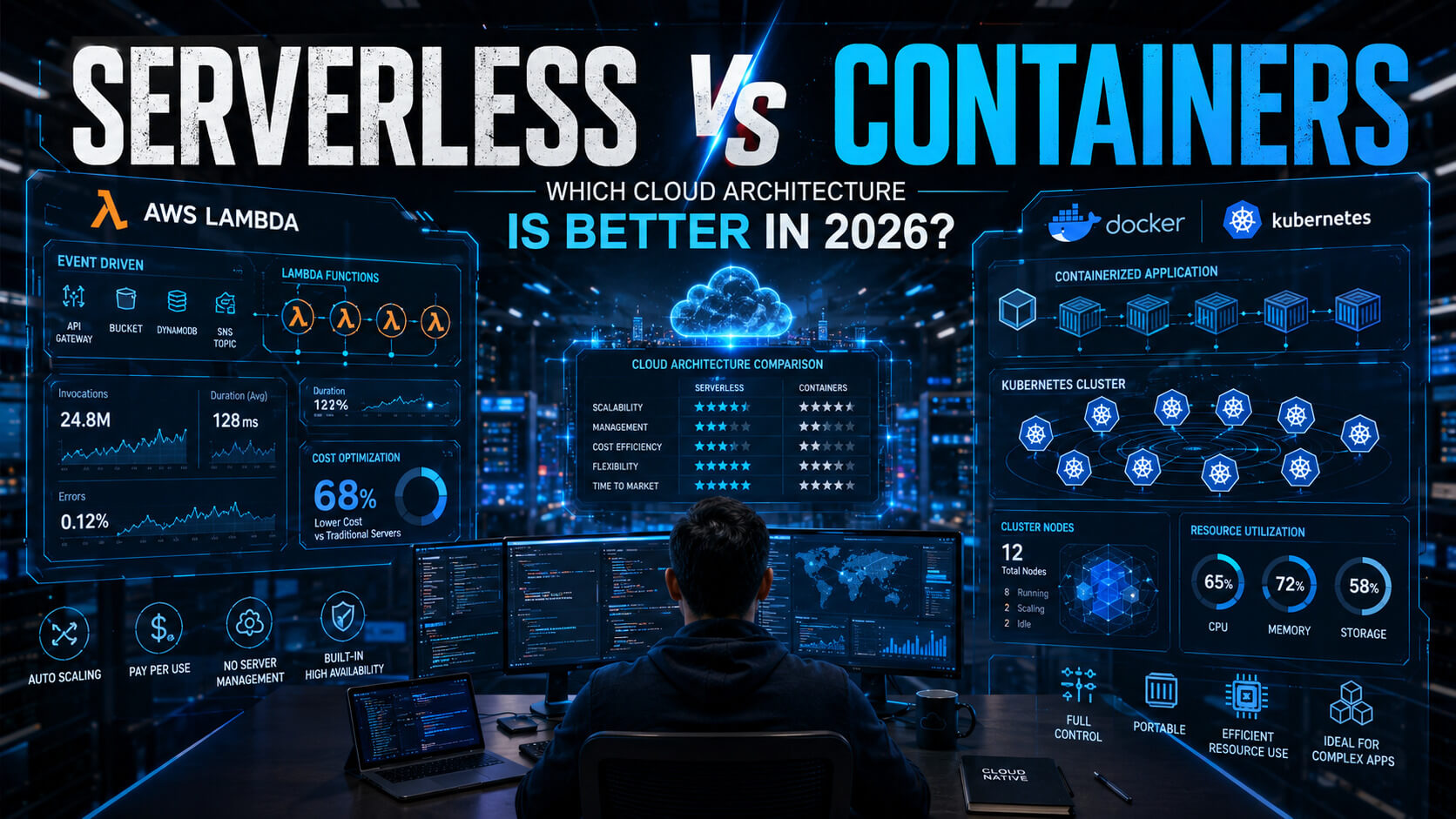
Every developer building in the cloud faces the same decision eventually: should this workload run serverless or in a container? Both approaches abstract server management. Both scale automatically. Both run on every major cloud provider. The architectural choice shapes your cost structure, developer experience, cold-start latency, and operational complexity for the life of the product.
This guide cuts through cloud provider marketing with a practical comparison based on real workloads. You will learn exactly when serverless wins, when containers win, where hybrid patterns apply, and how to choose correctly for your specific situation.
Quick Definitions
What Is Serverless?
Serverless (Functions as a Service, or FaaS) means you deploy individual functions that execute on demand. You write the code. The cloud provider handles provisioning, scaling, patching, and billing. AWS Lambda, Google Cloud Functions, Azure Functions, and Cloudflare Workers are the leading platforms in 2026.
You pay only for actual compute time. No idle servers. No capacity planning. Cold starts (a brief initialization delay when a function spins up after a period of inactivity) are the primary trade-off.
Modern runtimes have reduced cold start times significantly:
- Node.js and Python Lambda functions typically cold-start in under 200 milliseconds.
- Java and .NET still lag at 500ms to over 1 second without provisioned concurrency.
What Are Containers?
Containers (typically Docker) package your application and all its dependencies into a portable, consistent unit that runs the same way anywhere. Kubernetes, and managed versions like EKS (AWS), GKE (Google), and AKS (Azure), orchestrate containers at scale, handling deployment, auto-scaling, health checks, and self-healing.
Containers run as long as you keep them running. They offer more operational control and more operational responsibility than serverless. The processes inside are always warm, so there is no cold start problem for user-facing requests.
Serverless vs Containers: Full Comparison
| Factor | Serverless | Containers |
|---|---|---|
| Execution model | Event-driven, short-lived functions | Long-running processes, always warm |
| Cold starts | Yes (milliseconds to seconds) | No (always running) |
| Scaling | Auto to zero and back, extremely fast | Auto but requires upfront configuration |
| Cost at low traffic | Near zero (pay per invocation) | Fixed cost per running instance |
| Cost at high traffic | Can exceed containers at sustained load | Cheaper at high steady-state utilization |
| Max execution time | 15 min (Lambda), unlimited (Cloud Run) | Unlimited |
| State management | Stateless by design | Stateful or stateless |
| Debugging | Harder (ephemeral, distributed) | Easier (persistent, shell access available) |
| Local dev experience | Requires simulation tooling (SAM, Serverless Framework) | Runs identically on any machine with Docker |
| Vendor lock-in risk | Higher (event model is provider-specific) | Lower (Docker runs anywhere) |
| Operational overhead | Very low | Medium to high (higher with raw Kubernetes) |
| Best use case | Event handlers, APIs, scheduled jobs, automation | Complex apps, long-running workloads, microservices |
When Serverless Is the Right Choice
Event-Driven Workflows
Serverless was built for event-driven architecture. Webhook handlers, file upload processors, payment confirmation handlers, notification senders, and scheduled data jobs all fit the serverless model perfectly.
The function fires when an event occurs, completes its work, and costs nothing until the next event.
Real-World Example
An e-commerce platform uses Lambda functions to:
- Process order confirmation emails
- Resize product images on upload
- Calculate shipping costs on demand
- Trigger loyalty point credits when purchases complete
Each function scales to zero between events, costs almost nothing at low order volume, and handles Black Friday spike traffic without any capacity planning.
Variable or Unpredictable Traffic Patterns
If your traffic is highly variable (massive spikes followed by quiet periods), serverless billing aligns perfectly with actual usage.
Example
A retail site that processes:
- 100,000 transactions on a campaign day
- 200 transactions on a Tuesday
pays proportionally for both.
Containers require pre-provisioned capacity to handle the spike, which means paying for that capacity year-round.
Small APIs and Microservices
Individual API endpoints that perform one focused task are excellent serverless candidates.
Common Examples
- Image resize endpoint
- Address validation function
- JWT verification service
- PDF generation call
Each scales independently, deploys independently, and costs essentially nothing at low usage.
Teams Without Dedicated DevOps
Serverless removes the operational burden of managing server infrastructure.
A two or three-person engineering team can ship and scale a production API without a dedicated DevOps or platform engineering role. This is why serverless is the dominant choice for early-stage startups in 2026.
When Containers Are the Right Choice
Long-Running and Stateful Workloads
Machine learning model training, video transcoding, large file processing, database migrations, and any workload that runs longer than a few minutes are poor serverless fits.
Serverless execution time limits (15 minutes on Lambda for most configurations) and cold-start sensitivity make containers the right architecture.
Stateful Application Examples
- Game servers
- Real-time WebSocket services
- Applications with complex session management
Serverless functions are stateless by design and must externalize all state to databases or caches.
Complex Applications With Large Dependency Trees
Serverless functions work best when they are small and focused.
Applications with:
- Hundreds of dependencies
- Large ML libraries (PyTorch, TensorFlow)
- Complex ORMs
- Tight initialization sequences
perform poorly as serverless functions.
Container images can be gigabytes without penalty.
Portability and Multi-Cloud Requirements
A Docker container runs identically on:
- AWS
- GCP
- Azure
- Your laptop
- On-premises Kubernetes clusters
Serverless functions are more tightly coupled to the provider’s event model, runtime environment, and IAM systems.
If portability or avoiding vendor dependency is a priority, containers provide a much cleaner separation.
High, Steady Traffic at Scale
At sustained, high traffic volumes, running containers on reserved or committed-use instances is significantly cheaper than serverless invocation costs.
Typical Break-Even Point
The break-even point varies by workload but typically appears around:
- 60% to 70% steady-state utilization
If your API processes 10 million requests per day consistently, containers on reserved instances will almost certainly be cheaper than Lambda.
Managed Container Services: The Middle Path
Raw Kubernetes is powerful but operationally demanding. Managed container services sit between serverless and full Kubernetes, offering container flexibility without cluster management overhead.
AWS Fargate
Runs containers without managing EC2 instances.
Benefits
- Serverless-like billing
- Works with ECS and EKS
- Reduced infrastructure management
Google Cloud Run
Fully managed containers that scale to zero like serverless but run arbitrary Docker images without execution time limits.
Why It Matters
Cloud Run is considered the best middle-ground option for most teams in 2026.
Azure Container Apps
Microsoft’s managed container service with:
- KEDA-based autoscaling
- Serverless-like billing
- Simplified deployment
Why Managed Containers Matter
For many teams that previously faced the serverless vs containers dilemma, Cloud Run and similar services have resolved it.
They offer:
- Docker portability
- Scale-to-zero billing
- No Kubernetes cluster management
- Minimal cold-start problems with minimum instances configured
Hybrid Architecture: The 2026 Default
Most production systems in 2026 do not choose one or the other. They use both, matching the architecture to each workload.
Example Hybrid Architecture
| Workload | Architecture Choice |
|---|---|
| Core API server | Containers on Cloud Run or Fargate |
| Image processing | Lambda function |
| Email notifications | Lambda + SQS |
| Nightly exports | Lambda or Cloud Run jobs |
| ML inference endpoint | Dedicated GPU container |
Key Principle
The question to ask for every new service is:
- Will this run continuously?
- Or sporadically?
That single question gets you most of the way to the right answer.
Real-World Cost Comparison
| Workload | Serverless Monthly Cost | Container Monthly Cost | Better Choice |
|---|---|---|---|
| API: 1M requests/month, sporadic | $5 to $20 | $80 to $200 | Serverless |
| API: 50M requests/month, steady | $300 to $700 | $300 to $500 | Containers |
| ML inference, 500k calls/month | $150 to $500 | $400 to $900 | Serverless or Cloud Run |
| Background jobs, event-driven | $10 to $60 | $150 to $400 | Serverless |
| WebSocket server, 10k concurrent | Not practical | $200 to $600 | Containers only |
5 Common Architecture Mistakes
Defaulting to Containers Because They Feel Familiar
Docker expertise does not mean every workload should run in a container. Evaluate per workload.
Ignoring Cold Start Impact on Real Users
Serverless functions invoked synchronously during user requests must have cold-start latency counted in your response time budget.
Building Monolithic Lambda Functions
Large, bloated serverless functions lose the benefits of independent scaling and deployment.
Keep functions:
- Small
- Focused
- Purpose-specific
Adopting Raw Kubernetes Prematurely
Kubernetes is powerful and operationally demanding.
Unless you have a platform engineering team, start with managed container services first.
Not Profiling Costs Under Real Traffic
Architecture decisions made without real traffic data frequently lead to the wrong choice.
Test both options under representative load before committing.
Expert Tips
Use Managed Container Services Before Raw Kubernetes
Fargate, Cloud Run, and Azure Container Apps give you the portability of Docker without cluster management.
Pre-Warm Critical Serverless Functions
Provisioned concurrency (Lambda) and minimum instances (Cloud Run) eliminate cold starts at a small extra cost.
Worth it for user-facing APIs.
Use Infrastructure as Code for Everything
Strong options include:
- Terraform
- Pulumi
- AWS SAM
- Provider-native IaC tools
Profile Before You Optimize
The assumption that:
- Serverless is always cheaper
- Containers are always more reliable
is often wrong.
Real traffic data changes the math.
Frequently Asked Questions
Is Serverless or Containers Better for Startups?
For early-stage startups with small teams, serverless wins on operational simplicity and cost efficiency for most workloads.
As the product matures and workloads grow in complexity, a hybrid approach becomes more appropriate.
What Are the Main Serverless Limitations in 2026?
The biggest limitations include:
- Cold start latency
- Execution time limits
- Stateless design requirements
- Vendor-specific event models
- Harder debugging
- Package size constraints
Can I Use Serverless and Kubernetes Together?
Yes.
Many production systems use:
- Kubernetes for the core application
- Serverless for event-driven jobs
KEDA (Kubernetes Event-Driven Autoscaling) even allows Kubernetes workloads to scale similarly to serverless systems.
Match the Architecture to the Workload
Serverless and containers are both excellent tools with distinct strengths.
The mistake is treating the decision as system-wide rather than workload-specific.
Each service you build deserves its own architecture evaluation:
- How often is it invoked?
- How long does it run?
- Does it hold state?
- What are the latency requirements?
For the foundational context on cloud service models, migration strategy, and cost optimization, read our pillar: Cloud Computing in 2026: The Complete Guide. More cloud architecture guides live on PostoryCafe.com.