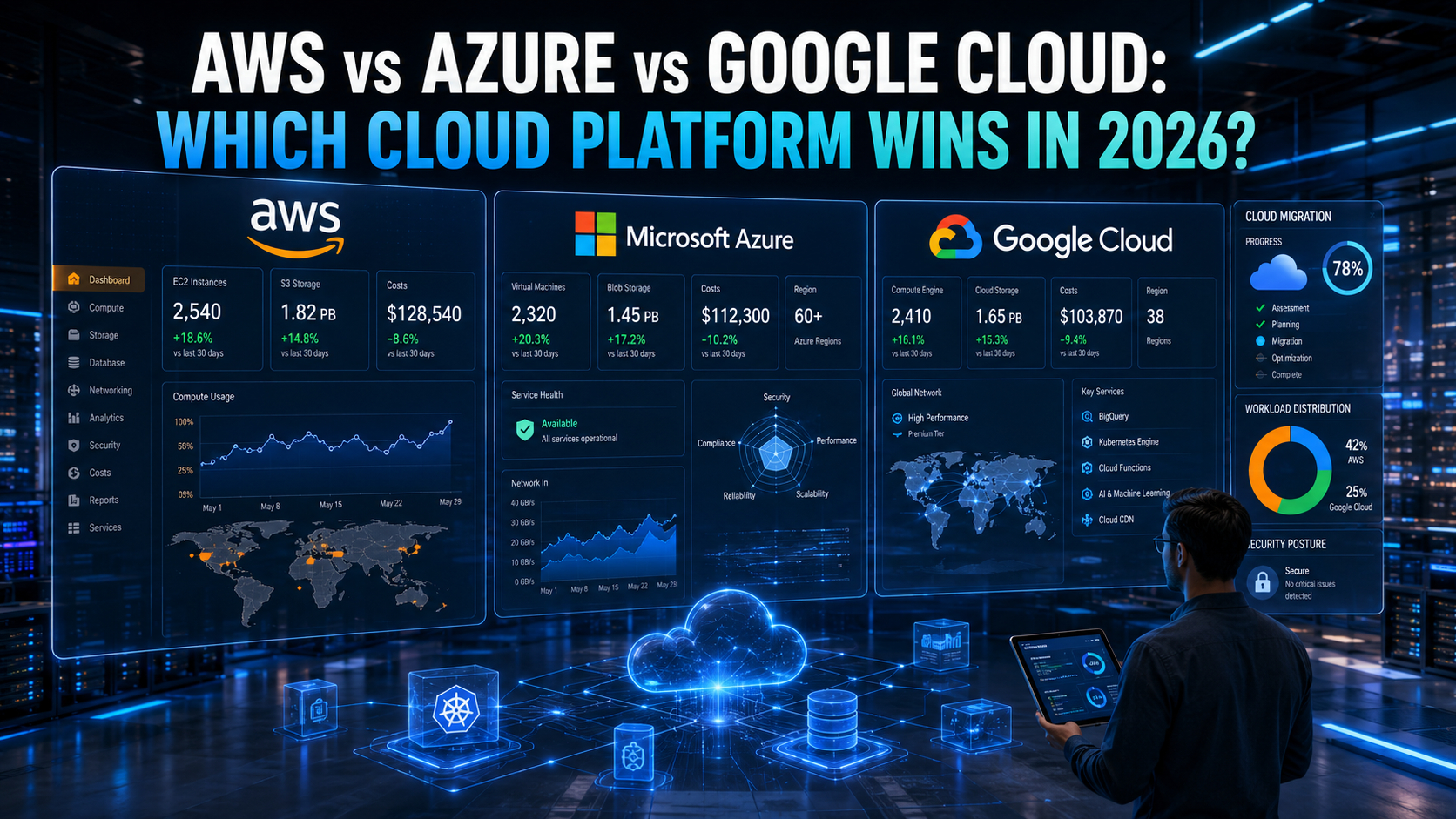
Three companies control roughly 65% of the global cloud market. AWS, Microsoft Azure, and Google Cloud each run global data center networks, offer hundreds of services, and serve everyone from two-person startups to the Fortune 100.
On the surface, they look similar. They all offer compute, storage, databases, AI, and networking. They all charge by the hour or per request. They all promise enterprise-grade reliability.
The differences matter more than most people realize. Picking the wrong platform can cost your team months of rework, tens of thousands in unexpected bills, and a painful migration later. Picking the right one accelerates your product roadmap and gives you a real competitive edge.
This guide breaks down AWS vs Azure vs Google Cloud across pricing, services, strengths, and real-world use cases. By the end, you will know exactly which cloud platform suits your business.
Quick Overview: The Big Three in 2026
Before we compare features, here is the landscape in plain terms.
| Provider | Global Market Share (2026) | Known For | Best Fit |
|---|---|---|---|
| AWS | ~32% | Broadest service catalog, deepest ecosystem | Startups, large enterprises, mature DevOps teams |
| Microsoft Azure | ~23% | Tight integration with Microsoft 365 and Windows | Enterprises using Microsoft stack, regulated industries |
| Google Cloud | ~11% | Leading AI/ML tools, Kubernetes, data analytics | Data-heavy startups, AI-first companies, modern workloads |
Other providers (Alibaba Cloud, Oracle Cloud, IBM Cloud) serve specific regions or specialized workloads, but most businesses evaluating a cloud platform in 2026 are choosing among these three.
AWS: The Veteran With the Deepest Toolbox
Amazon Web Services launched in 2006 and remains the largest cloud provider by revenue and customer count. It offers over 240 services across compute, storage, databases, AI, IoT, blockchain, quantum computing, and satellite data.
AWS Strengths
- Largest service catalog. If a cloud capability exists, AWS probably has it. This breadth matters for teams building complex products.
- Most mature ecosystem. The largest community of certified engineers, third-party tools, and training resources. Hiring AWS talent is easier than hiring Azure or GCP talent in most markets.
- Best global reach. Over 100 availability zones across 34 regions. AWS has data centers in places the others do not reach yet.
- Strong startup support. AWS Activate offers $1,000 to $100,000 in credits for early-stage companies through accelerators and incubators.
AWS Weaknesses
- Complex pricing. AWS has the most nuanced cost structure of the three, with hundreds of pricing dimensions. Cost surprises are common for teams without dedicated FinOps discipline.
- Steep learning curve. The sheer breadth of services can overwhelm small teams. Many features require deep configuration to work well.
- Enterprise support costs extra. Real human support requires paid support plans that can add 3% to 10% to your monthly bill.
When AWS Wins
AWS is usually the right pick for startups that expect to scale quickly, engineering-heavy companies with strong DevOps culture, and large enterprises that value service breadth over integration simplicity. Netflix, Airbnb, Lyft, and Stripe all run on AWS.
Microsoft Azure: The Enterprise Standard
Microsoft Azure has grown rapidly since 2010 and now runs more Fortune 500 workloads than any other cloud provider. Its key advantage is integration with the Microsoft ecosystem that most large enterprises already depend on.
Azure Strengths
- Tight Microsoft integration. Active Directory, Microsoft 365, Windows Server, SQL Server, and Dynamics all plug into Azure natively. For Microsoft shops, this reduces complexity dramatically.
- Strong hybrid cloud story. Azure Arc lets you manage on-premises servers and multi-cloud resources from a single control plane. Azure Stack brings Azure services into your own data center.
- Enterprise compliance leadership. More compliance certifications than any other cloud (90+ offerings), which matters for government, healthcare, and finance.
- OpenAI partnership advantages. Azure OpenAI Service offers production-grade access to GPT models with enterprise SLAs and data residency guarantees.
Azure Weaknesses
- Reliability reputation. Azure has had several high-profile outages over the past few years. While reliability has improved, enterprises with strict uptime requirements still scrutinize it.
- Documentation inconsistency. Azure documentation can vary in quality across services. Engineers often report searching harder to find working examples compared to AWS.
- Developer experience lags AWS and GCP. Azure CLI and portal improvements have closed the gap, but many developers still prefer the tooling on the other two platforms.
When Azure Wins
Azure is typically the best choice for large enterprises already standardized on Microsoft products, regulated industries with strict compliance needs, and organizations with significant on-premises infrastructure they want to modernize gradually. Walmart, Samsung, and BMW are major Azure customers.
Google Cloud: The AI and Data Powerhouse
Google Cloud Platform (GCP) is the smallest of the three but growing fastest, particularly among data-heavy and AI-first companies. Its strengths come directly from Google’s internal engineering culture.
Google Cloud Strengths
- Industry-leading AI and ML tools. Vertex AI, AutoML, and native TPU access make GCP the strongest platform for teams training or deploying machine learning models at scale.
- Kubernetes leadership. Google created Kubernetes. GKE (Google Kubernetes Engine) is widely considered the most mature managed Kubernetes service available.
- Best-in-class data analytics. BigQuery is a standout serverless data warehouse with a pay-per-query model that can be dramatically cheaper than AWS Redshift or Azure Synapse for analytics workloads.
- Simpler pricing. GCP’s per-second billing, automatic sustained-use discounts, and committed-use discounts tend to be easier to predict than AWS or Azure pricing.
- Strong networking. Google’s global fiber backbone gives GCP an edge in low-latency cross-region traffic.
Google Cloud Weaknesses
- Smaller service catalog. GCP has fewer niche services than AWS. Teams building uncommon workloads may hit gaps.
- Smaller talent pool. Fewer certified GCP engineers in most markets, which can slow hiring.
- Enterprise support still maturing. GCP has invested heavily here, but enterprise relationships often feel less established than AWS or Azure.
When Google Cloud Wins
GCP is usually the best choice for AI-first startups, data analytics teams, companies running Kubernetes at scale, and organizations that prioritize engineering quality over ecosystem size. Spotify, Snap, PayPal, and Twitter (pre-acquisition) all built on GCP.
Head-to-Head: Cloud Platform Comparison by Category
Here is how the three stack up across the dimensions that matter most for business decisions.
| Category | AWS | Microsoft Azure | Google Cloud |
|---|---|---|---|
| Service breadth | Widest | Very wide | Focused |
| AI and ML | Strong (Bedrock, SageMaker) | Strong (Azure OpenAI) | Leading (Vertex AI, TPUs) |
| Kubernetes | Good (EKS) | Good (AKS) | Best (GKE) |
| Data analytics | Strong (Redshift, Athena) | Strong (Synapse) | Leading (BigQuery) |
| Pricing transparency | Complex | Complex | Simplest |
| Hybrid cloud | Moderate (Outposts) | Best (Azure Arc) | Growing (Anthos) |
| Enterprise compliance | Strong | Broadest | Growing |
| Developer experience | Excellent | Good | Excellent |
| Global regions | 34+ | 60+ | 40+ |
| Startup credits | Up to $100k | Up to $150k | Up to $200k |
Pricing Realities: What Teams Actually Pay
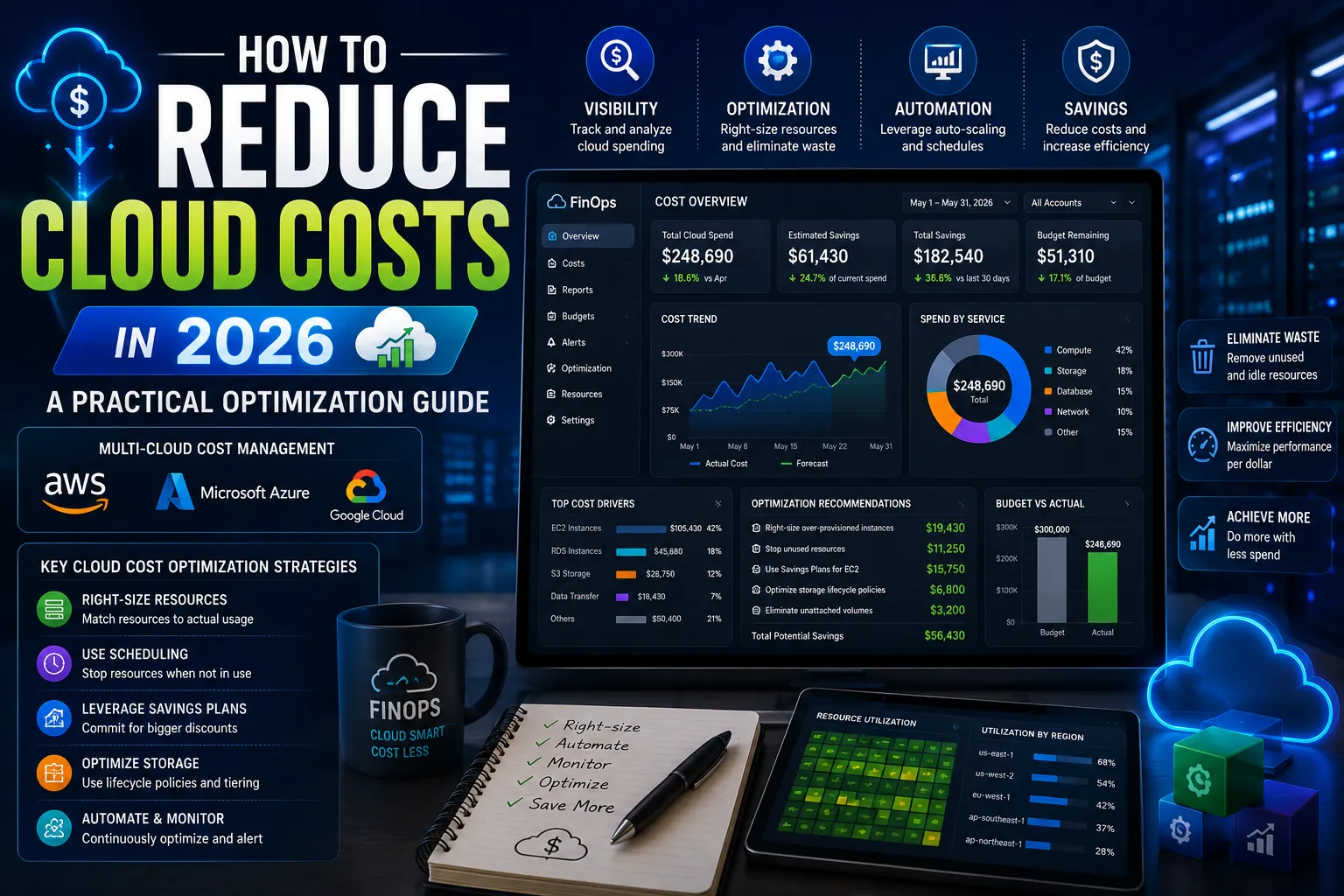
Headline compute prices are nearly identical across all three. The real cost differences show up in adjacent services: data transfer, storage tiers, managed databases, and egress fees.
A practical example: running a medium-sized web application with a managed database, CDN, object storage, and standard compute. Budget expectations for a mid-size production workload fall in the following ranges each month.
| Workload Type | AWS | Azure | Google Cloud |
|---|---|---|---|
| Basic web app + DB (small) | $200 to $500 | $220 to $520 | $180 to $450 |
| Mid-size SaaS production | $2,000 to $8,000 | $2,100 to $8,500 | $1,800 to $7,500 |
| Data analytics pipeline (1TB/month) | $800 to $2,500 | $900 to $2,600 | $500 to $1,800 |
| ML training workload (GPUs) | $3,000 to $15,000 | $2,800 to $14,000 | $2,500 to $12,000 |
These are illustrative. Your actual bill depends on instance types, reserved pricing, traffic patterns, and optimization effort. All three offer 30% to 70% savings through committed-use or reserved pricing compared to on-demand rates.
Multi-Cloud: Do You Need More Than One?
Multi-cloud used to be a rare strategy. In 2026, over 80% of enterprises run on at least two cloud providers, usually for one of three reasons.
- Vendor risk reduction. Running critical workloads on two providers reduces dependency on any single vendor’s pricing changes or outages.
- Best-of-breed services. Using BigQuery on GCP for analytics while running production apps on AWS lets you pick the strongest tool for each job.
- Compliance and data residency. Certain industries or regions require specific providers for certain workloads.
The trade-off is complexity. Running on two clouds roughly doubles the operational load unless you use abstraction tools like Terraform, Kubernetes, and platform-agnostic service meshes. Most small and mid-size teams get more value from going deep on one provider first.
How to Choose: A Simple Decision Framework
Instead of endless comparison, use this decision framework to pick a primary cloud in under 10 minutes.
- Pick AWS if: You are building a product-focused startup or scale-up, have strong DevOps talent, need the widest service catalog, or value the largest ecosystem and community support.
- Pick Azure if: Your organization runs on Microsoft 365, Active Directory, Windows Server, or SQL Server. You need extensive compliance certifications. You want the strongest hybrid cloud and on-premises integration story.
- Pick Google Cloud if: Your product depends heavily on AI, ML, or large-scale data analytics. You run Kubernetes as your core orchestration layer. You prefer simpler pricing and leading-edge engineering quality over ecosystem breadth.
5 Common Mistakes When Choosing a Cloud Platform
- Choosing based on current services alone. Your product will evolve. A platform that supports today’s requirements may struggle with next year’s AI workloads or compliance needs. Build in three years of runway when evaluating.
- Ignoring the hidden costs. Data egress, cross-region traffic, premium support, and managed service markups add 20% to 40% on top of headline compute costs. Model a full year of realistic usage before committing.
- Optimizing for short-term startup credits. Cloud providers offer generous credits to win you early. Those credits expire. Choose based on what the platform will cost when you are paying full price, not the first 12 months.
- Underestimating operational complexity. All three platforms require ongoing investment in monitoring, security, and cost management. Do not assume managed services eliminate the need for a competent platform team.
- Overvaluing brand preference. Engineers often pick cloud platforms based on personal familiarity. Business decisions should factor in hiring availability, service fit, and total cost of ownership, not just what the CTO used at their last job.
Expert Tips for Evaluating Cloud Providers
- Run a real proof of concept. Spend two weeks building a representative workload on each shortlisted platform. Nothing replaces hands-on comparison for revealing hidden friction.
- Talk to companies your size. Enterprise case studies are not useful if you are a 20-person startup. Find similar-stage companies using the platforms you are considering and ask what broke during year one.
- Check the hiring market locally. In Austin and Seattle, AWS talent is plentiful. In certain European cities, Azure dominates hiring pools. In Bangalore, all three are strong. Local talent density matters more than most founders expect.
- Use platform-agnostic tools where possible. Infrastructure as code (Terraform, Pulumi), container orchestration (Kubernetes), and CI/CD pipelines that treat the cloud as a substrate make future migrations less painful.
- Negotiate your enterprise agreement. Anyone committing over $200,000 per year in cloud spend should negotiate. All three providers offer significant discounts, flexible commit structures, and professional services included for committed customers.
Frequently Asked Questions
Which cloud platform is best for startups in 2026?
For most startups, AWS remains the safest default choice due to its broad service catalog, strong community, and generous Activate credits. AI-first startups often benefit more from Google Cloud’s Vertex AI and TPU access. Startups already deeply embedded in the Microsoft ecosystem should consider Azure. The right answer depends on your team’s skills and your product’s technical needs more than on any universal winner.
Is Google Cloud cheaper than AWS and Azure?
Google Cloud is typically 10% to 20% cheaper than AWS and Azure for comparable workloads, particularly for data analytics and Kubernetes-based applications. The pricing simplicity and automatic discounts also reduce the effort required to achieve those savings. However, total cost depends heavily on your specific services, optimization effort, and reserved pricing commitments. For some workloads, AWS or Azure come out cheaper once fully committed.
Can I switch cloud providers later if I pick wrong?
Yes, but it is expensive and time-consuming. A full cloud migration for a mid-size business typically takes 6 to 18 months and costs between $100,000 and $2 million, depending on complexity. Using platform-agnostic tools (Kubernetes, Terraform, open-source databases) from day one makes migration easier but not free. Choose carefully upfront and plan to stay on your primary provider for at least 5 years.
Which cloud is best for AI and machine learning?
Google Cloud has the strongest AI and ML platform overall, with Vertex AI, native TPU access, and tight integration with Google’s research-grade ML infrastructure. AWS SageMaker and Bedrock are highly capable, with particularly strong access to foundation models from Anthropic, Meta, and Mistral. Azure OpenAI Service is the best choice for teams specifically building on GPT models with enterprise compliance requirements. All three are viable. The differences come down to specific tool preferences and the foundation models you want to use.
Do most companies use just one cloud or multiple?
Over 80% of enterprises now use at least two cloud providers, but the primary workloads typically concentrate on one. Most successful multi-cloud strategies designate a primary provider for the core product and use a secondary provider for specific services (often BigQuery on GCP for analytics, or Azure OpenAI for GPT access). True multi-cloud for the same workload is rare because of the operational overhead it creates.
Making the Right Call for Your Business
There is no universally “best” cloud platform. AWS, Azure, and Google Cloud each dominate in different scenarios, and the right choice depends on your team, your product, and your constraints.
The costly mistake is choosing based on trends, hype, or what a well-known competitor uses. The safe path is to match the platform to your actual requirements, test with a real proof of concept, and invest in platform-agnostic tooling that gives you optionality later.
For the complete foundation on cloud infrastructure, IaaS vs PaaS vs SaaS, and migration strategy, read our pillar guide: Cloud Computing in 2026: The Complete Guide to Modern Infrastructure. Explore more cloud and DevOps content on PostoryCafe.com for deeper, practical guides on building modern cloud architecture.