
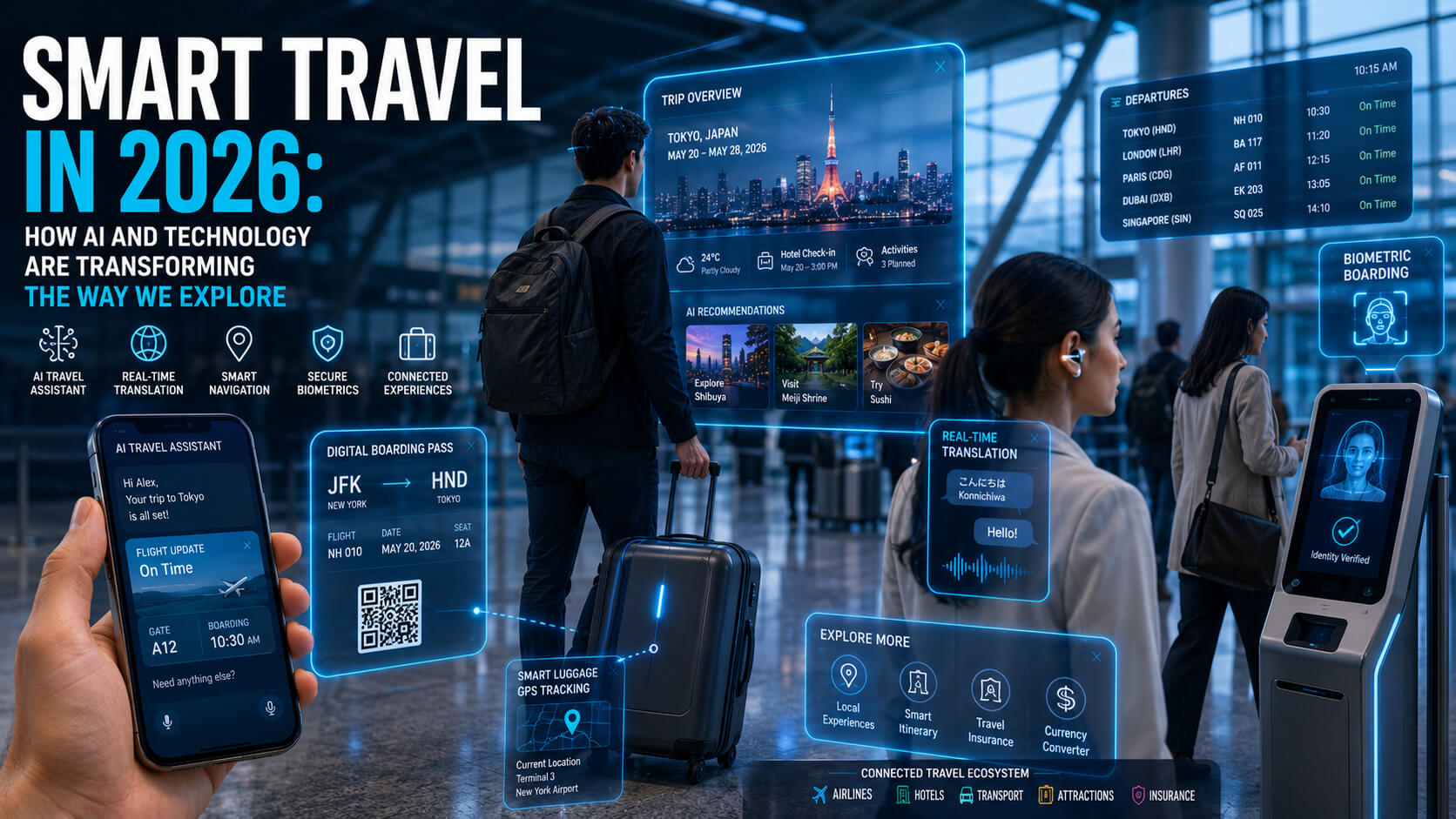
Travel used to mean a passport, a printed boarding pass, a guidebook, and a lot of luck. In 2026, it means a phone that unlocks hotel rooms, a smart suitcase that texts you when it lands in a different city, an AI assistant that rebooks your canceled flight before you hear the announcement, and a pair of earbuds that translate a menu in real time.
Travel technology has changed every part of the journey. Trip planning, navigation, safety, language, payments, and even luggage tracking all look different than they did even two years ago.
This guide covers the best travel apps and smart travel gadgets to carry in 2026. You will find recommendations for every stage of a trip, honest notes on what is worth the money, and tips for building a lightweight tech kit that works abroad.
What Is Smart Travel?
Smart travel is the use of connected devices, apps, and AI tools to make trips smoother, safer, and more personalized. It covers digital boarding and check-in, AI-powered itinerary planning, real-time translation, offline navigation, biometric airport access, and luggage tracking.
A decade ago, smart travel meant downloading Google Maps before a trip. In 2026, the average traveler uses 10 to 15 apps, at least one dedicated gadget, and increasingly an AI assistant that ties everything together.
None of this is required to travel well. But the right tools save time, money, and stress in ways travelers quickly appreciate once they experience them.
The Best Travel Apps of 2026 (By Trip Stage)
Not every travel app is essential. This section breaks down the handful that actually earn their space on your phone, organized by when you use them.
Trip Planning and Booking
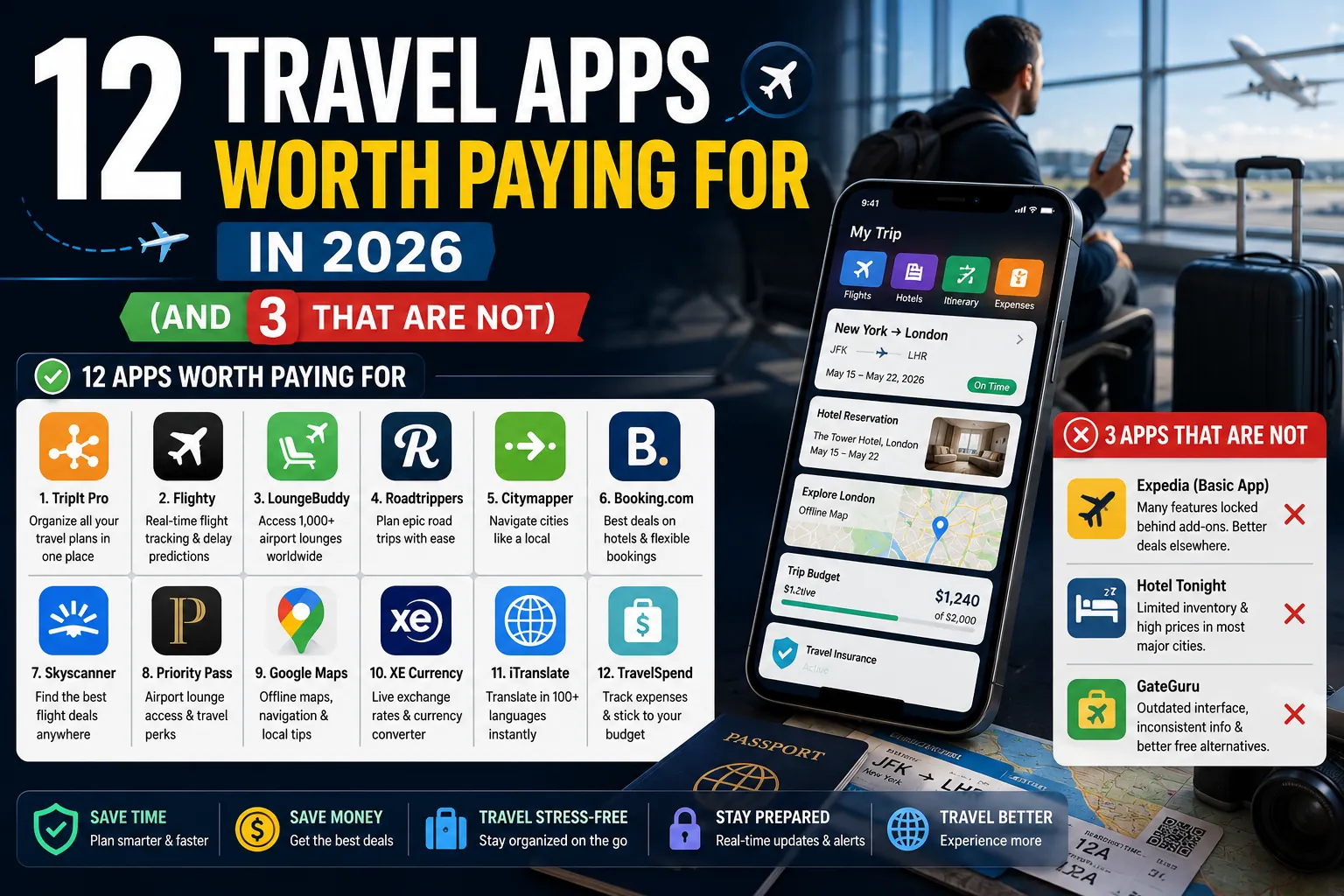
- Google Flights / Kayak: Still the two most reliable flight search engines. Google Flights excels at flexible-date searches and price tracking. Kayak covers more small airlines and obscure routes.
- Hopper: Good for predictive pricing (it tells you whether to book now or wait) and for bundled hotel deals on mobile.
- Airalo / Holafly: eSIM marketplaces that give you international data in minutes without swapping physical SIM cards. Airalo is cheapest for most regions. Holafly is better for unlimited data.
- Booking.com / Agoda / Hotels.com: Each dominates in different regions. Booking.com is strongest in Europe. Agoda usually wins in Asia. Hotels.com is competitive in the Americas.
- Wanderlog / TripIt: Wanderlog is the modern choice for collaborative itinerary building with maps and notes. TripIt remains the best for automatically organizing every confirmation email into one clean itinerary.
AI-Powered Trip Assistants
- ChatGPT / Claude / Gemini: General AI assistants are surprisingly useful for travel. “Plan a 5-day itinerary for Lisbon focused on food and history” produces a strong starting draft in seconds. Always verify hours and prices independently.
- Mindtrip: A dedicated AI travel planner that builds custom itineraries with real bookable links and maps. Stronger than general chatbots for structured planning.
- Roam Around: Popular for fast, shareable itineraries. Good for first drafts that you refine manually.
Navigation and Local Discovery
- Google Maps: Still the default for most of the world. Download offline maps before you leave any area with unreliable service.
- Apple Maps: Has improved dramatically. Particularly strong in major cities for detailed transit, cycling, and walking directions.
- Citymapper: The best public transit app for large global cities (London, New York, Paris, Tokyo, Singapore).
- Maps.me: Free, works fully offline, and covers regions where Google Maps is weak. A must-have backup for remote areas.
Translation and Communication
- Google Translate: Supports real-time voice translation, camera-based menu translation, and offline packs for major languages. Still the most comprehensive free option.
- DeepL: Produces more natural translations than Google Translate for European languages. Many travelers use both.
- Microsoft Translator: Strong for group conversations where multiple people speak different languages.
Safety, Health, and Money
- Smart Traveler (US State Department): Registers your trip with the nearest embassy and delivers alerts for your destination.
- SafetyWing / World Nomads: Travel insurance apps with quick claims and digital policy documents.
- Wise (formerly TransferWise): Multi-currency account and debit card that saves 3% to 6% on every international purchase compared to typical bank cards.
- Revolut: Similar to Wise but with more investing and crypto features built in.
- XE Currency: Fast, clean conversion tool that works offline once initialized.
Smart Travel Gadgets Worth Carrying in 2026
The right gadgets remove pain points that no app can solve. These are the travel accessories most frequent travelers now consider non-negotiable.
| Gadget | Why It Matters | Price Range |
|---|---|---|
| AirTag / Samsung SmartTag 2 | Track checked bags, backpacks, and lost items via global networks | $25 to $35 per tag |
| Anker 20,000 mAh GaN power bank with AC output | Charge laptop, phone, and camera from the same small brick | $80 to $130 |
| Universal travel adapter with USB-C PD | One adapter for every country; fast charging up to 65W | $35 to $60 |
| Noise-cancelling earbuds (Sony WF-1000XM5, Apple AirPods Pro 2) | Survive long flights, better in-ear translation apps | $200 to $300 |
| Timekettle X1 AI Interpreter or WT2 Edge earbuds | Dedicated two-way translation earbuds for long trips abroad | $300 to $450 |
| Osprey Farpoint / Fairview 40L travel backpack | Airline carry-on size, lasts a decade, no checked bag fees | $180 to $220 |
| Away / July smart carry-on (with compression and USB) | Built-in charging, compression packing, durable shell | $250 to $400 |
| Kindle Paperwhite | Entire library in one small device, weeks of battery | $140 to $200 |
| GoPro HERO13 or DJI Pocket 3 | Compact video creation for travel content or family memories | $400 to $550 |
A practical note: travel is about subtraction, not addition. Most frequent flyers carry a phone, noise-cancelling earbuds, one power bank, one adapter, and a Kindle. The rest depends on the trip type.
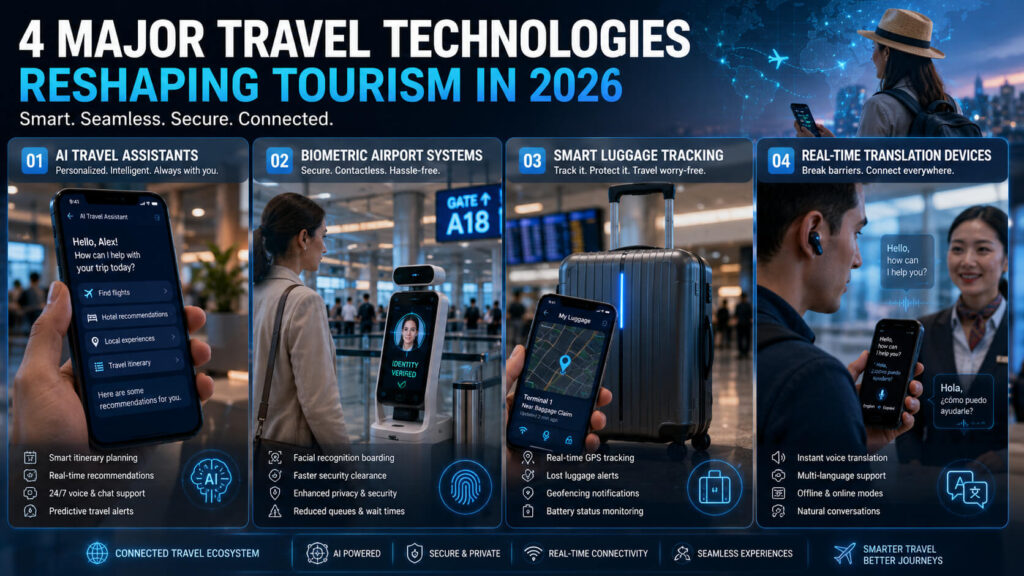
4 Travel Technology Trends Changing How We Move in 2026
1. Biometric Airports and Digital Travel Credentials
Major airports in Singapore, Dubai, Doha, Atlanta, and Los Angeles now offer biometric boarding that lets travelers skip paper passes entirely. The US Digital ID program and the ICAO Digital Travel Credential framework are standardizing these protocols globally.
What this means for travelers: fewer paper documents, faster processing, and in many cases, near-instant immigration for pre-registered travelers. Privacy concerns are real, but the convenience has accelerated adoption far beyond what airports predicted.
2. AI Concierges in Hotels and Airlines
Major hotel groups (Marriott, Hilton, Accor) now deploy AI concierges inside their apps. Ask a question in plain language (“What is the best nearby coffee shop open at 6am?”) and get instant, curated answers. Airlines are adding similar features for rebookings, seat changes, and travel questions.
The best implementations blend AI with human escalation. The worst feel like glorified FAQ pages. Quality varies, but the direction is clear.
3. Real-Time Flight Disruption Management
Apps like App in the Air, Flighty, and airline-native tools now predict delays before the airline officially announces them. Some automatically rebook you into backup flights or notify your hotel of a late arrival.
This has turned one of the most stressful parts of travel (delays and cancellations) into a more manageable experience for tech-savvy travelers. Paying for Flighty Pro is among the highest-ROI app purchases frequent flyers can make.
4. Sustainable and Slow Travel Tools
New apps help travelers choose lower-carbon flights, find train alternatives to short-haul flights, and track the environmental footprint of their trips. Google Flights now shows carbon emissions per option. Apps like Rome2Rio surface rail and bus routes that are often faster or nicer than flying.
Slow travel (fewer destinations, longer stays, less flying) has become a clear trend among millennials and Gen Z travelers, driven in part by these tools.
Essential vs Nice-to-Have: Building Your Travel Tech Kit
If you are overwhelmed by options, here is a clean separation of what every traveler should have versus what is situational.
| Essential for Every Trip | Nice to Have (Trip-Dependent) |
|---|---|
| Smartphone with offline maps downloaded | Smart luggage with built-in tracking |
| Translation app (Google Translate or DeepL) | Translation earbuds (for long trips in non-English countries) |
| Universal travel adapter with USB-C PD | GoPro or pocket camera |
| Noise-cancelling headphones or earbuds | e-Reader (Kindle or Kobo) |
| Multi-currency card (Wise or Revolut) | Portable monitor (for digital nomads) |
| Portable power bank (10,000 mAh minimum) | Portable coffee maker or specialty kitchen tools |
| AirTag on each checked bag | Travel router or Wi-Fi hotspot |
| Digital backup of passport and insurance | Compression packing cubes |
Smart Travel Safety: What Most Travelers Forget
Technology helps with logistics, but safety is where most travelers under-prepare. A few basics make a real difference.
- Share your location with a trusted contact. Apple Find My, Google Maps location sharing, and WhatsApp’s live location feature all let someone back home know roughly where you are.
- Register with your embassy. Free, takes five minutes, and gets you actionable alerts during emergencies. In the US, this is the STEP program.
- Keep digital copies of every document. Passport, driver’s license, insurance policy, and a credit card contact list should live in a secure cloud folder you can access from anywhere.
- Buy real travel insurance. Not the airline add-on. A dedicated policy from SafetyWing, World Nomads, or a similar provider covers medical, evacuation, and trip interruption. Medical evacuation alone can cost over $50,000 out of pocket.
- Set up an emergency SOS on your smartwatch. If something serious happens, help is one button press away.
- Lock down your devices. Use a strong passcode (not a four-digit one), enable biometric unlock, and turn on Find My device features. A lost phone abroad is a nightmare without these basics.
6 Common Travel Tech Mistakes to Avoid
- Relying on your bank’s standard debit card. Most traditional debit cards charge 2% to 5% on every foreign purchase and poor ATM exchange rates. A Wise, Revolut, or Charles Schwab card will save real money on any trip longer than a few days.
- Not downloading offline maps. The moment you lose service, a paper-free traveler is stuck. Download the entire area you will visit before you leave home.
- Buying cheap power adapters. Sub-$10 adapters often fail, damage devices, or trip out under load. A quality GaN adapter with surge protection costs more but protects $2,000 of devices.
- Ignoring eSIM options in favor of airport roaming. Airport SIM cards and hotel Wi-Fi packages are usually two to five times more expensive than an eSIM you buy in 60 seconds from Airalo.
- Overpacking gadgets. Most travelers carry two or three accessories they never use. Pack for the trip you are actually taking, not the one you imagine.
- Trusting public Wi-Fi without a VPN. Coffee shops, airport lounges, and hotels are all fair game for basic attacks. A reputable VPN (Mullvad, Proton, NordVPN) keeps your data safe while you browse.
Expert Tips From Frequent Travelers
- Book direct when the price is similar. Third-party booking platforms are great for finding deals. But when the price is within 5% of the airline or hotel direct, book direct. Changes, upgrades, and rebookings are far easier when you are the airline’s customer.
- Screenshot everything. Confirmation numbers, booking receipts, insurance details, and key maps. Cell service can fail. A screenshot never does.
- Use airline apps, not just aggregators. Real-time gate changes, delay notifications, and rebooking options often appear in the airline app minutes before official channels update.
- Learn three phrases in the local language. “Hello,” “thank you,” and “do you speak English?” open doors no translation app can. Locals almost universally respond better to a clumsy attempt at their language than to a confident assumption that everyone speaks yours.
- Keep a “last resort” backup credit card separately from your main wallet. If your main wallet gets stolen, this backup keeps the trip going until you can sort things out.
- Review your tech kit after every major trip. Note what you actually used and what stayed in your bag. Travel kits evolve with how you travel.
Frequently Asked Questions
What are the best travel apps to download in 2026?
The essentials for most travelers are Google Maps (with offline maps downloaded), Google Translate or DeepL, your airline app, Wise or Revolut for international money, Airalo for eSIM data, TripIt or Wanderlog for itinerary management, and an AI travel assistant like Mindtrip or ChatGPT for planning. Add safety tools like Smart Traveler (STEP) and your insurance provider’s app. This base stack covers 80% of use cases for a typical international trip.
Are smart travel gadgets worth the investment?
For frequent travelers, yes. Noise-cancelling earbuds, a quality universal adapter, a GaN power bank, and at least one AirTag pay for themselves quickly through saved time, reduced stress, and prevented losses. For occasional travelers, invest selectively. A $25 AirTag on a checked bag prevents one lost luggage disaster. A $300 pair of translation earbuds is only worth it for extended trips where language is a real barrier.
How has technology changed travel over the past few years?
Three shifts stand out. First, AI-powered planning has replaced most of what guidebooks used to do. Second, biometric and contactless airport technology has cut wait times and reduced paperwork. Third, real-time money tools (Wise, Revolut, eSIMs) have lowered the hidden costs of international travel significantly. The overall effect is that experienced travelers can now handle complex trips with less friction than ever, while first-time travelers have more help available than any previous generation.
What is the best way to stay connected internationally?
For most travelers, an eSIM from Airalo, Holafly, or Nomad is the best balance of price and simplicity. You buy and activate it on your phone before landing, keep your main phone number active, and get local data at a fraction of roaming costs. For heavy data users or long stays, a local physical SIM still tends to be cheapest. For business travelers, some employers still prefer global roaming through carrier plans. Avoid airport SIM kiosks, which are almost always overpriced.
Can AI planning really replace a human travel agent?
For most leisure trips, yes. AI tools like Mindtrip, ChatGPT, and Claude generate solid itineraries, hotel shortlists, and restaurant recommendations in minutes. For complex multi-city business trips, luxury bookings with specific preferences, or high-stakes travel (honeymoons, anniversaries, large group trips), a human travel advisor still adds value through relationships, upgrades, and problem-solving when things go wrong. The best travelers use AI for drafts and specialists for execution.
Smart Travel, Better Memories
Technology cannot make a trip meaningful. That part is still up to you, the places you choose, and the people you share them with. But the right apps and gadgets can remove the friction that used to steal hours from every journey.
Build a light, reliable tech kit. Learn the few apps that matter. Invest in two or three gadgets that save you real time. Then put the phone down and let the trip happen.
For more travel guides, gear reviews, and digital nomad resources, explore the rest of PostoryCafe.com. We publish new content every week for travelers who want to move smarter, not just farther.