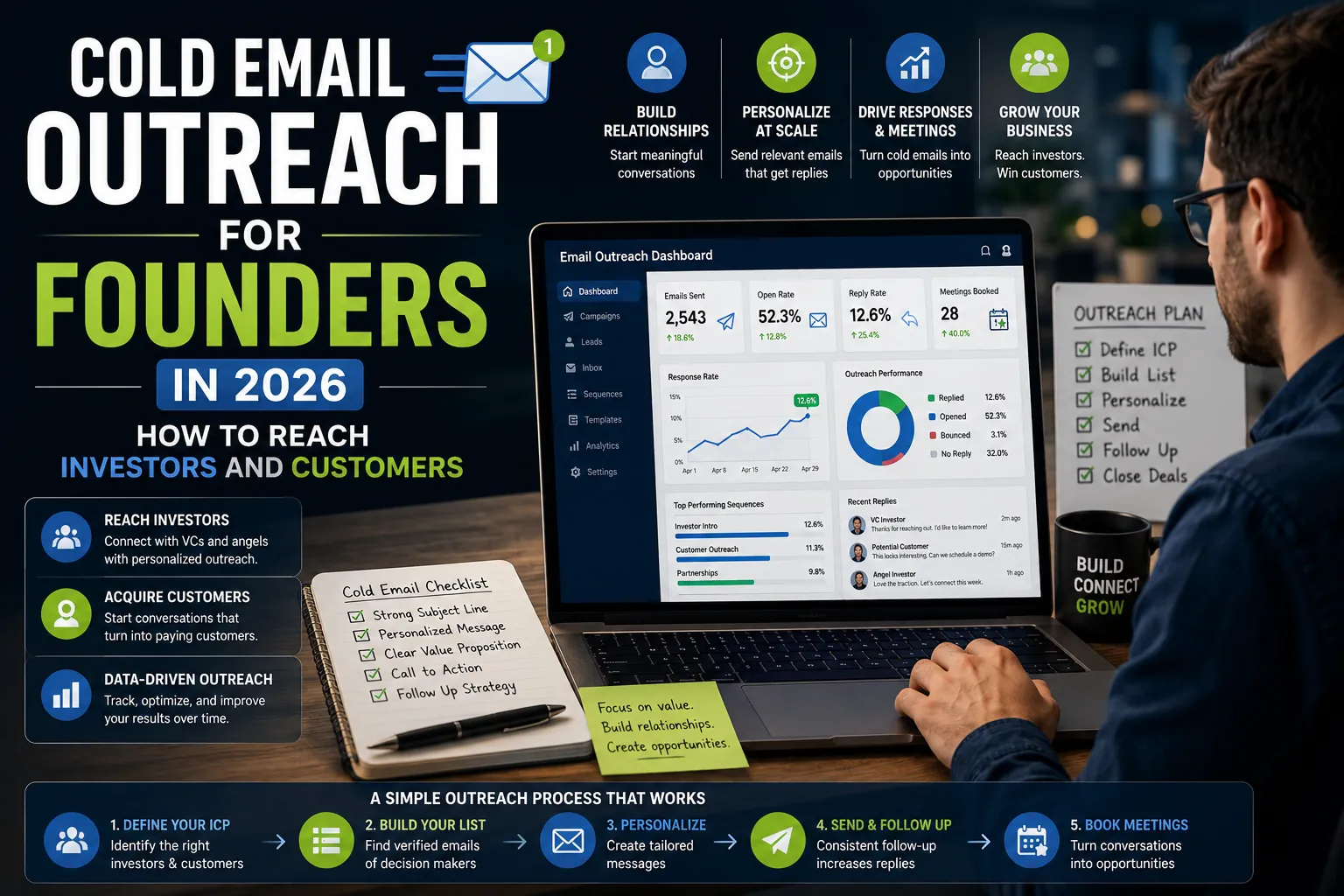
Cold email is dead, except that it is not. Done badly, it gets ignored or reported as spam. Done well, it remains one of the most reliable ways founders break into investor networks, generate first customers, and book sales calls without paying for ads.
The difference between cold email that works and cold email that does not has narrowed in 2026. Spam filters are smarter. Recipients are more selective. AI has flooded inboxes with templated outreach. The bar is higher, but the upside for founders who get it right is also higher because most competitors get it wrong.
This guide covers the cold email playbook for early-stage founders in 2026: how to write emails investors and prospects actually open, the tools that scale outreach without destroying your sender reputation, and the patterns that consistently produce replies.
When Cold Email Works (and When It Does Not)
Cold email works in three specific situations. First, breaking into investor networks where warm intros are not available. Second, reaching prospective enterprise customers whose decision-makers do not respond to inbound marketing. Third, finding strategic partners, advisors, or specific hires.
Cold email does not work for high-volume B2C product marketing, generic networking, or audiences your peers reach better through warm introductions. If a warm intro is available and reasonable to pursue, always start there.
The Anatomy of a High-Performing Cold Email
Strong cold emails share five elements. Each one matters. Skip any of them and reply rates drop sharply.
1. The Subject Line
You have one line and roughly 50 characters of preview text. The subject must be specific enough to feel personal, short enough to read at a glance, and curious enough to open. Generic subjects (“Quick question,” “Partnership opportunity”) underperform consistently. Specific subjects (“Question about your post on Series A pricing”) perform 3 to 5 times better.
Strong patterns: a specific reference to something the recipient said or wrote, a clear statement of a single question, or a named connection (“Sarah suggested I reach out about X”). Avoid clickbait or fake urgency.
2. The Personalization Line
The first sentence proves you know who they are. Reference something specific they wrote, a podcast they appeared on, a portfolio company they invested in, or a public statement they made. The personalization must be authentic. Generic flattery (“I have been following your work”) is worse than no personalization at all.
3. The Reason for Emailing
One sentence that names exactly why you are reaching out and why they specifically should care. Not your full pitch. The reason this email is for this person.
Example: “We are building expense management software for SMB restaurants. We just crossed $50K MRR with 60% gross margins, and given your investments in Toast and Gusto, I thought our approach might be relevant for your fund.”
4. The Specific Ask
A clear, low-friction next step. Asking for “your thoughts” is too vague. Asking for a “quick chat sometime” is too open. Strong asks: “Are you open to a 20-minute call next week?” or “Would you mind if I sent the deck to learn whether this is the kind of company you would invest in?”
5. The Signature
A simple signature with your name, role, company, and one credibility marker if relevant. Avoid long signatures with logos, certifications, and 5 social links. Clean is better.
Two Cold Email Examples That Work
Example 1: Cold Email to a Seed VC
Subject: Question about your investment thesis on vertical SaaS
Hi Maya,
Your post on why vertical SaaS is more defensible than horizontal SaaS made me reconsider our positioning. We are building expense management for SMB restaurants and just crossed $50K MRR with 60% gross margins after 8 months.
Given your investments in Toast and Sweetgreen, I thought your perspective on what comes next would be valuable. Would you be open to a 20-minute call next week to share what we are seeing in the market?
Thanks,
Alex Chen
Founder, RestaurantOS
Example 2: Cold Email to a Prospective Enterprise Customer
Subject: Question about your team’s expense management workflow
Hi Marcus,
I read your interview last month on building finance operations at Lola.com. The part about reconciling expense reports across 14 entities struck me because that is the exact problem we set out to solve.
We just shipped automated multi-entity reconciliation for finance teams managing 5+ entities. Three customers in your size range cut their close time by 40% in the first 60 days.
Would a 15-minute call next week be useful to see whether the approach fits your stack? Happy to send a 2-minute Loom first if you prefer.
Thanks,
Alex Chen
Founder, FinanceOps
Cold Email Tools for Founders in 2026
| Tool | Best For | Cost | Standout Feature |
|---|---|---|---|
| Gmail / Outlook (manual) | 1 to 20 emails per week | Free | No deliverability risk if used carefully |
| Mailmeteor | Mail merge from Gmail | Free to $30/month | Simple personalization at small scale |
| Lemlist | Founder-led outreach campaigns | $59 to $99/month | Personalization with images and video |
| Smartlead.ai | Higher-volume cold outreach | $39 to $94/month | Inbox rotation, deliverability optimization |
| Apollo.io | Lead database + email sending | $59 to $149/month | B2B contact data combined with outreach |
| Instantly.ai | Scaled cold outreach | $37 to $97/month | Sender reputation warming, email validation |
For founders sending under 30 emails per week, Gmail with manual sending is more than sufficient and avoids deliverability issues entirely. For higher-volume outreach (sales prospecting, investor mass campaigns), Smartlead, Lemlist, or Instantly handle email warming and reputation properly.
Following Up Without Being Annoying
Most replies come from follow-ups, not the first email. A reasonable cadence: original email, follow-up after 4 to 5 business days, second follow-up after 2 weeks, final follow-up after another 3 to 4 weeks. Stop after that.
Each follow-up should add value, not just nag. A new piece of news, a relevant case study, an updated metric, or a new question that makes the original email easier to respond to. Empty “just bumping this” follow-ups feel desperate and generally underperform.
Common Cold Email Mistakes
- Generic templates with merge fields. “Hi {first_name}, hope you are doing well!” reads as automated immediately. AI has eliminated the personalization wins of basic templating.
- Long emails. Most cold emails should be under 100 words. Cold readers do not have patience for paragraphs.
- Asking for too much in the first email. A 60-minute call is too much to ask before the relationship exists. Start small with a question or a 15-minute conversation.
- Sending to invalid addresses. Bouncing emails destroys sender reputation. Verify addresses with tools like NeverBounce or ZeroBounce before campaigns.
- Following up too aggressively. Three follow-ups maximum after the original email. Beyond that, it becomes harassment.
- Leading with the pitch. Cold emails that open with what you are selling almost never get replies. Lead with relevance to the recipient.
Expert Tips
- Send from a custom domain, not Gmail. Cold email from your-name@yourcompany.com lands in the inbox more often than from a personal Gmail address.
- Warm new sending domains for 2 to 4 weeks. New domains sending cold email immediately get flagged. Use a service like Lemwarm or Smartlead’s warming tool.
- A/B test subject lines. Most reply rate variation comes from subject lines. Test two variants per campaign and double down on the winner.
- Personalization beats volume every time. 30 highly personalized emails will produce more replies than 300 templated ones, almost always.
- Track reply rates, not open rates. Open rates are unreliable in 2026 due to email privacy features. Reply rate is the real metric that matters.
Frequently Asked Questions
How many cold emails should I send per day as a founder?
For solo founders sending personalized outreach, 15 to 30 emails per day from a single inbox is a sustainable maximum. Beyond that, deliverability and quality both decline. For higher volume, use multi-inbox tools (Smartlead, Instantly) that distribute sending across multiple verified inboxes.
What is a good reply rate for cold email in 2026?
Highly personalized cold email to relevant audiences typically achieves 8% to 15% reply rates. Generic templated outreach averages 1% to 3%. Investor outreach with strong personalization can reach 20% to 30% reply rates. Anything below 5% is a sign that targeting, personalization, or message-fit needs work.
Is cold email legal?
In the US, cold email for B2B purposes is legal under CAN-SPAM as long as you include a clear sender address and an unsubscribe option. In the EU, GDPR requires that cold email be limited to legitimate business communication and offer easy opt-out. UK PECR rules are similar. Always include a real physical address and a way to unsubscribe in any cold email campaign.
How do I find investor email addresses?
For investors, common sources include Hunter.io for email pattern discovery, Apollo and ZoomInfo for B2B contact databases, LinkedIn Sales Navigator for verified profiles, and Crunchbase Pro for portfolio company associations. Many partner emails follow predictable patterns (firstname@firmname.com), and tools like Hunter let you guess and verify before sending.
The Skill That Compounds Over a Career
Cold email is a craft. The first 100 emails will be uncomfortable. The first 1,000 will produce a small number of meaningful replies that change your trajectory. Founders who develop the skill early and keep refining it can reach almost anyone over time, which compounds every other thing they want to build.
Send the first email this week. Iterate on what works. Track reply rates. Be specific, be brief, and respect the reader. The right cold email reaches the right person at the right moment, and a single one of those can change a company.
For the complete fundraising playbook including pitch decks, valuation, term sheets, and round closing, read our pillar: How to Raise Seed Funding in 2026. More founder content lives on PostoryCafe.com.