
A great pitch deck is not a corporate document. It is a sales tool that has roughly three minutes to convince a busy investor to keep reading. Most founder decks fail at this because they treat the deck like a business plan instead of a story.
The pitch deck market has matured significantly. Investors review hundreds per month and have developed strong preferences for specific structures, lengths, and information density. The deck framework that worked in 2018 looks bloated and unfocused in 2026.
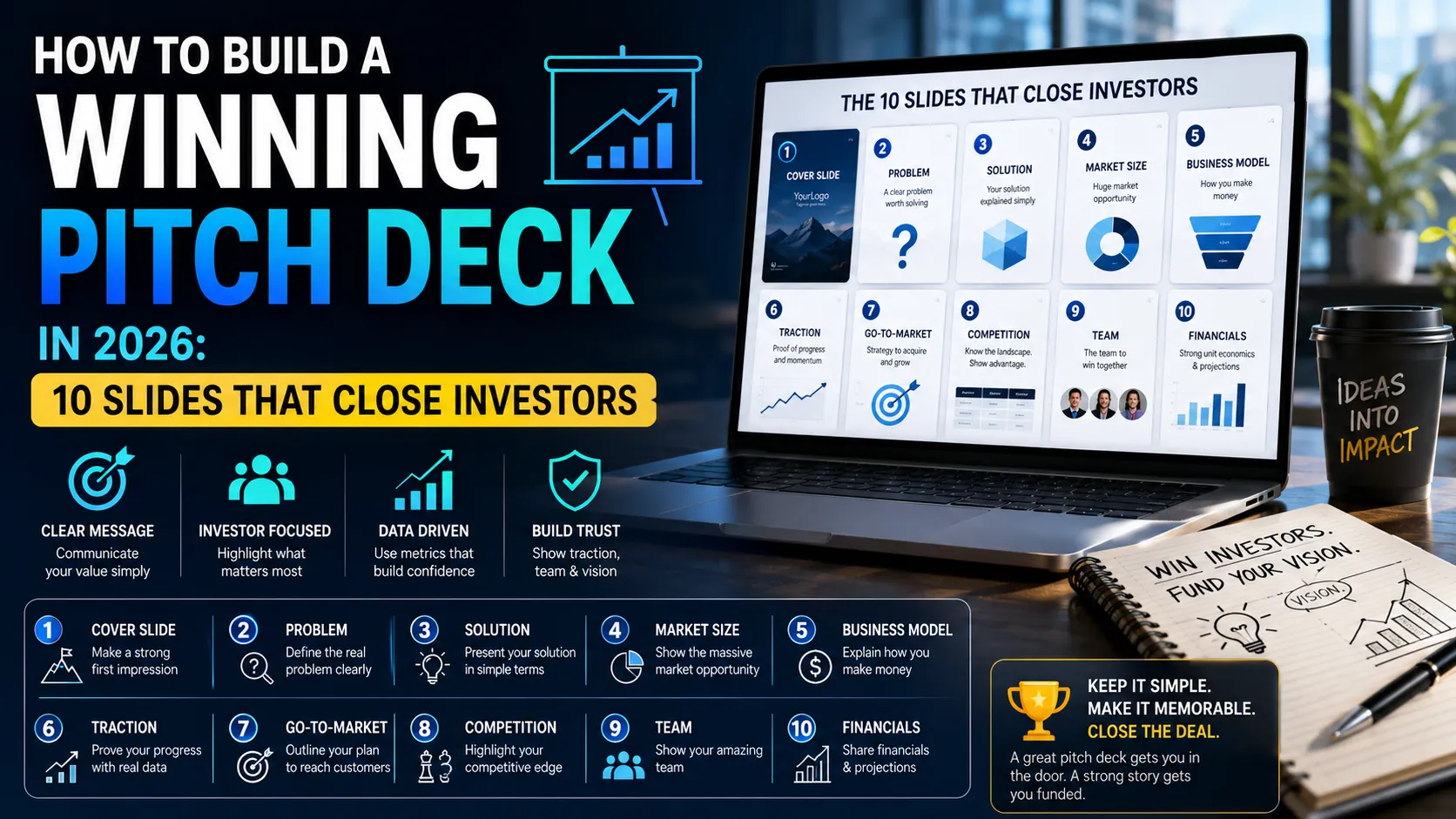
This guide covers the 10-slide pitch deck structure that consistently wins seed and Series A meetings in 2026. Each slide has a specific job. Get all 10 right and your deck does what it should: open the door for a real conversation.
Why Most Pitch Decks Fail
Most decks fail for the same five reasons: too many slides (over 15 is a red flag for most seed VCs), unclear problem statements, weak or invented market sizing, no real traction signal, and an ask that does not match the rest of the deck. Investors notice these patterns immediately.
A great deck does the opposite. It tells a story in 10 to 12 slides. Each slide has a clear job. The problem is described from the customer’s perspective, the market sizing uses defensible bottom-up math, and the ask is grounded in a specific milestone the company will reach.
The 10-Slide Pitch Deck Structure That Works in 2026
| Title | Job to Be Done |
|---|---|
| Title Slide | Company name, one-line description, founder name, contact |
| Problem | Specific pain point with real customer data or quotes |
| Solution | How your product solves that pain, with a clear product demo or screenshot |
| Market Size | TAM, SAM, SOM with bottom-up math the investor can verify |
| Traction | Revenue, users, growth rate, key partnerships, or design partner LOIs |
| Business Model | How you make money, pricing, LTV/CAC if available |
| Competition | Competitive landscape and your specific differentiation |
| Team | Founders and key hires with relevant experience |
| Financials | 18 to 24-month projections with clear assumptions |
| The Ask | Amount raising, valuation, use of funds, and 18-month milestones |
Slide-by-Slide Breakdown
Slide 1: Title Slide
Your title slide is the first signal. Include your company name, a clear one-line description of what you do (not your mission), the founder’s name, and a contact email. Skip the inspirational quote and the stock photography. A clean title slide that explains what the company does in one line passes the busy-investor test.
Strong examples of one-line descriptions: “Stripe for real estate transactions.” “Mercury for restaurants.” “AI co-pilot for radiologists.” Specific, clear, and instantly understood.
Slide 2: Problem
The problem slide should make the investor feel the pain. Lead with a specific customer scenario or a striking statistic. Avoid abstract claims like “the market is broken.” Instead: “Restaurants spend 12 hours per week on labor scheduling. The cost of mistakes (overstaffing or no-shows) is $2,400 per location per month.”
Real customer quotes work well here. A direct quote from a paying user describing the problem in their own words is more persuasive than any internal research summary.
Slide 3: Solution
Show the solution working. Include a product screenshot, a short demo GIF, or a workflow diagram. Avoid feature lists. Investors care about what your product does for the customer, not which features it has. One sentence that captures the change your product creates: “Restaurants set their schedule in 15 minutes. Staff shifts are filled automatically. Labor cost overruns drop 40% in the first 60 days.”
Slide 4: Market Size
Market sizing is where most founder decks lose credibility. Top-down sizing (“the global X market is $400 billion”) signals that the founder did not do real work. Bottom-up math (“there are 750,000 US restaurants. Our average annual revenue per restaurant is $1,200. TAM is $900 million”) shows you understand your business.
Show three layers: TAM (total addressable market), SAM (serviceable addressable market for your specific approach), and SOM (the realistic market you can capture in the next 5 years). Cite credible sources for population data, but build the revenue math yourself.
Slide 5: Traction
For pre-seed and seed pitches, traction is the single most important slide after the team. Show whatever proof of demand you have: revenue, monthly active users, growth rates, paid pilots, design partner letters of intent, organic waitlist size, retention metrics, or revenue per customer.
Honest framing matters. A pre-product company should not fake traction with vanity metrics. If you have 12 paid design partners committed at $50,000 ARR each, say so. That is meaningful traction that investors respect.
Slide 6: Business Model
Explain exactly how you make money. Pricing, contract terms, expansion economics, and customer lifetime value if you have data. For SaaS, include LTV and CAC if you can defend the numbers. For marketplaces, include take rate and net revenue retention.
Avoid vague references to “monetization opportunities.” Investors want to see that you have made specific decisions about pricing and that early customers are paying for the product.
Slide 7: Competition
Never claim “we have no competition.” Investors hear it as “the founder has not done their research.” Show the real competitive landscape and explain what you do differently. A 2×2 matrix or a feature comparison table works well here.
Be honest about where competitors are stronger. Acknowledging a competitor’s real strength while explaining your specific advantage builds far more credibility than dismissing the entire field.
Slide 8: Team
Show the founders and any key team members. For each person, include name, role, relevant experience (one or two roles, not a full LinkedIn), and one specific accomplishment that demonstrates fit for this company.
For seed-stage companies, the team slide is one of the two most important slides in the deck (alongside traction). Investors are betting on people more than ideas at this stage.
Slide 9: Financials
Show 18 to 24 months of projections. Revenue, costs, headcount, and key metrics. Avoid 5-year hockey-stick projections, which signal inexperience to investors. The honest timeframe is 18 to 24 months because that is the period your seed funding will cover.
Include the assumptions behind your numbers. “We project 30% MoM growth based on the past 4 months of performance” is defensible. “We assume 30% MoM growth” alone is not.
Slide 10: The Ask
Close the deck with a specific ask. How much you are raising, what valuation you are targeting, how the funds will be allocated, and what milestones you will hit before the next round. The use of funds breakdown should be specific: percentages going to engineering, sales, marketing, and operations.
Tie the ask to traction milestones investors care about. “Raising $3M to reach $1M ARR by Q4 2026, which sets up a Series A at the right valuation step.” That framing positions the deck as a step in a longer plan rather than an isolated request.
Pitch Deck Design Principles in 2026
- One idea per slide. If a slide tries to communicate three things, the reader catches none of them.
- Visual over textual. Charts, screenshots, and diagrams beat paragraphs of text every time.
- Consistent design. Use one or two fonts, two or three colors, and consistent slide structure. The deck should look professional, not designed by a graphic artist.
- Readable from across a room. Minimum 24-point font for headlines, 18-point for body text. Investors review decks on phones and laptops in coffee shops, not on home theater screens.
- No more than 12 slides. Above 12 and most investors stop reading. The 10-slide structure works because it forces clarity.
Common Pitch Deck Mistakes
- Telling instead of showing. “We have great traction” is meaningless. “We grew from $20K MRR to $80K MRR in 6 months with 95% net revenue retention” is real.
- Inflated market sizing. Top-down TAM claims of $400 billion+ for a niche product signal a founder who did not do the work.
- No clear competitive differentiation. Claiming no competition or simply listing logos without explanation both fail.
- Hockey stick projections without basis. 5-year revenue projections that grow 10x year over year without supporting assumptions destroy credibility.
- Burying the ask. If an investor cannot find how much you are raising in the first 30 seconds of reviewing the deck, you have already lost the deal.
Expert Tips
- Build two versions: a sent version and a presented version. The sent version reads cleanly without you in the room. The presented version has fewer words because you fill in the context verbally.
- Test on three target investors before sending broadly. Get feedback on flow and clarity from people who actually invest in your category. Iterate before you send to your full target list.
- Save the appendix for due diligence. Customer reference logos, detailed financials, and product roadmap belong in an appendix or follow-up document, not in the core deck.
- Use the 30-90-3 rule. A great deck delivers the core message in 30 seconds, the full pitch in 90 seconds, and a deep dive in 3 minutes. Anything longer requires a meeting.
Frequently Asked Questions
How many slides should a seed pitch deck have?
10 to 12 slides is the standard range for seed-stage pitch decks in 2026. Any more and most investors lose interest before reaching the ask. Any fewer and you have not made the case for investment. The 10-slide structure works because it covers every essential element without padding.
Should I send my deck before or after the meeting?
Most founders send a sent version of the deck before the first meeting so investors arrive prepared. The sent deck includes more context than a presented version because you are not there to explain. Some founders prefer to send only after a first call, but for seed-stage outreach, sending before the meeting is the norm in 2026.
What pitch deck tools do most founders use in 2026?
Pitch (formerly the Pitch.com tool), Google Slides, Figma, and Gamma are the most common tools in 2026. Pitch and Gamma offer modern templates and collaboration features built specifically for pitch decks. Google Slides remains popular for accessibility. Avoid Microsoft PowerPoint unless you are pitching to enterprise investors who specifically use it.
Your Deck Opens Doors, Not Deals
A pitch deck is not designed to close an investment. It is designed to earn the next conversation. Get the 10 slides right, send it cleanly, and the deck does its job. The actual deal closes through follow-up meetings, due diligence, and the relationships you build with the right investors.
For the complete fundraising playbook including investor outreach, valuation, term sheets, and round closing, read our pillar: How to Raise Seed Funding in 2026. More startup content lives on PostoryCafe.com.