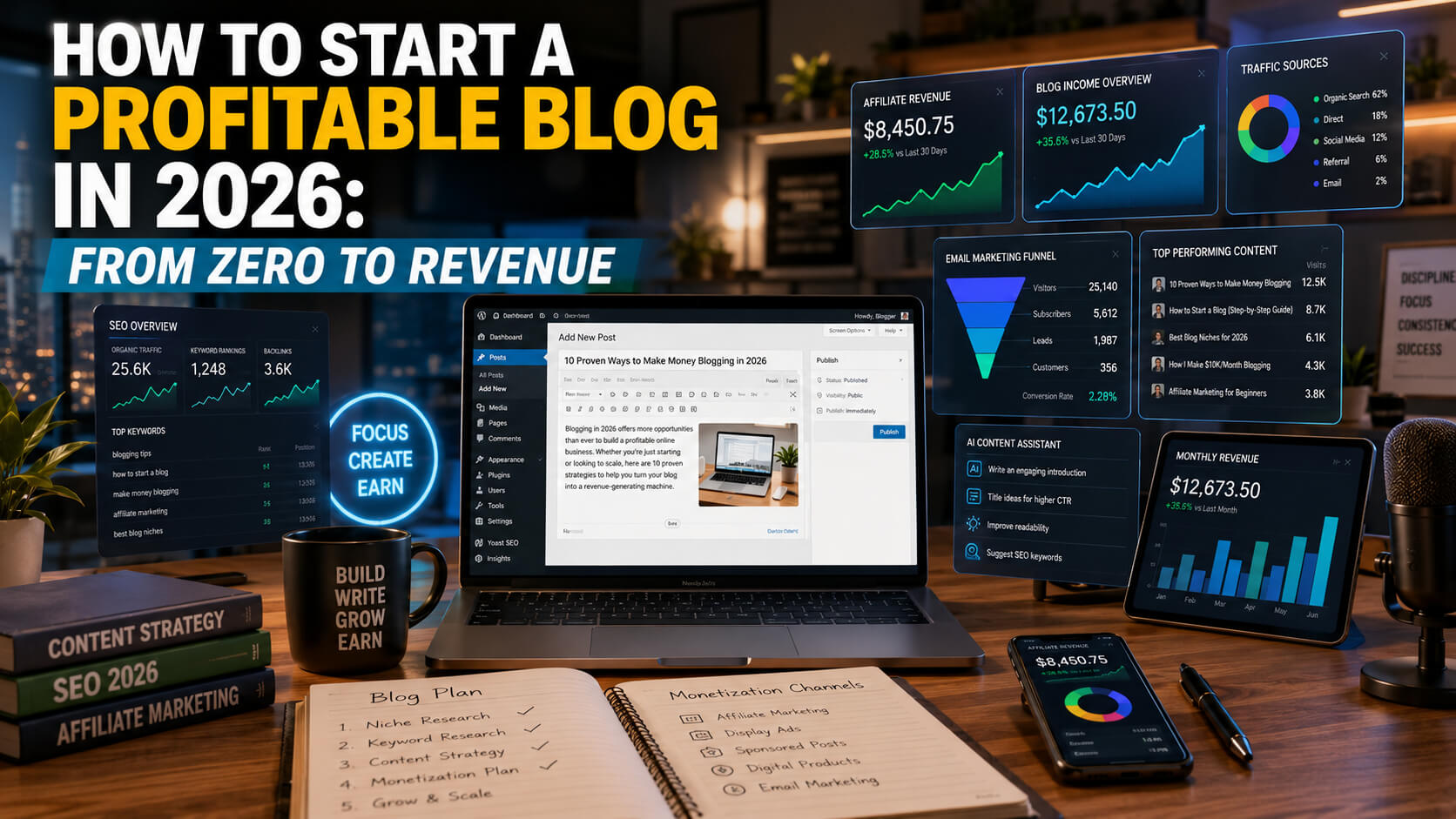
Every year for the last decade, someone has declared that blogging is dead. Every year, the same people are wrong. Blogs still drive billions of dollars in revenue, still rank at the top of Google, and still give independent creators a direct line to their audience.
What has changed is the bar. Starting a blog in 2026 is not about posting random thoughts and hoping for traffic. It is about building a focused content asset that answers real questions, attracts the right readers, and earns revenue through multiple streams.
This guide is written for beginners who want to do this seriously. You will learn how to pick a niche that can actually make money, which blogging platform fits which goal, the realistic cost of starting, and how to go from zero readers to a monetized blog within the first year.
No shortcuts, no “get rich quick” framing, just a clear path.
Is Starting a Blog in 2026 Still Worth It?
Short answer: yes, but only with a strategy. The era of easy traffic from generic lifestyle posts ended years ago. The era of serious independent publishers earning real income from niche expertise is very much alive.
Statista data shows that over 600 million active blogs exist online, and total daily blog posts exceed 7 million. That sounds like impossible competition until you look at what most of those posts are: thin, AI-generated, or targeting keywords nobody cares about.
A blog built around genuine expertise, consistent publishing, and real reader value still ranks, still gets shared, and still earns money. Top solo bloggers in niches like personal finance, tech reviews, travel, and B2B software routinely clear $10,000 to $100,000 per month in revenue.
What Blogging Looks Like in 2026 (And How It Changed)
Three shifts define modern blogging compared to five years ago.
AI-written content flooded the market. Generic AI posts now fill search results, which lowered trust and raised the value of clearly human, expert-written content.
Google prioritizes E-E-A-T. Experience, expertise, authoritativeness, and trustworthiness are now central ranking factors. Anonymous content farms are losing ground fast.
Email and community replaced social as the main retention layer. Social algorithms throttle organic reach. Email subscribers are the single most valuable asset a blogger can build.
Step 1: Choose a Niche That Can Actually Make Money
Niche selection is the single most important decision you will make. A great niche sits at the intersection of three things: something you can write about knowledgeably, something readers search for consistently, and something with commercial intent (people buy products, services, or subscriptions related to it).
Here are niche categories that consistently perform for independent bloggers in 2026.
| Niche Category | Monetization Strength | Competition | Best For |
|---|---|---|---|
| Personal finance and investing | Very high | High | Writers with real financial or industry background |
| SaaS reviews and B2B tools | Very high | High | Operators who use the tools daily |
| Travel (specific region or style) | Medium to high | Medium | Travelers with a clear angle (budget, luxury, specific country) |
| Health and fitness (specific condition or goal) | High | High | Certified trainers, dietitians, or personal experience writers |
| Parenting (specific age or topic) | Medium to high | Medium | Parents with a genuine, relatable voice |
| Developer tutorials and tech how-tos | Medium | Medium | Engineers who like to teach |
| Hobbies with purchase decisions (photography, cooking, cycling) | Medium to high | Medium | Enthusiasts with deep product knowledge |
A quick test before committing to a niche: search your top five planned blog topics on Google. If every first-page result is a massive publisher with thousands of backlinks, the niche will take years to crack. If you see a mix of independent sites, forum threads, and older posts, you have an opening.
Step 2: Pick the Right Blogging Platform for Your Goals
Your platform is your foundation. Changing it later is painful, so choose based on where you realistically want the blog to go, not just where it starts.
| Platform | Best For | Monthly Cost (Starting) | Key Strength |
| WordPress.org (self-hosted) | Serious bloggers who want full control | $3 to $15 (hosting) | Unlimited customization, best for SEO and scale |
| Ghost | Writers who want a clean interface with built-in subscriptions | $9 to $25 (Ghost Pro) or self-hosted | Native paid subscriptions, beautiful defaults |
| Substack | Newsletter-first writers who want to monetize fast | Free (10% of paid revenue) | Built-in audience tools, no setup friction |
| Medium | Casual writers or testing a topic | Free or $5 for Medium membership | Built-in traffic from Medium readers |
| Wix / Squarespace | Non-technical creators who want drag-and-drop design | $18 to $40 | Simple setup, weak long-term SEO |
For most serious bloggers targeting long-term growth and SEO traffic, self-hosted WordPress remains the strongest choice in 2026. It requires slightly more setup (one hour with a modern host) but gives you control over every optimization that matters.
If your plan is to sell paid newsletters or courses from day one, Ghost or Substack may serve you better because monetization is built in.
Step 3: The Real Cost of Starting a Blog in 2026
Most beginner guides lowball the startup cost or inflate it to sell hosting affiliate commissions. Here is the honest breakdown for someone who wants a professional blog.
- Domain name: $10 to $15 per year. Use Namecheap, Porkbun, or Cloudflare Registrar.
- Hosting: $4 to $15 per month for your first 12 months on shared hosting. Good options include Hostinger, SiteGround, and Cloudways. Upgrade to a managed WordPress host (Kinsta, WP Engine) when monthly traffic reliably exceeds 20,000 visits.
- Theme: $0 to $70 one-time. Use a free theme like Astra or Kadence to start. Upgrade if your design needs outgrow the free version.
- Essential plugins: $0 to $100 per year combined. Yoast or Rank Math for SEO (free tier is enough), an image optimizer, a caching plugin, and a backup solution.
- Email tool: $0 to $30 per month to start. Beehiiv and MailerLite offer generous free tiers up to 1,000 subscribers.
- Design assets: $0 to $15 per month. Canva Free or Pro for graphics, a royalty-free stock library if needed.
Realistic first-year cost for a lean, professional blog: $150 to $400 total. You do not need a paid course, a copywriter, or expensive tools to start well.
Step 4: Set Up Your Blog the Right Way (Technical Basics)
Skipping the technical setup will hurt you later. Here is the minimum checklist every new blog should complete before publishing.
- Buy a domain that is short, readable, and future-proof. Avoid numbers and hyphens. A .com is still best for credibility.
- Install WordPress (or your chosen platform) and a fast, SEO-friendly theme.
- Enable HTTPS with a free SSL certificate (most hosts do this automatically).
- Install an SEO plugin and configure basic settings (sitemap, metadata defaults, schema).
- Set up Google Search Console and Google Analytics 4 so you can track performance from day one.
- Create the essential pages: About, Contact, Privacy Policy, Terms of Use, and Disclosure page.
- Add an email capture form on the homepage and at the end of each post.
- Optimize core pages for load speed. Target a Lighthouse mobile score above 80.
Step 5: Plan Your First 20 Blog Posts
New bloggers often publish whatever comes to mind and wonder why traffic never grows. The fix is boring but effective: plan your first 20 posts strategically, before you write any of them.
A useful framework is the pillar-and-cluster model. Pick one or two broad topics (pillars) that define your blog. Under each pillar, write a comprehensive guide (2,500+ words) that covers everything on that topic. Then write 8 to 12 supporting posts (1,000 to 2,000 words) that go deep on specific subtopics and link back to the pillar.
This structure signals topical authority to Google, keeps your site organized for readers, and gives you a content map so you never run out of ideas.
Use free keyword research tools like Google Keyword Planner, Answer the Public, and the People Also Ask boxes in Google results to find search questions real readers ask. Every post should target one primary keyword and several related variations.
Step 6: Write Content That Actually Ranks and Converts
Good blog writing in 2026 looks different from the formulaic “listicle with H2 every 200 words” style that dominated the 2010s. What ranks now is content that genuinely answers the question and demonstrates experience.
A Simple Post Structure That Works
- Open with a hook that names the reader’s real problem in plain language.
- State what the post will deliver and why you are qualified to deliver it.
- Cover the core question thoroughly with clear H2 and H3 sections.
- Include examples, small case studies, or screenshots that no AI could fabricate.
- Answer common follow-up questions in a FAQ section.
- End with a clear but non-pushy call to action (read a related post, subscribe, or try a tool).
Writing Tone and Voice
Write the way you would explain the topic to a smart friend who is new to it. Use short paragraphs. Use active voice. Avoid corporate filler, unnecessary qualifications, and jargon unless the jargon is what the reader searched for.
Google rewards content that reads as if a real expert wrote it for a real person. AI detection tools are imperfect, but Google’s human quality raters are increasingly good at spotting generic, templated content. Write for the human, not the algorithm, and you will usually satisfy both.
Step 7: Blog Monetization: How New Bloggers Actually Earn Revenue
Most new bloggers try to make money too early with the wrong methods. Here is the order that usually works for independent bloggers in 2026.
| Stage | Best Monetization Method | Typical Earnings (Monthly) |
| 0 to 10,000 monthly visits | Build the audience first. Monetization is distraction at this stage. | $0 to $100 |
| 10,000 to 50,000 monthly visits | Display ads (Mediavine, Raptive, Ezoic) + affiliate links | $300 to $3,000 |
| 50,000 to 150,000 monthly visits | Affiliate marketing + sponsored content + digital products | $2,500 to $15,000 |
| 150,000+ monthly visits | Own products (courses, memberships), premium sponsorships | $10,000 to $100,000+ |
The highest-earning bloggers typically combine three to five revenue streams. Display ads give predictable baseline income. Affiliate marketing scales well once you have search rankings. Digital products (courses, ebooks, templates, memberships) have the best margins but take the longest to build.
Sponsored posts and paid newsletters fit in once you have a real audience relationship. Avoid accepting sponsorships too early. A badly-chosen sponsor can damage trust before you build much of it.
Step 8: Build an Email List From Day One
If you take only one piece of advice from this guide, take this one: capture emails from your very first post.
Search traffic and social traffic can vanish overnight from an algorithm update. Email subscribers are yours. They let you ship revenue without paying middlemen, launch new products quickly, and build real trust over time.
Offer a small but genuinely useful free resource (a checklist, template, or short guide) as the email sign-up incentive. Keep the form simple (first name and email). Send a welcome email within minutes and a short onboarding series over the next two weeks. After that, a consistent rhythm (weekly or biweekly) works better than daily emails for most niches.
7 Common Blogging Mistakes That Kill Beginners
- Publishing before the blog is properly set up. Skipping the technical foundation (SSL, analytics, SEO plugin) creates problems that compound over time.
- Writing for yourself instead of the reader. Diary-style posts rarely rank or convert. Every post should solve a specific problem or answer a specific question.
- Targeting keywords you cannot compete for. New blogs cannot outrank Forbes or Healthline for broad keywords. Go after long-tail, specific queries where quality content can still win.
- Quitting at month three. SEO results take six to twelve months to show up. Most beginners quit right before their work would have started paying off.
- Chasing every monetization method at once. Display ads, affiliate links, and product pitches on the same page destroy reader trust. Choose your focus and keep posts clean.
- Ignoring mobile optimization. Over 70% of blog traffic is mobile. If your site is slow, hard to read, or broken on mobile, nothing else matters.
- Never updating old posts. Search rankings decay over time unless you refresh content. Plan to update your top-performing posts every six to nine months.
Expert Tips from Profitable Bloggers
- Treat it like a business, not a hobby. Track publishing cadence, traffic growth, email signups, and revenue. If you cannot measure it, you cannot improve it.
- Publish consistently, even if slowly. Two strong posts a month for two years beats twenty weak posts in one month and then silence.
- Learn basic SEO before you scale. Keyword research, on-page SEO, and internal linking are skills, not guesses. Spend a week learning them before publishing your first twenty posts.
- Network with other bloggers in your niche. Genuine relationships lead to guest post opportunities, backlinks, and joint launches. Be helpful before asking for anything.
- Repurpose every post into at least three formats. A long post can become a newsletter, a LinkedIn carousel, a short video, and a Pinterest pin. Creating once and distributing many times is how small teams compete with large ones.
Frequently Asked Questions
How long does it take to make money blogging?
Most serious bloggers who follow a strategic approach start earning small amounts (under $500 per month) between months six and twelve. Reaching meaningful income ($2,000 to $5,000 per month) typically takes 18 to 30 months of consistent, quality publishing. A small number of bloggers hit six-figure annual revenue in year two, but that usually requires either existing audience transfer (from social media or a podcast) or aggressive reinvestment.
What is the best blogging platform in 2026?
Self-hosted WordPress remains the best all-around blogging platform for bloggers targeting long-term growth and SEO traffic. Ghost is a strong alternative for writers focused on paid subscriptions or newsletter-first models. Substack works well for quick starts and newsletter monetization but limits long-term SEO and customization. For hobby or low-commitment blogs, Medium is a reasonable free option.
How much can a blog realistically earn?
Earnings vary wildly by niche, traffic volume, and monetization strategy. A small blog with 20,000 monthly visits in a high-commercial niche (personal finance, SaaS, insurance) can earn $1,000 to $5,000 per month. A larger blog with 100,000+ monthly visits can earn $10,000 to $50,000 per month with a diversified revenue model. Top independent bloggers routinely earn over $100,000 per month, but they represent a small percentage and usually run blogs as full businesses with teams.
Do I need to be a great writer to start a blog?
No. You need to be a clear writer and a generous teacher. Readers care more about whether you helped them than whether your sentences are beautiful. Writing improves quickly with practice, particularly if you read your posts out loud before publishing and study blogs you admire in your niche.
Should I use AI to write blog posts in 2026?
AI can help with research, outlines, and first drafts. It should not write the published content for you. Google, readers, and search algorithms increasingly penalize generic AI-generated posts. Use AI to speed up your process, but write in your own voice, add real experience, and review every line before publishing. The bloggers earning serious money in 2026 use AI as an assistant, not an author.
Your First Step Starts Today
Starting a blog in 2026 is not the gold rush it was a decade ago. It is slower, more competitive, and more rewarding for those who take it seriously. The bloggers who win are the ones who treat their blog like a long-term asset, not a side experiment.
Pick your niche this week. Register your domain this month. Publish your first pillar post within 60 days. Keep going for a full year before judging the results. That is the honest path from zero to revenue, and it still works.
If you are ready to build a serious blog, explore more of our content on blogging, SEO, and digital monetization at PostoryCafe.com. Every post is designed to help independent creators publish, grow, and earn on their own terms.