
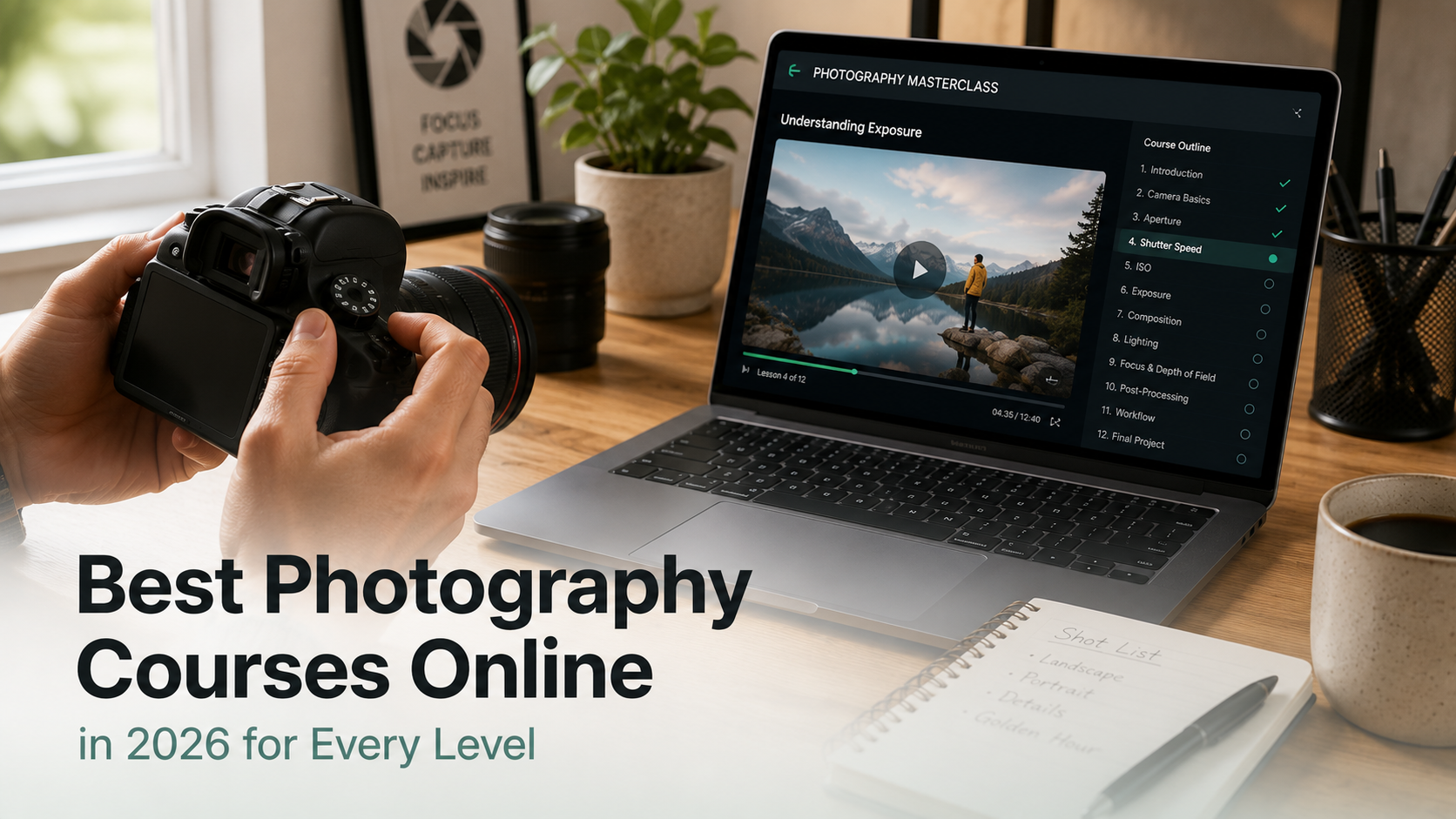
Class Central, which has aggregated reviews across 250,000 online courses for over a decade, points beginners toward structured options like Coursera’s Photography Basics and Beyond from Michigan State University, a five-course specialization with peer-reviewed assignments and a portfolio capstone. For more specialized instruction, Magnum Photos’ collaboration with photographer Alec Soth offers 19 lessons across 5 hours covering portrait work, editing, and sequencing, taught by someone who has published over 25 photography books.
Photography courses in 2026 split into three practical tiers: broad platforms like Udemy and Skillshare offering affordable, self-paced fundamentals; specialized instruction from working photographers on platforms like MasterClass and Domestika; and free content on YouTube and through institutions like Stanford’s archived lecture series. This guide compares the leading options by cost, depth, and who each one actually suits.
Courses for Absolute Beginners
Udemy’s Photography Masterclass by Phil Ebiner and William Carnahan runs 25.5 hours with 65 articles and lifetime access, covering camera basics through advanced techniques without requiring expensive equipment, since the course explicitly supports learning on a smartphone camera first. Coursera’s university-backed specialization takes a slower, more structured path over three to six months, with peer feedback built into every module, which suits learners who want accountability and a completion certificate over speed.
Free options remain truly strong for absolute beginners: Adorama’s Exploring Photography series on YouTube offers roughly 50 hours of practical instruction at no cost, and Stanford’s archived 18-lecture digital photography course, though released in 2011, still covers composition, color theory, and depth of field fundamentals that have not changed.
Photography Courses Compared by Platform
| Platform | Best For | Typical Cost | Format |
| Udemy | Affordable, lifetime-access fundamentals | 15 to 30 dollars per course on sale | Self-paced video, downloadable resources |
| Coursera | Structured, university-backed learning | Subscription or per-course, financial aid available | Peer-reviewed assignments, capstone project |
| Skillshare | Short, focused skill-building | $13.99 to $32 per month subscription | Bite-sized classes, community projects |
| MasterClass | Learning directly from working professionals | Annual subscription, all-access | Cinematic lessons, workbook PDFs |
| Domestika | Niche skills like mobile or product photography | Per-course with permanent access after purchase | Video lessons plus project-based learning |
| YouTube (free) | Zero-cost fundamentals | Free | Varies widely in structure and quality |
Specialized and Niche Courses
For street photography specifically, a Magnum Photos course featuring seven photographers including Bruce Gilden and Susan Meiselas covers the specific psychological challenge of approaching strangers, a skill no general photography fundamentals course addresses. For anyone selling products or building a personal brand on Instagram, Domestika’s Instagram-focused courses, taught by working creative directors, cover flatlay composition, color-consistent feeds, and phone-only lighting setups aimed squarely at commercial application rather than fine art.
Photo editing deserves its own course track separate from shooting technique: Adobe’s Photography Plan bundles Photoshop and Lightroom access for roughly 10 dollars a month, and KelbyOne, founded by Scott Kelby, focuses specifically on photography-oriented editing workflows like portrait retouching and landscape enhancement rather than Photoshop’s broader design use cases.
Choosing the Right Course for Your Goals
Match the course format to your actual learning style rather than the platform’s marketing: structured learners who want deadlines and feedback do better on Coursera, while visual, self-directed learners often get more from YouTube or short Skillshare classes they can binge over a weekend. Anyone considering photography as a career path should weigh a formal program, such as those from the New York Institute of Photography or Academy of Art University, which add portfolio development and career guidance a single course rarely provides.
Regardless of platform, the fastest way to actually improve is finishing one course completely and applying its lessons to real shooting before starting a second course, since course-hopping without practice is the most common reason photography skills plateau despite an expanding library of unfinished lessons.
Budgeting for Course Fees vs Equipment
A common beginner mistake is spending heavily on a camera body before spending anything on instruction, when the reverse investment usually produces faster improvement: a 20 to 40 dollar Udemy course applied consistently to a smartphone camera teaches composition and lighting principles that transfer directly once better equipment eventually gets added. Reserve equipment upgrades for after finishing at least one structured course, since by that point you will actually know which limitations are truly holding your work back rather than guessing based on marketing copy for the newest camera body.
Subscription platforms like Skillshare and MasterClass make the most financial sense for people planning to take several courses across a year, since the per-course cost drops sharply once you use the subscription for three or more classes, while a one-off course purchase on Udemy remains cheaper for someone who only wants a single focused topic like flash photography or a specific editing workflow.
Watch for platform sales cycles specifically on Udemy, where list prices rarely reflect what most buyers actually pay; courses regularly discount to 15 to 30 dollars during recurring promotional periods, making patience around a purchase date a truly effective savings strategy rather than a minor convenience.
Frequently Asked Questions: Online Photography Courses
Q: Can I really learn photography from an online course? A: Yes, with consistent practice alongside the lessons; structured platforms with peer feedback or assignments tend to produce better retention than passive video-watching alone.
Q: Do I need an expensive camera to start a photography course? A: No, most beginner courses, including top-rated options on Udemy and YouTube, are explicitly designed to work with a smartphone camera before any DSLR investment.
Q: What is the best free way to learn photography online? A: Adorama’s Exploring Photography series on YouTube and Stanford’s archived digital photography lecture series both offer substantial free instruction covering real fundamentals.
Q: Is Skillshare or Udemy better for photography? A: Udemy suits learners who want one comprehensive course with lifetime access, while Skillshare’s subscription model favors people who want to sample many short, focused classes across different photography niches.
Q: How long does it take to get good at photography through an online course? A: Course completion alone typically runs 10 to 30 hours depending on depth, but genuine skill improvement depends far more on hours of actual shooting practice applied after the course than the course length itself.
Q: Are MasterClass photography courses worth the subscription price? A: They are worth it primarily for the value of learning directly from a specific working professional’s process and mindset, which suits learners past the absolute basics more than complete beginners needing structured fundamentals.
Building a Practice That Outlasts Any Course
The 20-60-20 rule that many photography instructors reference, where roughly 20 percent of shots turn out great, 60 percent are average, and 20 percent miss, is a useful reminder that no course eliminates the need for volume and repetition. Pick one course, finish it, and carry its lessons directly into your own ongoing projects rather than searching for the next course to start.
Looking to grow your own reach? Postorycafe is a guest posting platform that welcomes writers across every niche covered here. Submit your guest posting pitch today and get your work in front of a global audience.