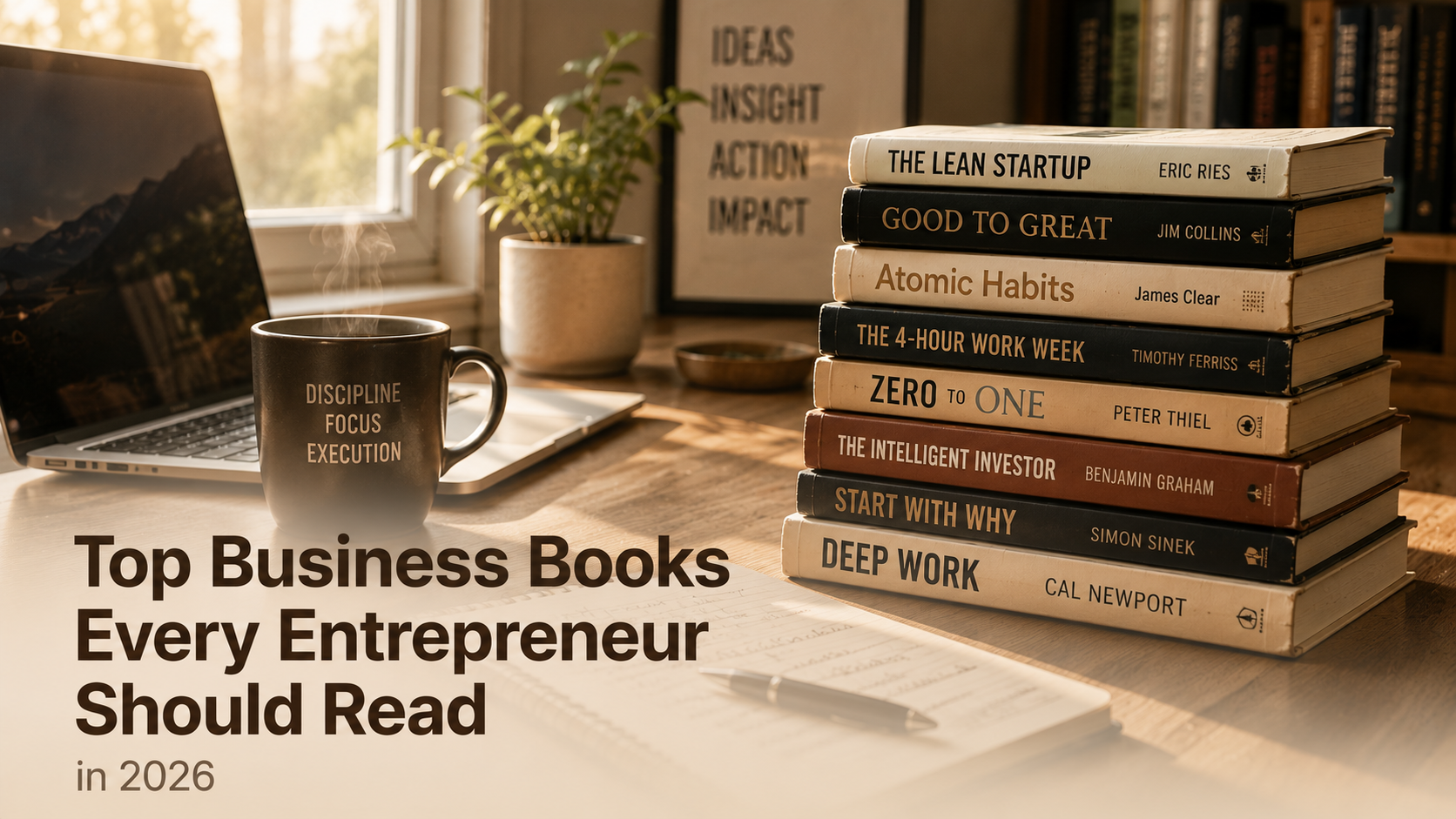
Eric Ries’s The Lean Startup remains one of the most consistently recommended books among founders building something new in 2026, introducing validated learning and rapid prototyping as a way to reduce the risk of building a product nobody wants. Mike Michalowicz’s Profit First takes a different angle entirely, arguing that setting aside a profit percentage the moment revenue arrives, rather than treating profit as whatever is left after expenses, works better with human psychology than the standard accounting approach most small businesses default to.
With over 665 million entrepreneurs worldwide and roughly 90 percent of startups eventually failing, the right book at the right stage can truly shift how a founder thinks about risk, cash flow, and leadership, though the right book depends heavily on where a business actually is in its growth. This guide organizes the most recommended titles in 2026 by the stage they help most, rather than repeating a generic top-ten list.
Books for the Starting-Out Stage
The Lean Startup teaches the discipline of testing an idea with the smallest viable version before committing resources to build it fully, a lesson Dropbox famously applied by using a simple explainer video as its minimum viable product rather than building the full file-syncing product first. Phil Knight’s memoir Shoe Dog, cited by Bill Gates as one of his favorite books, offers something different: an honest, unglamorous account of Nike’s early years told through mistakes, near-failures, and sacrifice rather than a tidy success formula.
For anyone whose biggest early fear is cash running out before the business finds its footing, Profit First directly addresses the psychological trap of paying yourself last, restructuring the accounting sequence so a small business owner protects margin from day one rather than discovering too late that expenses consumed everything.
Books for the Scaling Stage
| Book | Author | Best For |
| Good to Great | Jim Collins | Understanding what separates lasting companies from average ones |
| Traction | Gino Wickman | Small business owners needing an operating system for growing teams |
| The Five Dysfunctions of a Team | Patrick Lencioni | Leaders building or repairing team trust |
| Radical Candor | Kim Scott | Managers learning to give direct, honest feedback |
| Zero to One | Peter Thiel | Founders thinking about building genuine market differentiation |
Traction specifically fills a gap many growing businesses hit: the founder who built the company through instinct and hustle suddenly needs actual systems for hiring, meetings, and accountability, and Gino Wickman’s Entrepreneurial Operating System gives a concrete framework rather than abstract advice. Good to Great, despite being written primarily about large public companies, still offers useful research on disciplined leadership and rigorous decision-making that scales down to smaller businesses navigating their own growth inflection points.
Books on Mindset and Leadership
The Psychology of Money by Morgan Housel explores the emotional and behavioral drivers behind financial decisions rather than pure logic, a useful corrective for founders whose gut instincts about money have not always served their business well. Brene Brown’s Dare to Lead reframes vulnerability as a leadership asset rather than a weakness, a perspective one founder in the education sector specifically credited with giving her the tools to lead with empathy and clarity during a difficult scaling period.
Deep Work by Cal Newport addresses a problem nearly every founder eventually faces regardless of industry: the inability to focus long enough to do meaningful strategic thinking amid constant operational fires, and many executives who adopt the book’s blocked-off deep work sessions report meaningful output gains within weeks.
How to Actually Use These Books
Reading without implementation is entertainment, not education: for each book, identify three specific things to try in your business within the following week rather than simply absorbing the ideas as interesting theory. Bill Gates, who reportedly reads around 50 books a year, has specifically credited reading as one of his primary learning tools precisely because he treats books as inputs to test against his own thinking rather than passive consumption.
Find people who have read the same books you have, since shared reading creates a common vocabulary that makes networking and mentorship conversations meaningfully more productive; asking a potential advisor or mentor about their favorite business books is a low-stakes way to start a deeper conversation about how they actually think.
Where to Get These Books Without Breaking Your Budget
Public libraries carry most of these titles both physically and through apps like Libby, making a full reading list achievable at zero cost for anyone willing to wait a week or two for a popular hold. Audiobook subscriptions through Audible or Spotify increasingly bundle business titles at no extra cost, a format many busy founders prefer specifically because it fits into a commute or workout rather than requiring dedicated reading time.
Buying used copies through resale marketplaces or a service like Bookshop.org, which splits proceeds with independent bookstores, typically cuts the cost of a physical copy by 40 to 60 percent compared with a new retail purchase, a meaningful saving for anyone building a working reference shelf of ten or more titles. Several of the classics referenced here, including older public-domain works, are also available free through Project Gutenberg or similar archives.
A founder-run book club, even an informal one with two or three other entrepreneurs reading the same title on the same timeline, consistently produces better retention and application than solo reading, since discussing a chapter with someone else forces the kind of active engagement that turns an interesting idea into an actual behavior change.
Frequently Asked Questions: Business Books for Entrepreneurs
Q: What is the single best business book for a brand-new entrepreneur? A: The Lean Startup is the most consistently recommended starting point, since it teaches validated learning and rapid testing before committing significant resources to an unproven idea.
Q: Is Profit First actually better than standard accounting for a small business? A: For many small business owners it works better in practice because it aligns with human psychology, setting aside profit first rather than treating it as leftover money, which tends to protect margin more reliably than the standard pay-yourself-last approach.
Q: Which business book is best for a founder scaling past the early startup stage? A: Traction by Gino Wickman is widely recommended for this transition, since it provides a concrete operating system for meetings, accountability, and team structure rather than abstract growth advice.
Q: Do successful entrepreneurs actually read as much as business advice suggests? A: Many do; Bill Gates has publicly stated he reads around 50 books a year and treats reading as one of his primary tools for learning and testing his own understanding.
Q: Are older business books like Good to Great still relevant in 2026? A: Yes for the underlying leadership and organizational discipline principles, though founders should pair classic titles with more recent releases addressing AI, remote work, and current market conditions specifically.
Q: How many business books should a busy entrepreneur try to read? A: Quality of implementation matters more than quantity; reading fewer books but actually applying three specific changes from each one produces more real business impact than speeding through a long list without acting on it.
Building a Reading Practice That Actually Changes Your Business
The best business book library is not the longest one but the one an entrepreneur actually returns to and applies at each new stage of growth, since a book that felt irrelevant during the earliest days of a business often becomes exactly the right read once scaling problems emerge. If your reading has you eyeing outside capital to fund the next stage, our guide to raising seed funding in 2026 walks through that process in detail. Treat this list as a starting menu rather than a mandatory syllabus, and pick up the title that speaks most directly to whatever challenge your business is actually facing this quarter.
Looking to grow your own reach? Postorycafe is a guest posting platform that welcomes writers across every niche covered here. Submit your guest posting pitch today and get your work in front of a global audience.