
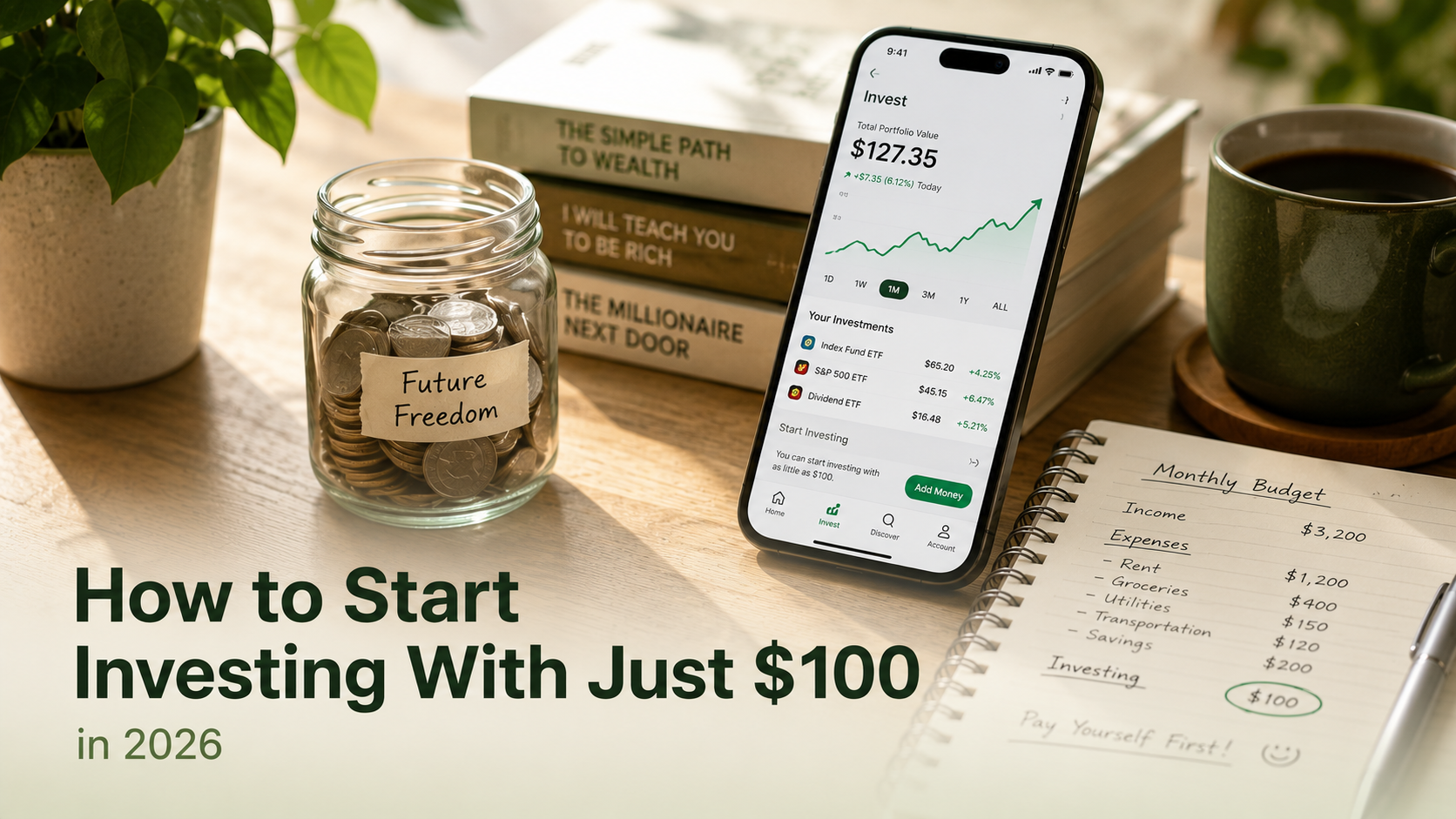
Fractional share investing, now offered by nearly every major brokerage including Fidelity, Schwab, and Robinhood, lets someone with just 100 dollars own a genuine slice of expensive stocks like Amazon or Google rather than needing thousands of dollars to buy a single whole share. Data on new investor behavior shows beginner investors aged 18 to 34 now account for 51 percent of new brokerage account openings, with 73 percent choosing mobile-first platforms specifically because fractional shares and zero minimums removed the barrier that once kept small budgets out of the market entirely.
Investing 100 dollars will not make anyone wealthy overnight, but building the habit and mechanics of investing early matters more than the starting amount, since the systems and behaviors learned with a small sum transfer directly once larger amounts become available. This guide covers exactly how to put a first 100 dollars to work in 2026, which platforms fit different starting goals, and the mistakes that trip up most first-time investors.
How Fractional Shares Actually Work
Rather than buying a whole share at whatever the current market price happens to be, fractional share investing lets you specify a dollar amount, say 100 dollars, and the broker calculates exactly what portion of a share that buys, whether the stock trades at 50 dollars or 3,000 dollars per share. This single feature is what transformed investing accessibility over the past several years: diversifying 100 dollars across five different companies used to be mathematically impossible for most stock prices, and now takes a few taps in any major investing app.
Fractional shares carry a few minor limitations worth knowing upfront: you typically cannot vote on shareholder matters with a fractional position, and transferring a fractional share to a different broker is not always possible, meaning a stock split or corporate action might force a sale rather than a clean transfer if you ever switch platforms.
Best Platforms for a First 100 Dollars
| Platform | Minimum to Start | Fractional Shares | Best For |
| Fidelity | $1 | Yes, most US stocks and ETFs | Beginners wanting strong customer service and education |
| Charles Schwab | $1 | Yes, most US-listed stocks and ETFs | Long-term investors wanting research tools |
| Robinhood | $1 | Yes | Simple, mobile-first first-time investors |
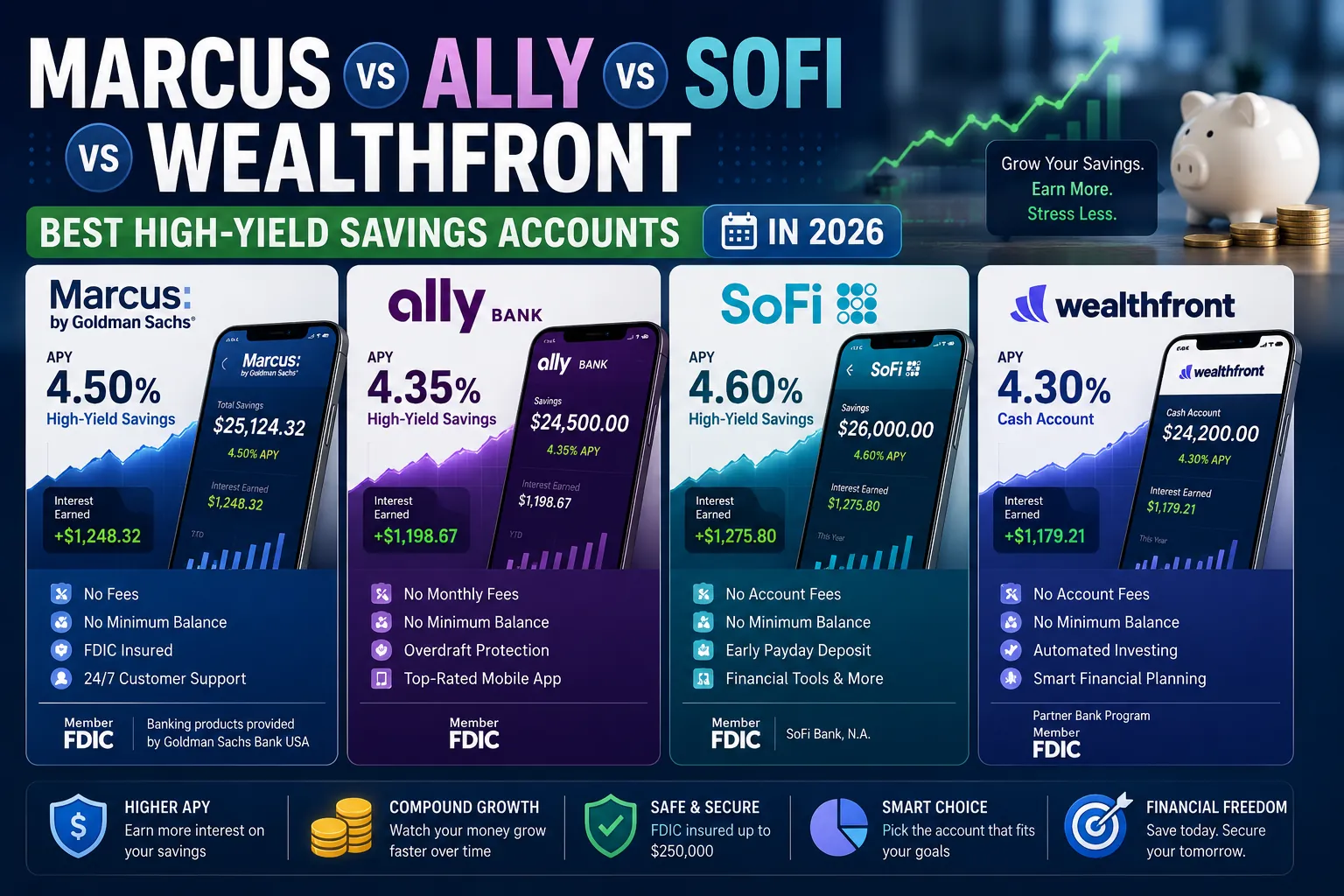
| SoFi Active Investing | $1 | Yes | Beginners wanting no account minimums or fees |
| Vanguard (dollar-based trading) | $1 | Yes, Vanguard ETFs and mutual funds | Long-term, low-cost index investing |
What to Actually Buy With Your First $100
A broad-market index fund ETF, such as one tracking the S&P 500, remains the most commonly recommended first investment for a small starting amount, since it spreads risk across hundreds of companies instead of betting everything on a single stock a beginner may not have researched deeply. Dollar-cost averaging, contributing a fixed amount like 50 or 100 dollars on a regular schedule regardless of what the market is doing that week, smooths out the risk of investing a lump sum right before a market dip and is easier to sustain emotionally for a new investor still learning to tolerate normal market swings.
Individual stock picking with a first 100 dollars is not inherently wrong, but it concentrates risk in a way that can be an expensive lesson if the specific company underperforms; a reasonable middle path many beginners use is splitting a small starting amount between one broad index ETF and one or two individual companies they already understand well as a customer or employee.
Common First-Time Investor Mistakes
Checking the account balance daily and reacting emotionally to short-term price swings is the most common way new investors talk themselves out of a strategy that would have worked fine if left alone, since normal market volatility looks alarming when watched constantly but averages out over years for a diversified position. Chasing whatever stock is trending on social media, rather than sticking to a plan built around index funds and dollar-cost averaging, is the second major trap, since by the time a stock is trending widely enough to notice, much of the easy gain has often already happened.
Ignoring fees on a small account is a subtler mistake: a flat monthly account fee that seems trivial on a large balance can meaningfully eat into returns on a 100 dollar starting position, which is exactly why the zero-fee, zero-minimum platforms listed above matter disproportionately for small first-time investors.
Tax Considerations Beginners Often Overlook
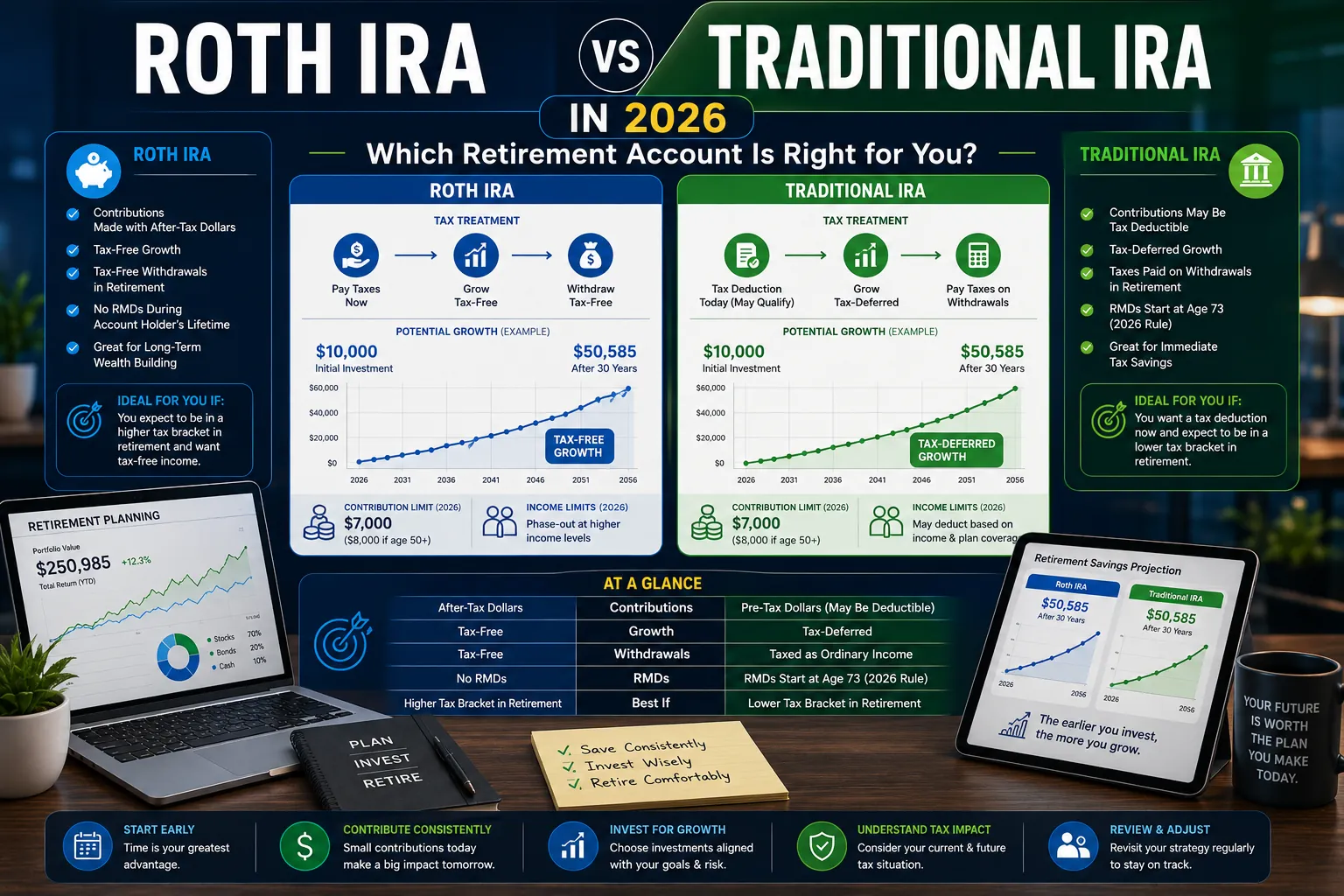
Investing through a taxable brokerage account means any dividends or capital gains generally create a tax obligation each year, even if you never withdraw the money, which surprises many first-time investors who assumed taxes only applied once they actually sold and cashed out. Retirement accounts like a Roth IRA offer a meaningfully different tax treatment, letting investments grow and eventually be withdrawn tax-free in retirement, and several major brokerages allow opening a Roth IRA with the same 100 dollar starting minimum as a standard taxable account.
For a first 100 dollars specifically earmarked for long-term goals rather than near-term flexibility, a Roth IRA is often the more tax-efficient choice precisely because a small starting balance has decades to compound before any withdrawal, maximizing the benefit of tax-free growth over that horizon. Anyone uncertain which account type fits their situation should look at their expected timeline, money needed within a few years generally belongs in a standard taxable account for flexibility, while money truly earmarked for retirement decades away benefits more from a Roth structure.
Brokerages are required to send a 1099 tax form reporting any dividends or realized gains each year, and even a modest 100 dollar position can generate a small 1099 that needs to be included on a tax return, a minor administrative step worth expecting rather than being surprised by the following spring.
Frequently Asked Questions: Investing With $100
Q: Is $100 actually enough to start investing meaningfully? A: Yes, thanks to fractional shares and zero-commission trading now standard across major platforms, 100 dollars can buy a diversified mix of index funds or partial shares of individual companies rather than sitting idle.
Q: What is the safest first investment for a beginner with $100? A: A broad-market index fund ETF tracking something like the S&P 500 is the most commonly recommended first investment, since it diversifies risk across hundreds of companies rather than concentrating it in one stock.
Q: Do I lose money to fees investing only $100? A: Not if you choose a zero-commission, zero-minimum platform like Fidelity, Schwab, or Robinhood, all of which allow fractional share trading with no account fees eating into a small starting balance.
Q: What is dollar-cost averaging and why does it matter for small investors? A: It means investing a fixed amount on a regular schedule regardless of market conditions, which smooths out the risk of poor timing and is easier to sustain emotionally than trying to time a single lump-sum investment.
Q: Can I lose all my money investing $100 in stocks? A: A diversified index fund position is very unlikely to go to zero, though any stock market investment carries real risk of loss, which is why diversification and a long time horizon matter more than picking a single winning stock.
Q: Should I invest $100 or pay off debt first? A: High-interest debt, such as credit card debt, typically costs more in interest than average market returns provide, so paying that down first is usually the better financial move before starting to invest a small amount.
Growing From Your First $100
The real value of investing a first 100 dollars is building the habit, the account setup, the automatic contribution, the tolerance for normal market swings, that will carry directly into larger contributions as income grows. Growing the amount available to invest matters just as much as the strategy itself, and our guide on negotiating salary in 2026 covers ways to free up more room in your budget for exactly that. Set up a recurring automatic investment, even a modest 25 or 50 dollars a month, and let the compounding mechanics that made this small start worthwhile keep working quietly in the background while you focus on the rest of your financial life.
Looking to grow your own reach? Postorycafe is a guest posting platform that welcomes writers across every niche covered here. Submit your guest posting pitch today and get your work in front of a global audience.