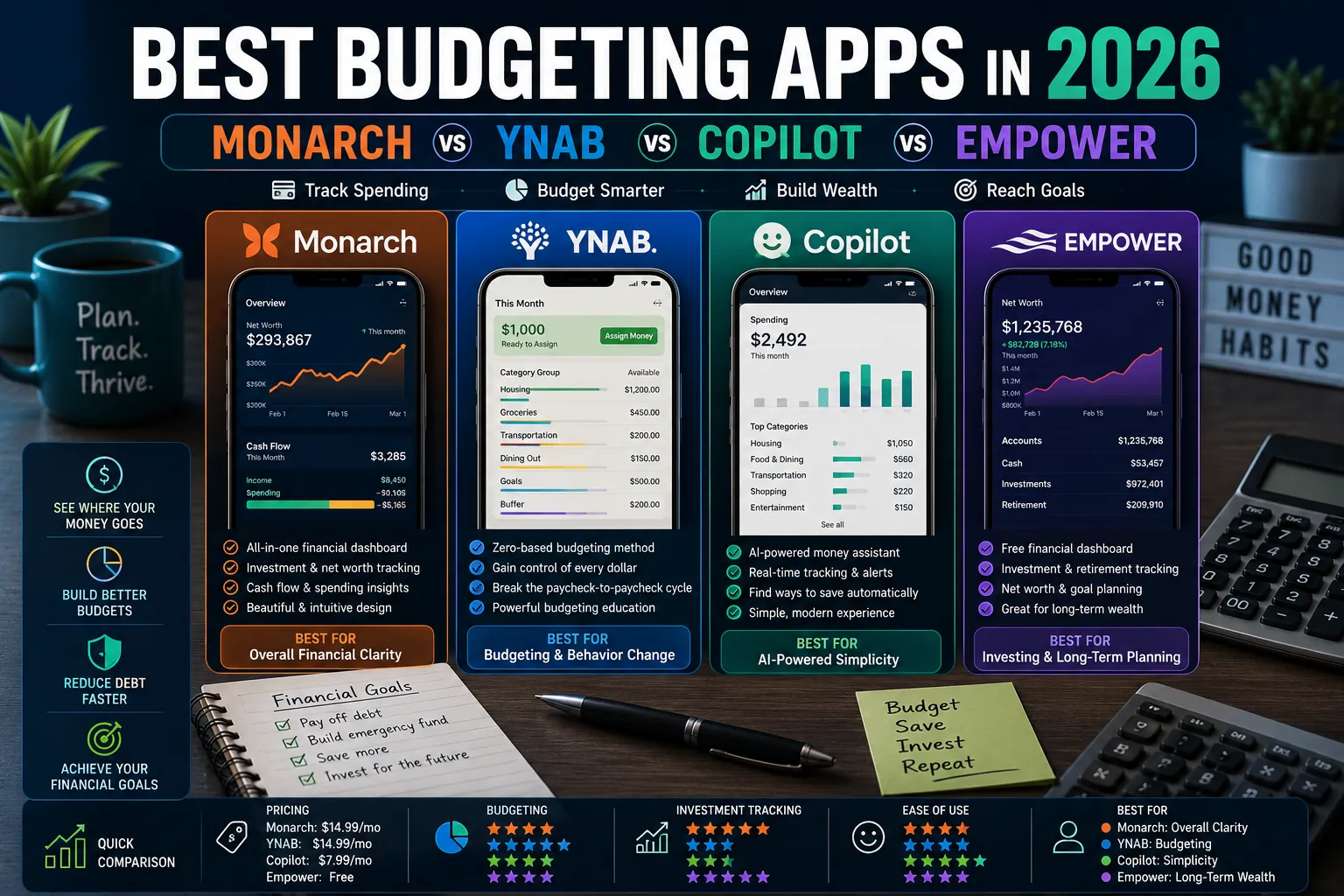


The average Indian smartphone user now spends 27 minutes per day on finance apps, up from 11 minutes in 2022, according to Sensor Tower’s 2025 Mobile Finance Report. ET Money crossed 10 million active investors in India in Q4 2025. YNAB (You Need a Budget) reported that its average subscriber saves 600 US dollars in their first two months of use, based on aggregated and anonymised user data published in its 2025 annual review. Personal finance app usage correlates directly with improved savings rates: a 2025 study in the Journal of Financial Planning found that individuals using dedicated budgeting apps saved 18.5 percent more than those tracking finances only in spreadsheets.
The personal finance app category in 2026 has bifurcated into two clear groups: broad-purpose money management platforms that aggregate accounts and track spending automatically, and focused tools that do one thing exceptionally well, whether budgeting, investing, or net worth tracking. This guide evaluates the best options in both categories for Indian and global users, with honest assessments of where each delivers measurable value and where it falls short.
Best Budgeting Apps in 2026
YNAB (You Need a Budget)
YNAB is the most effective budgeting app in 2026 for users willing to engage with a deliberate budgeting methodology. Its zero-based budgeting approach assigns every rupee or dollar a specific purpose before the month begins, eliminating the common problem of unallocated spending that accumulates invisibly in traditional expense trackers. At $109 per year (approximately 9,100 rupees annually), it is the most expensive app in this category, but its documented average savings of $600 in the first two months makes the cost-benefit ratio compelling for users in income brackets where $600 represents meaningful financial progress.
Spendee
Spendee at $2.99 per month offers automatic bank synchronisation across 20,000 financial institutions in 60 countries and generates visual spending breakdowns by category without manual input. It added UPI transaction tracking for Indian users in 2025, making it one of the few international apps to accurately capture the fragmented reality of Indian digital payments where spending spans UPI, credit cards, and cash simultaneously.
Best Personal Finance Apps for Indian Users
ET Money
ET Money, owned by Times Internet, is the most comprehensive personal finance app for Indian investors in 2026. It combines direct mutual fund investments (at zero commission through direct plans), term insurance comparisons, and loan tracking in a single interface. Its Smart Deposits feature connects users to small finance banks offering 8 to 9 percent interest on fixed deposits, significantly above the 6.5 to 7 percent offered by major scheduled commercial banks. ET Money’s tax planning module automatically calculates 80C deduction utilisation and recommends ELSS funds to close the gap before March 31.
Walnut
Walnut’s automatic SMS-based expense tracking captures transactions across all Indian banks and payment apps without requiring bank login credentials, addressing a significant data privacy concern that prevents many Indian users from linking accounts directly. The app processed over 200 million transactions in 2025 and maintains a 4.3 star rating on the Google Play Store. Its spending insights are less sophisticated than ET Money’s investment features, but its zero-friction setup makes it the most accessible starting point for first-time personal finance app users.
Groww
Groww crossed 10 million registered investors in India in 2026 and is the preferred investment app for retail equity and mutual fund investing among users under 35. Its interface reduces the complexity of stock and ETF investing to the level of an e-commerce purchase, which has been deliberately credited for onboarding India’s next generation of investors. The SEBI-registered platform charges no account opening fee and zero commission on direct mutual fund purchases, monetising through premium subscription features and margin trading products.
Best Global Personal Finance Apps in 2026
| App | Best For | Price | Bank Sync | Investment Features |
| YNAB | Zero-based budgeting | $109/yr | Yes (US/EU/AU) | No |
| Mint (successor) | Automatic tracking | Free | Yes | Basic |
| Personal Capital | Net worth + investing | Free (advisory fee) | Yes | Comprehensive |
| Monarch Money | Couples and families | $99.99/yr | Yes | Basic |
| ET Money | Indian investors | Free (direct funds) | SMS-based | Mutual funds + FD |
| Groww | Indian equities/MFs | Free | No | Stocks + MF + ETF |
| Walnut | Indian expense tracking | Free | SMS-based | No |
What to Look For in a Personal Finance App in 2026
Bank synchronisation security is the most important criterion that users consistently underweight when choosing a personal finance app. Apps using Plaid (US/EU) or Account Aggregator (India) for bank connections operate through regulated data-sharing frameworks that do not store banking passwords. Apps requiring direct username and password input for bank connections should be avoided because they assume full account access credentials, creating unacceptable security exposure.
Data privacy practices diverge significantly across free personal finance apps. Free apps typically monetise through selling anonymised spending data to financial product advertisers or through referral commissions on financial products they recommend. This is not inherently harmful, but users should read the privacy policy of any free app before connecting bank accounts. ET Money and Groww are regulated by SEBI and operate under explicit data protection obligations; their monetisation is transparent through subscription features and direct fund commission structures.
Frequently Asked Questions: Best Personal Finance Apps 2026
What is the best personal finance app in India in 2026?
ET Money is the best all-in-one personal finance app for Indian users in 2026, combining zero-commission mutual fund investing, FD comparisons, insurance, and loan tracking. Groww is the best choice for equity and ETF investing. Walnut is the easiest starting point for expense tracking without requiring bank login credentials. For disciplined budgeting, YNAB works for Indian users despite being internationally designed.
Are personal finance apps safe to use with bank accounts in 2026?
Personal finance apps using India’s Account Aggregator framework or international equivalents like Plaid are safe to connect to bank accounts in 2026 because they use read-only data access without storing banking passwords. Apps certified under the RBI’s Account Aggregator ecosystem, including ET Money and fi.money, operate under regulated data-sharing rules. Users should avoid any app requiring direct bank login credentials rather than using a regulated connection framework.
How much can I save using a budgeting app in 2026?
YNAB’s 2025 user data shows its average subscriber saves 600 US dollars in their first two months using the app. A 2025 Journal of Financial Planning study found budgeting app users save 18.5 percent more annually than those not using dedicated apps. Results depend significantly on user engagement: passive tracking without reviewing categories and adjusting spending delivers minimal benefit, while active weekly reviews drive the documented savings improvements.
What is the difference between a budgeting app and an investment app?
Budgeting apps track income and spending against planned categories to control where money goes each month. Investment apps facilitate the purchase of financial instruments including mutual funds, stocks, and fixed deposits to grow saved capital. ET Money and Personal Capital blur this line by combining both functions. Most financial advisers recommend using a budgeting tool to control outflow and a separate investment platform for maximum control over each function.
Do I need to pay for a personal finance app in 2026?
Free personal finance apps including Walnut, Groww, and the basic tiers of Spendee provide sufficient functionality for most users to track spending and begin investing. Paid apps like YNAB at $109 per year are worth the cost only when the user actively follows the methodology and values the documented savings improvement over free alternatives. Paying for a personal finance app that sits unused is the least effective personal finance decision possible.
What is the best app for tracking investments and net worth in 2026?
Personal Capital (now Empower Personal Dashboard) is the best free net worth and investment tracking tool globally in 2026, aggregating retirement accounts, taxable brokerage accounts, real estate values, and debts into a single net worth dashboard. For Indian users, ET Money provides the most comprehensive investment tracking across mutual funds, fixed deposits, and insurance. Neither charges a fee for the tracking functionality, monetising through optional advisory services.
The App That Does Not Work Is the One You Do Not Open
The best personal finance app in 2026 is the one whose interface and methodology you will consistently engage with, not the one with the most features. YNAB is objectively the most powerful budgeting system but delivers zero value to users who find its methodology too structured. Walnut requires almost no active effort and consequently produces modest but real insights for users who would never track spending manually. Match the tool to your engagement style before you match it to the feature list.
The most financially impactful use of any personal finance app is not the app itself but the behaviour change it supports. Users who review their spending weekly, even for five minutes, consistently outperform those who install an app and check it monthly. The technology is the infrastructure. The habit is the return.