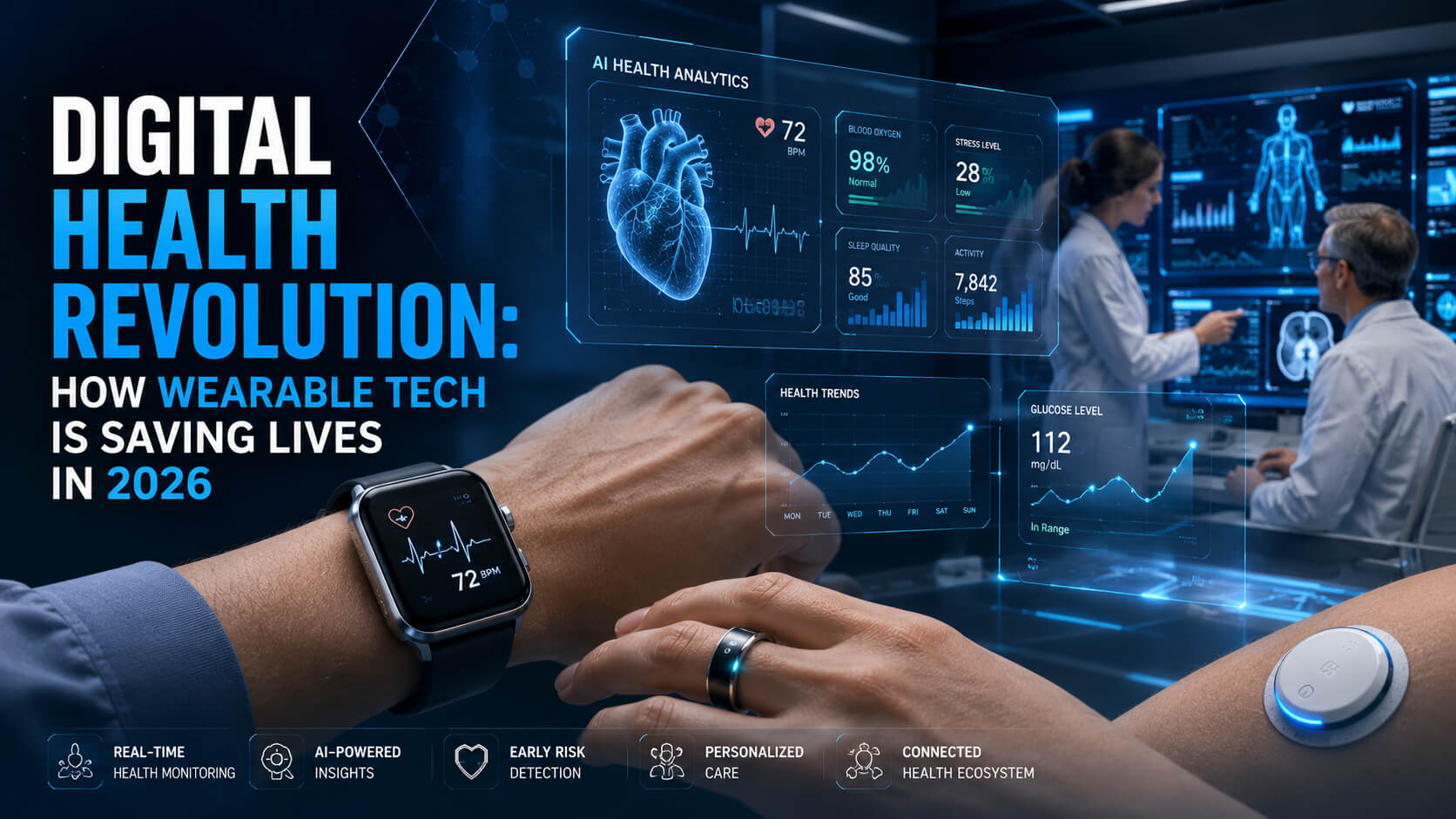

Apple reported in 2025 that its Apple Watch fall detection feature had triggered emergency services for more than 50,000 users globally who were unable to call for help themselves. Abbott’s FreeStyle Libre 3 continuous glucose monitor, worn by more than five million diabetics in 50 countries, reduced hypoglycaemic events by 38 percent compared to traditional finger-stick monitoring in a 2025 clinical study published in The Lancet Diabetes and Endocrinology. The global wearable health technology market reached 96 billion US dollars in 2025, according to Grand View Research, and is projected to exceed 186 billion US dollars by 2030.
Wearable technology in 2026 has moved well beyond step counting. Today’s devices monitor cardiac rhythms for atrial fibrillation, track blood oxygen saturation continuously, measure skin temperature for early illness detection, and in an expanding category, estimate blood glucose levels without needles. This guide examines what wearable health technology can genuinely do in 2026, where the clinical evidence is strong, and where the marketing exceeds the science.
Cardiac Monitoring: The Clearest Clinical Win
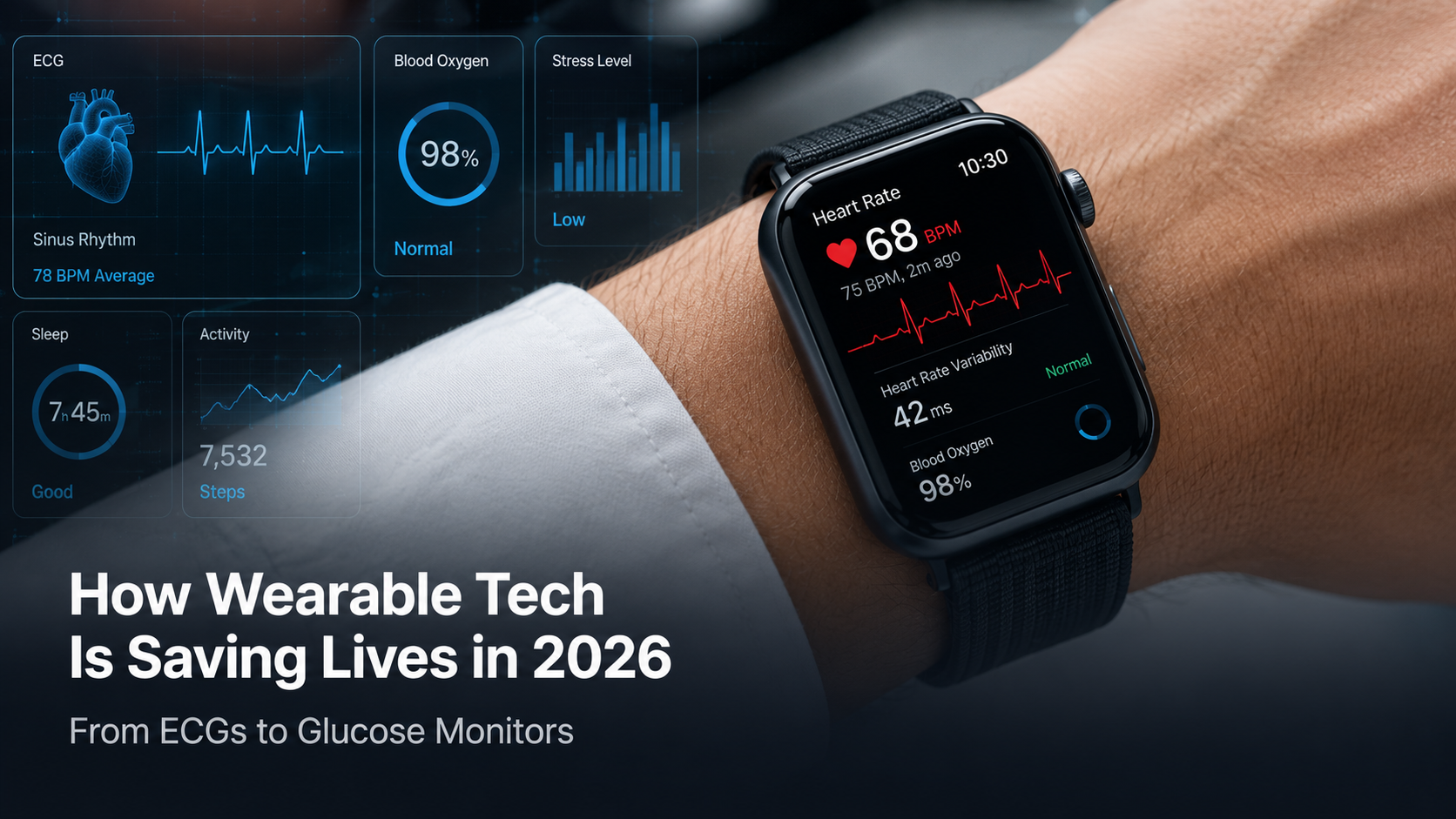
Atrial fibrillation (AFib) affects an estimated 59 million people globally and significantly increases stroke risk. The Apple Watch Series 10 and Samsung Galaxy Watch 7 both carry FDA clearance for their single-lead ECG capabilities, which can detect irregular heart rhythms consistent with AFib in a 30-second recording. A 2025 study in the Journal of the American College of Cardiology found that wearable ECG monitoring in 11,000 participants identified AFib in 34 patients who had no prior diagnosis, leading to anticoagulation therapy that reduced their stroke risk by approximately 60 percent.
Continuous photoplethysmography (PPG) heart rate monitoring, used in virtually all smartwatches, achieves accuracy within five beats per minute of ECG-grade measurement during rest and moderate exercise, according to a 2025 validation study by Stanford Medicine covering 23 wearable devices. During high-intensity exercise, PPG accuracy drops to within 10 to 15 beats per minute, still sufficient for cardiovascular training guidance but not medical-grade cardiac monitoring. The distinction matters: wearable ECG features should be used to flag potential arrhythmias for medical review, not to diagnose them.
Continuous Glucose Monitoring: Transforming Diabetes Management
The FreeStyle Libre 3 and Dexcom G7 represent the clinical gold standard in wearable glucose monitoring in 2026. Both are FDA-approved medical devices worn on the upper arm or abdomen, using a small subcutaneous filament to measure interstitial glucose every one to five minutes without finger sticks. The Dexcom G7 achieved a Mean Absolute Relative Difference (MARD) of 8.2 percent in FDA clinical validation, meaning its readings deviate by an average of 8.2 percent from laboratory blood glucose measurements.
Non-invasive glucose monitoring, which would allow smartwatches to estimate blood glucose through the skin without any penetration, remains the most sought-after but least proven capability in consumer wearables. Samsung confirmed in 2025 that its non-invasive glucose sensor development is ongoing but that it has not yet achieved the accuracy required for medical or consumer product launch. Apple similarly filed patents for optical glucose sensing but has not announced a commercial timeline. The technology exists in laboratory conditions; achieving sub-10 percent MARD without a needle in everyday conditions remains unsolved in 2026.
Fall Detection and Emergency Response
Fall-related injuries are the second leading cause of unintentional injury death globally according to the World Health Organization, responsible for approximately 684,000 deaths per year. Wearable fall detection has emerged as one of the clearest life-safety applications of consumer technology. Apple Watch’s fall detection uses a combination of the accelerometer, gyroscope, and proprietary motion algorithms to distinguish falls from other high-impact activities. When a fall is detected and the user remains motionless for 60 seconds, the watch automatically calls emergency services and shares the user’s location.
The clinical evidence for fall detection accuracy in consumer wearables is mixed. A 2024 study in JAMA Internal Medicine tested fall detection accuracy in five wearable devices across 40 simulated fall types. Detection rates ranged from 54 percent to 91 percent across devices, with false positive rates (detecting a fall when none occurred) between three and 12 percent. Apple Watch achieved 88 percent sensitivity and a four percent false positive rate in that study, the highest performance among tested devices. The real-world impact is documented: Apple’s 50,000 emergency contacts figure represents a substantial life-safety use case that is difficult to dispute.
Sleep Tracking: Useful but Not Clinical
Sleep tracking in wearables uses accelerometer data and heart rate variability to estimate sleep stages including light, deep, and REM sleep. Oura Ring Generation 4 and Fitbit Sense 2 are the most accurate consumer sleep tracking devices in 2026, according to a 2025 comparative study by the University of Washington Sleep Lab that validated wearable sleep staging against polysomnography (the clinical gold standard). Both achieved greater than 78 percent agreement with polysomnography for sleep versus wake detection, but dropped to 65 to 70 percent accuracy for specific sleep stage classification.
The practical value of wearable sleep tracking is in identifying trends and patterns, not precise nightly staging. A user whose wearable consistently shows reduced deep sleep percentages and elevated resting heart rate during sleep has actionable information to discuss with a physician, even if the exact stage percentages are approximations. Most sleep researchers in 2026 recommend using wearable sleep data as a trend indicator over one to four weeks rather than drawing conclusions from any single night’s output.
Frequently Asked Questions: Wearable Tech and Health 2026
What health conditions can wearables detect in 2026?
Wearable technology in 2026 can detect or monitor atrial fibrillation (Apple Watch, Samsung Galaxy Watch, both FDA-cleared), low blood oxygen saturation (SpO2 monitoring), fall events with automatic emergency alerting, skin temperature deviations that may indicate illness or menstrual cycle phase, and blood glucose levels (FreeStyle Libre 3, Dexcom G7, requiring subcutaneous sensor). Sleep apnea screening is available on Apple Watch Series 9 and later, with FDA clearance granted in 2024.
How accurate are fitness trackers for health monitoring in 2026?
Fitness tracker accuracy in 2026 varies significantly by metric. Step counting accuracy is generally within five to ten percent of manual counts. Resting heart rate accuracy is within three to five beats per minute of ECG measurement during rest. Sleep staging accuracy is 65 to 78 percent agreement with clinical polysomnography. Blood oxygen (SpO2) accuracy in consumer wearables during rest is within two to three percentage points of clinical pulse oximetry. Calorie burn estimation remains the least accurate metric, with errors of 27 to 93 percent reported in a 2025 Stanford Medicine study.
Is the Apple Watch better for health monitoring than a Fitbit in 2026?
Apple Watch Series 10 offers more clinically validated health features than Fitbit devices in 2026, including FDA-cleared ECG and AFib detection, sleep apnea screening, and crash detection. Fitbit’s strength is in fitness and wellness tracking with superior battery life (six to seven days versus 18 to 36 hours for Apple Watch). Users prioritising cardiac health monitoring benefit more from Apple Watch; users prioritising continuous all-day fitness and sleep tracking over a week without charging find Fitbit more practical.
What is the best wearable for diabetes management in 2026?
The Dexcom G7 and Abbott FreeStyle Libre 3 are the best wearable devices for diabetes management in 2026. Both are FDA-approved continuous glucose monitors with real-time readings sent to a smartphone. The Dexcom G7 offers a 10-day sensor life, a 30-minute warmup period, and the highest clinical accuracy with a MARD of 8.2 percent. The FreeStyle Libre 3 has a 14-day sensor life and integrates directly with Abbott’s LibreLinkUp app for caregiver monitoring.
Do wearables improve health outcomes or just track them?
Wearables improve health outcomes when they change behaviour, not merely when they record it. A 2025 meta-analysis of 38 randomised controlled trials in JAMA Internal Medicine found that wearable activity monitoring increased daily step counts by an average of 1,235 steps per day, reduced body weight by 1.1 kg, and lowered systolic blood pressure by 2.4 mmHg compared to control groups. Outcomes were strongest when wearables were paired with goal-setting interventions and clinical feedback loops rather than used as standalone devices.
What are the risks or limitations of health wearables in 2026?
The primary limitations of health wearables in 2026 are measurement accuracy gaps (particularly for calorie estimation and sleep staging), the risk of health anxiety from continuous monitoring of metrics whose normal variability is not well understood by users, and data privacy concerns around how health data collected by consumer devices is stored and shared. Apple’s Health app encrypts health data on-device. Fitbit (Google) collects anonymised aggregate data for product improvement. Users should review privacy policies and disable data sharing where available.
The Wearable as a Health Partner, Not a Doctor
The most important frame for understanding wearable health technology in 2026 is the distinction between screening and diagnosis. Wearables screen for patterns that warrant medical attention; they do not diagnose conditions. An Apple Watch that detects an irregular heart rhythm flags a pattern for medical review. A physician who reviews an ECG, orders follow-up testing, and interprets results in clinical context makes the diagnosis. Conflating the two creates both false security and unnecessary anxiety.
The direction of travel is clear. Non-invasive glucose monitoring, continuous blood pressure measurement, and early-warning biosignals for conditions including Parkinson’s disease and early-stage infection are all in active development across Apple, Samsung, Withings, and specialised medical device companies. The wearables of 2028 will almost certainly do things that sound implausible today. What will not change is the requirement that any health claim be validated against clinical standards before being acted upon.