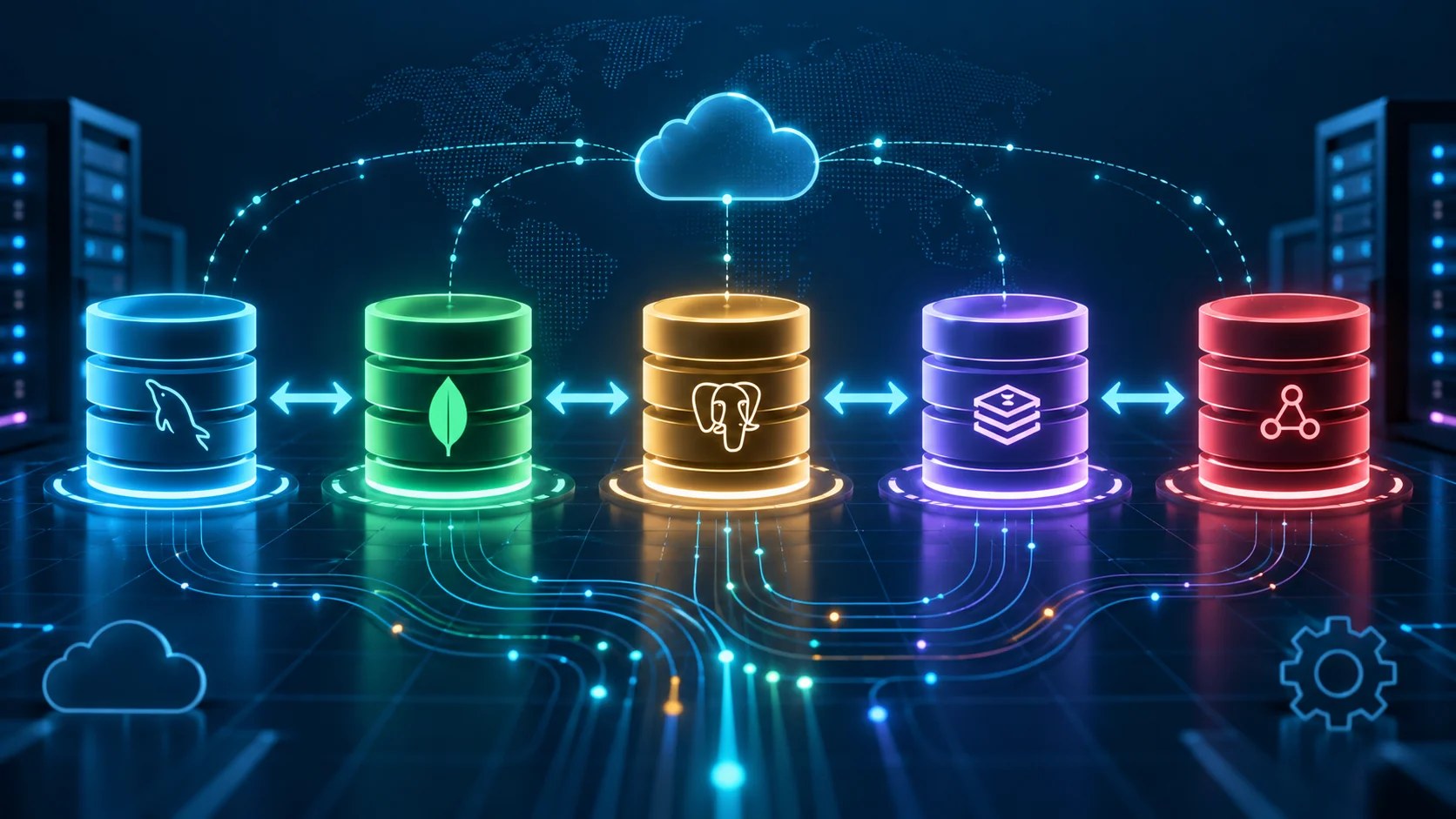
The database choice is one of the most consequential technical decisions in application development. The wrong database creates performance ceilings, operational complexity, and migration pain that compounds for years. The right database is invisible: it handles the data access patterns your application needs without creating bottlenecks or excessive operational overhead.
This guide covers the main database categories, the leading cloud-native options in each, and the decision framework for choosing correctly in 2026.
The Three Main Categories
SQL (Relational Databases)
SQL databases store data in structured tables with predefined schemas and enforce relationships through foreign keys. They use SQL for querying. ACID transactions guarantee consistency. They are the default choice for most applications that handle structured business data: orders, users, payments, inventory.
SQL databases excel at complex queries across multiple related tables, transactional integrity, and maintaining data relationships. They typically scale vertically (larger machines) more naturally than horizontally (more machines).
NoSQL Databases
NoSQL databases trade some ACID guarantees for horizontal scalability and flexible schema. The major subtypes include document stores (MongoDB), key-value stores (Redis, DynamoDB), column-family stores (Cassandra), and graph databases (Neo4j).
NoSQL excels at: high-volume data at scale, flexible or frequently changing data structures, specific access patterns like cache or session storage, and distributed architectures where horizontal scaling matters.
NewSQL Databases
NewSQL databases combine SQL semantics and ACID transactions with NoSQL-scale horizontal distribution. They are designed for workloads that need both relational integrity and global scale: CockroachDB, PlanetScale, Google Spanner, and Neon are the leading examples in 2026.
Leading Cloud Database Options in 2026
| Database | Type | Best For | Managed Cloud Service |
|---|---|---|---|
| PostgreSQL | SQL | Most web apps, complex queries | Amazon RDS, Google Cloud SQL, Supabase, Neon |
| MySQL | SQL | Traditional web apps, WordPress | Amazon RDS, PlanetScale |
| MongoDB | Document (NoSQL) | Flexible schemas, content, catalogs | MongoDB Atlas |
| DynamoDB | Key-Value (NoSQL) | High-scale AWS apps, sessions | AWS DynamoDB (fully managed) |
| Redis | Key-Value (NoSQL) | Caching, sessions, real-time leaderboards | Amazon ElastiCache, Redis Cloud |
| Cassandra | Column-family (NoSQL) | Time-series, high-write workloads | Amazon Keyspaces, Astra DB |
| CockroachDB | NewSQL | Global distributed apps needing SQL | CockroachDB Cloud |
| PlanetScale | NewSQL (MySQL-compatible) | Serverless MySQL at scale | PlanetScale Cloud |
| Google Spanner | NewSQL | Enterprise global consistency | Google Cloud Spanner |
The Decision Framework
Start With PostgreSQL Unless There Is a Strong Reason Not To
PostgreSQL has become the default recommendation for new applications in 2026. It handles most SQL workloads excellently, supports JSON storage for semi-structured data, has excellent extension ecosystem (PostGIS for geospatial, pgvector for vector search), scales to very high throughput with proper indexing, and is supported by every major cloud provider.
Managed PostgreSQL services like Supabase, Neon, and Amazon RDS reduce operational overhead significantly. For most web applications, SaaS products, and internal tools, PostgreSQL is the right choice.
When to Choose NoSQL
- MongoDB: when your data is document-like (each record has a different structure), when you iterate on schema frequently, or for content management and product catalogs.
- DynamoDB: when you need massive throughput at AWS scale, have simple access patterns (lookup by key), and the workload is tightly integrated with AWS services.
- Redis: for caching, session storage, real-time rate limiting, leaderboards, and pub/sub messaging. Almost always used alongside a primary database, not instead of one.
- Cassandra: for high-volume time-series data, IoT sensor data, or write-heavy workloads that need linear horizontal scaling.
When to Choose NewSQL
NewSQL databases make sense when you need SQL semantics (complex queries, joins, transactions) but need to serve global users with low latency or need horizontal scale beyond what vertical PostgreSQL can handle. CockroachDB is the go-to for most teams in this category.
The Rise of Managed Serverless Databases
A significant shift in 2025 and 2026: serverless databases that scale to zero and charge per query rather than per always-on instance. Key options:
- Neon: serverless PostgreSQL with branching for development environments. Scale to zero between uses.
- PlanetScale: serverless MySQL with zero-downtime schema migrations via a git-like branching workflow.
- Fauna: serverless document database with strong consistency.
- Turso (libSQL): SQLite-compatible database for edge deployments.
For startups and side projects, serverless databases eliminate the cost of always-on instances during development and early scaling. For production workloads with steady traffic, traditional managed databases often cost less at high utilization.
Vector Databases: The AI-Era Addition
Vector databases are purpose-built for storing and querying embedding vectors (numerical representations of text, images, and other data used by AI models). In 2026, they are essential infrastructure for AI applications that need semantic search, recommendation systems, or RAG (Retrieval Augmented Generation) workflows.
- Pinecone: the leading dedicated vector database. Fully managed, easy setup.
- Weaviate: open-source vector database with strong hybrid search.
- pgvector: PostgreSQL extension that adds vector search. Lets you avoid a separate vector database for smaller-scale AI applications.
- Qdrant: high-performance vector search built in Rust. Strong for production workloads.
5 Common Cloud Database Mistakes
- Choosing NoSQL because it sounds modern. NoSQL databases trade relational integrity and query flexibility for specific benefits. Use them when those specific benefits are needed.
- Under-indexing. Most database performance problems trace back to missing indexes. Profile query performance from the start.
- Not planning for migrations. Your schema will change. Use a migration tool (Flyway, Liquibase, Prisma Migrate) from day one.
- Mixing concerns in one database. Use Redis for caching, PostgreSQL for your core data, and a vector database for AI search. Right tool for each job.
- Ignoring backup and recovery testing. Automated backups are not enough. Regularly test that restores from backup actually work.
Expert Tips
- Use connection pooling. PgBouncer for PostgreSQL and similar tools for other databases prevent connection exhaustion at scale.
- Enable query logging in development. N+1 query problems and missing indexes are invisible without query logs.
- Separate read replicas from write primary. Read-heavy workloads can offload to replicas without touching the primary.
- Use database branching for development. Neon and PlanetScale offer git-like branching so development databases do not affect production.
Frequently Asked Questions
Should I use SQL or NoSQL?
For most applications, start with PostgreSQL. Move to NoSQL when you have a specific, identified use case where NoSQL’s trade-offs (flexible schema, horizontal scale, specific access patterns) provide a clear advantage that SQL cannot match. The rule: SQL by default, NoSQL by design.
Is DynamoDB worth using?
DynamoDB is excellent for specific workloads: high-throughput key-value lookups, session storage at AWS scale, and applications tightly integrated with the AWS ecosystem. For general-purpose application data with complex query patterns, PostgreSQL on RDS is usually a better choice with lower operational complexity.
What is the best database for a startup?
PostgreSQL on a managed service (Supabase for full-stack, Neon for serverless, Amazon RDS for AWS-native). Add Redis for caching when needed. Avoid premature optimization toward NoSQL until you have identified specific scale or schema flexibility requirements that PostgreSQL cannot handle.
Default to PostgreSQL, Specialize When Needed
The database decision should follow the data. Understand your access patterns, your query requirements, your scale targets, and your consistency needs. Start with PostgreSQL. Add specialized databases (Redis for caching, a vector database for AI, DynamoDB for specific AWS-integrated workloads) only when the data access patterns genuinely require them.
For the foundational view on cloud architecture, service models, and migration strategy, read our pillar: Cloud Computing in 2026: The Complete Guide. More cloud engineering guides live on PostoryCafe.com.