

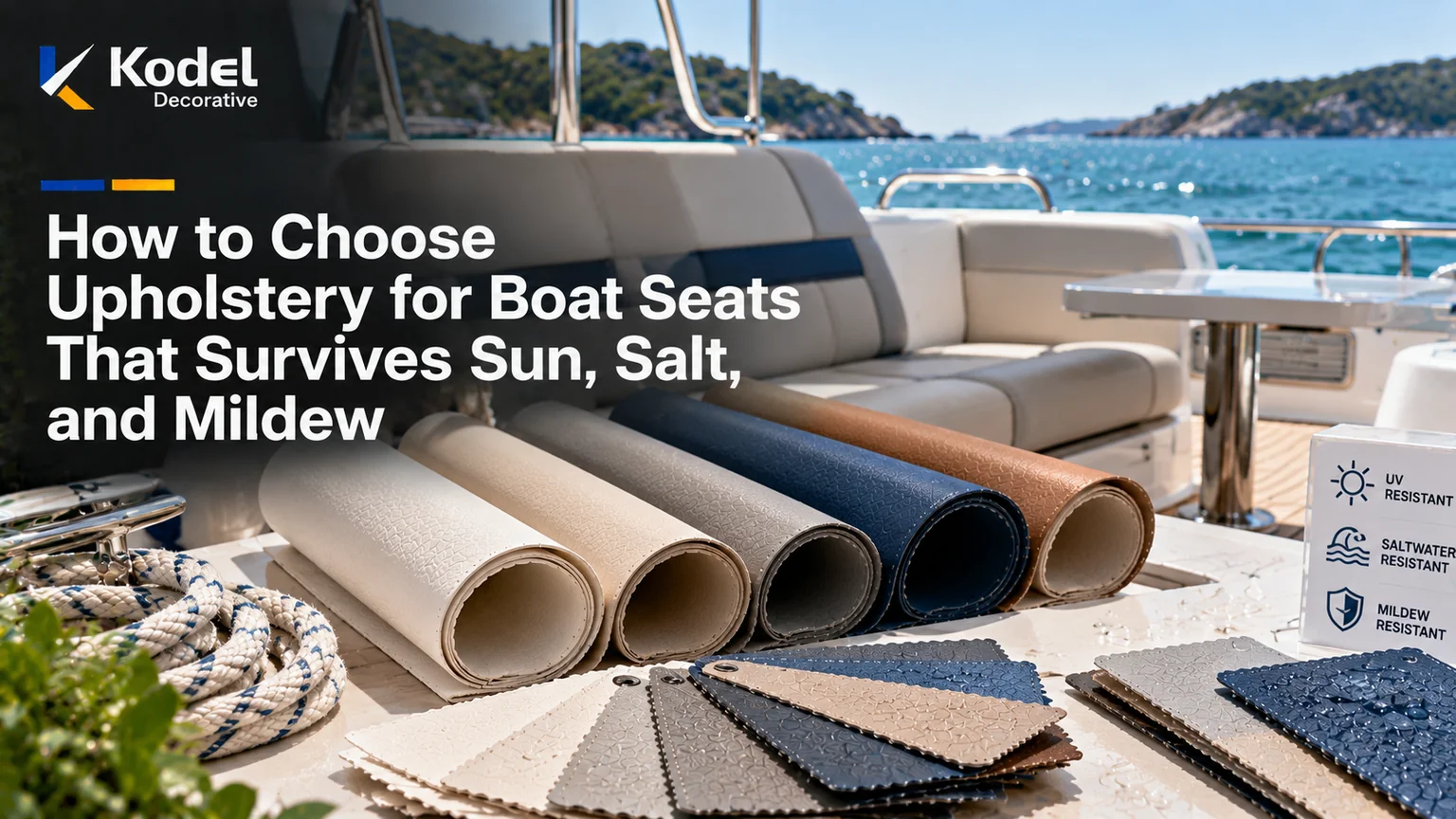
A boat seat has a harder life than a sofa. It sits in direct sun, takes spray and rain, and is often left closed up under a cover for weeks. Most early failures come from a material chosen for its looks rather than for the water.
If you are weighing options, it helps to look through the range of a custom synthetic leather supplier first, because marine seating calls for a different kind of material than indoor furniture.
Why boat seats fail early
Three forces do most of the damage. Ultraviolet light fades colour and dries out the surface. Moisture feeds mildew and weakens the backing. Constant flexing, from people sitting down and standing up, stresses the seams.
A material that handles one of these well can still fail on another. That is why marine upholstery is judged on several properties at once, not on a single rating.
What to look for in marine upholstery
UV resistance
Sunlight on open water is harsh, and reflected light adds to it. Look for material described as UV stabilised and ask what test supports the claim. Lighter colours also stay cooler to the touch than dark ones.
Mildew resistance and backing
Mildew usually starts beneath the surface, in the backing, where moisture lingers. Ask whether the backing has a mildew-resistant treatment, especially for below-deck cushions that stay damp.
A waterproof, flexible coating
The coating should keep water out without turning stiff in cold weather or sticky in heat. Press a sample and bend it several times. It should recover without whitening or cracking.
The parts people forget: thread, seams and foam
Even a waterproof fabric leaks at every needle hole. Marine-grade thread, which resists sunlight, matters as much as the material.
Foam is the other hidden weak point. Open-cell foam soaks up water and dries slowly, so many boat owners choose quick-dry foam or add drainage gaps under the seat. Dry foam keeps mildew away from the fabric above it.
Choosing colour and texture
Dark seats absorb heat and can become uncomfortable in midday sun. Light and mid-tone colours stay cooler, though they show dirt more easily.
A fine grain or light texture hides scuffs better than a smooth, glossy finish. It also gives bare legs better grip when the surface is wet.
Where to find material built for the job
Not every waterproof fabric is built for continuous marine exposure. Purpose-made boat seat upholstery leather is usually designed around UV, moisture and flexing together, so you are not trading one property for another.
Whichever source you use, ask for a physical sample. Leave it in the sun for a week, wipe it with the cleaner you plan to use, and see how it behaves before you commit to a full set.
How to clean and care for marine seats
Rinse salt off with fresh water after each trip. Salt crystals are abrasive and attract moisture.
Wash with mild soap and a soft brush, then rinse and let the seats dry fully. Avoid strong solvents and harsh bleach, which can strip the coating and speed up cracking.
Use a ventilated cover rather than a sealed one. Trapped humidity under a tight cover is a common reason for mildew on seats that look fine from above.
Matching the material to how you use the boat
A day boat that is dried and covered after every trip can use a lighter specification than a boat that lives on a mooring. A liveaboard or a charter boat sees constant use and should lean towards the heaviest, most water-resistant grade.
Climate changes the answer too. In tropical waters, heat, humidity and UV all peak together, so mildew resistance and UV stability are not optional extras. In cooler regions, flexibility in cold weather deserves more attention.
Common mistakes to avoid
The most frequent mistake is using indoor upholstery on deck because it looks good in the showroom. It is rarely tested for sunlight or constant damp, and it tends to fade and crack within a season or two.
Other mistakes are quieter. Standard steel staples rust, so stainless steel fixings are worth the small extra cost. Skipping drainage leaves water sitting under the cushion, and storing wet seats under a sealed cover invites mildew.
When to replace rather than repair
Small seam splits can be restitched with marine thread. A surface that is peeling, tacky or cracked across large areas usually cannot be saved, because the coating has failed.
Mildew that has reached the foam is the other signal. If it comes back after cleaning, replace the foam along with the cover.
Thinking about cost over time
Marine upholstery costs more per metre than indoor material. It also lasts longer, so the cost per season is often lower than a cheap cover that needs replacing every two years.
A short checklist before you buy
Choose material rated for marine use, check the backing treatment, and match the thread and foam to the fabric. Test a sample in real sun and water. Then care for the seats with fresh water, mild soap and a ventilated cover.
Seats chosen this way tend to look good for years rather than a single season, and they cost less over time than a cheap set replaced twice.
If you are sourcing material in Southeast Asia, a PVC leather supplier in Thailand that stocks marine grades can send samples for the sun-and-water test described above.
Was this guide helpful?
Thanks for the feedback. It helps us write better guides.