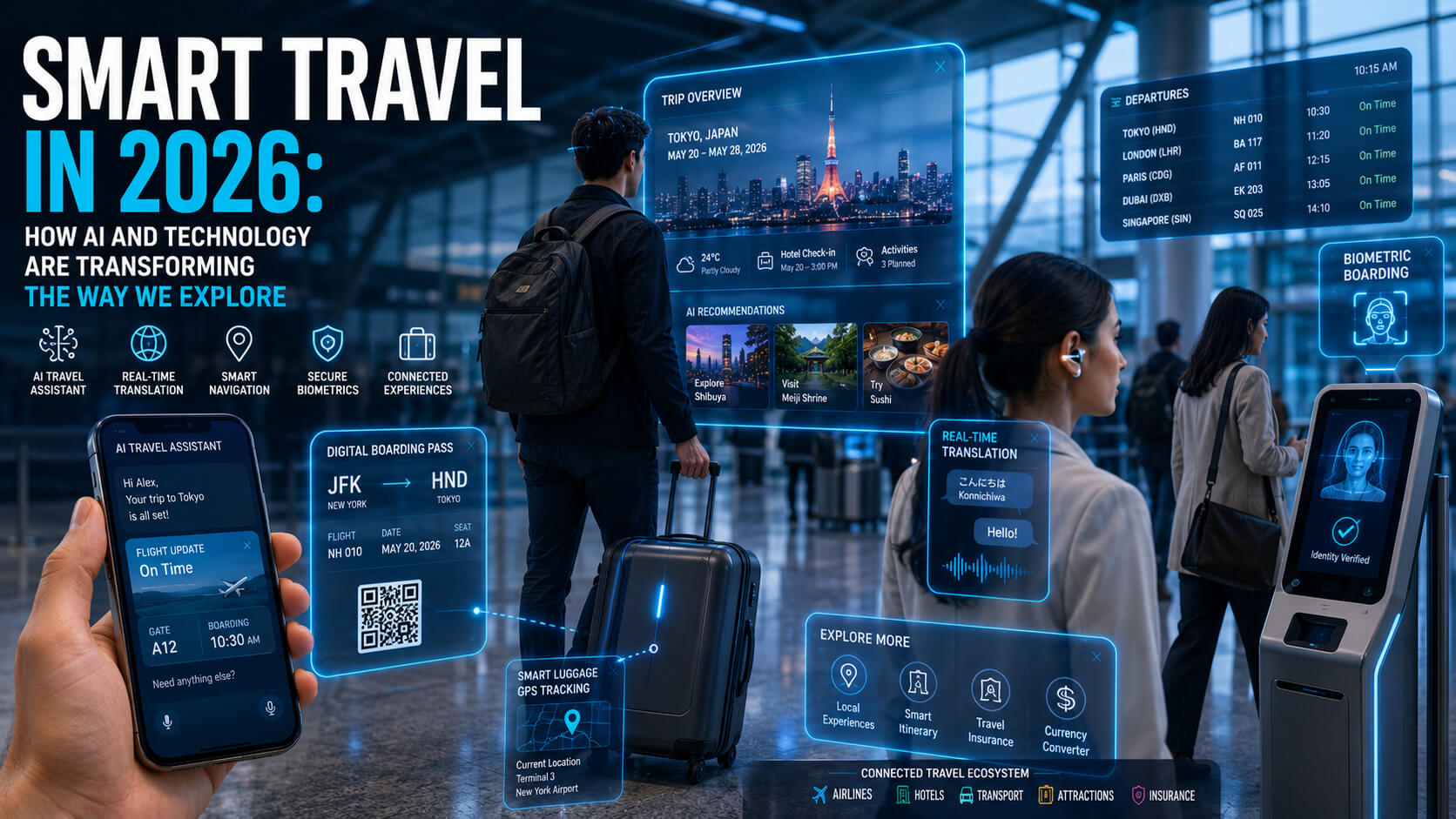

The global travel technology market reached 13.5 billion US dollars in 2025, according to Allied Market Research. Google Flights processed more than two billion flight searches in 2025, while Airbnb reported 448 million nights and experiences booked across 220 countries and regions. Apple AirTag, since its 2021 launch, has been used to locate more than 1.2 million lost or stolen bags globally, according to data cited by Apple at its 2025 product event. Travel has become one of the domains most transformed by mobile technology and IoT connectivity, yet most travellers use only a fraction of what is available to them.
This guide covers the essential travel apps and gadgets in 2026 that deliver measurable improvements to the travel experience, from AI-powered itinerary planning to offline navigation, sleep on long-haul flights, and real-time luggage tracking. Each recommendation is based on current functionality, user-verified utility, and honest assessment of where the technology creates genuine value versus marketing-driven novelty.
Essential Travel Apps for 2026
Google Flights and Hopper: Booking Strategy
Google Flights remains the most effective tool for flight price research in 2026, displaying price history graphs, fare prediction signals, and flexible date grids that reveal the cheapest departure and return combinations within a date range. Hopper’s AI-powered prediction engine analyzes billions of historical flight price data points to recommend whether to book now or wait, with a reported accuracy rate of 95 percent for its predictions according to Hopper’s 2025 transparency report. The combination of Google Flights for discovery and Hopper for timing optimisation outperforms using either tool alone.
Google Maps and Maps.me for Offline Navigation
Downloading Google Maps offline sections of up to 50 GB per region ensures navigation functions without data connectivity, critical in countries where roaming is expensive or coverage is unreliable. Maps.me, using OpenStreetMap data, provides more detailed offline hiking trail and rural road mapping than Google Maps in destinations across Southeast Asia, Central America, and Eastern Europe. Both apps function with GPS only once offline maps are downloaded, consuming zero mobile data during navigation.
Revolut and Wise for Currency and Payments
Revolut and Wise are the two most cost-effective multi-currency travel cards available globally in 2026. Revolut’s free tier allows currency exchange at interbank rates up to 1,000 euros per month, with conversions above that limit at a 0.5 percent fee on weekdays. Wise charges a small transparent fee (typically 0.4 to 1.5 percent depending on currency pair) with no markup above the mid-market rate. Both cards work in 150-plus countries, include virtual card numbers for online bookings, and offer real-time spending notifications. Standard bank debit cards charge three to five percent in combined foreign transaction and currency conversion fees; switching to either of these cards saves meaningfully on week-long international trips.
Best Travel Gadgets in 2026
Apple AirTag and Tile Pro: Luggage Tracking
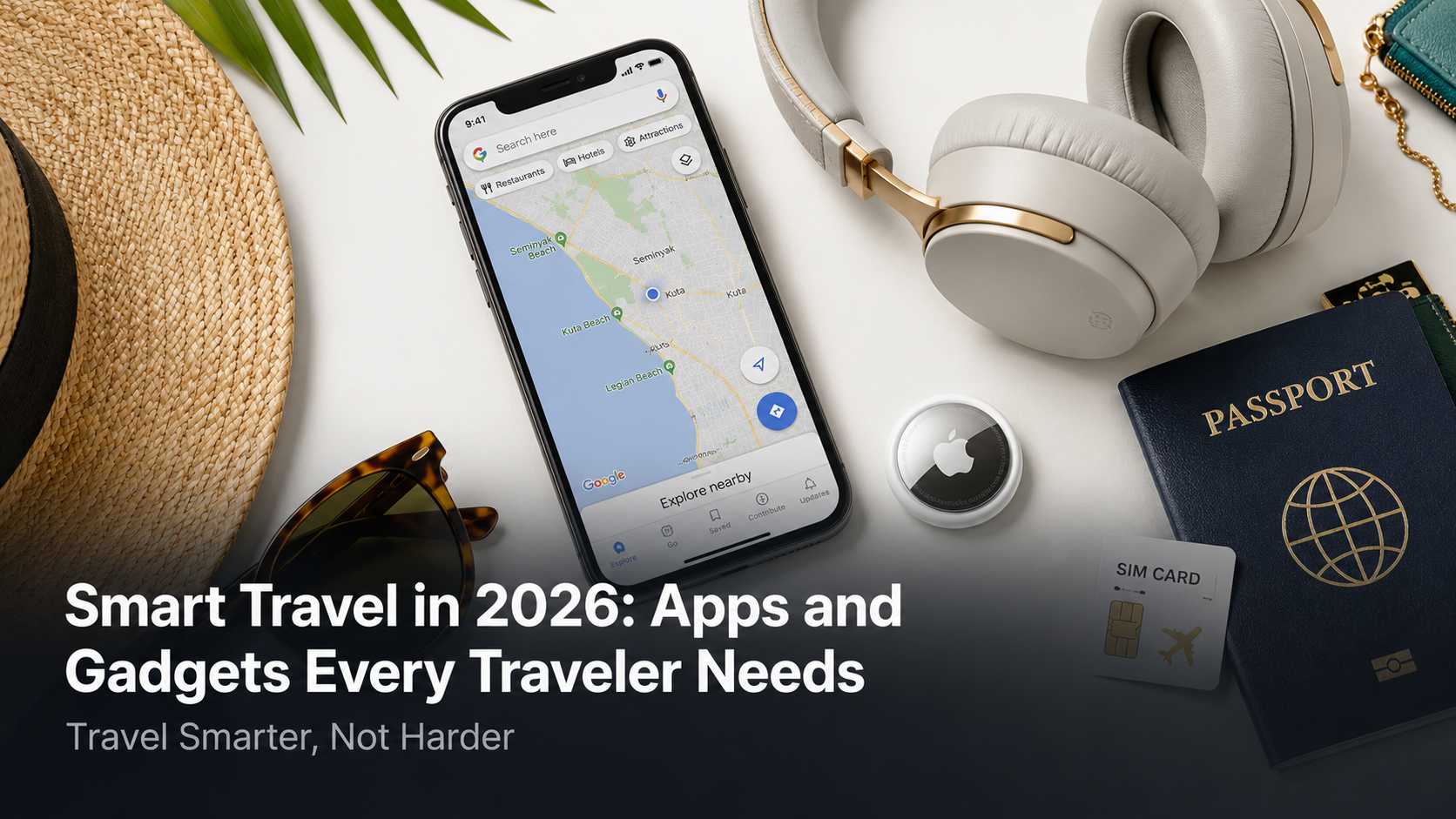
Apple AirTag at $29 (or $99 for a four-pack) uses Apple’s Find My network of over two billion active Apple devices to locate lost luggage anywhere in the world where an Apple device has been within Bluetooth range. Tile Pro at $34.99 uses Tile’s network of 70 million devices and is the better choice for Android users or mixed-device travel groups. Airlines including Delta, British Airways, and Lufthansa officially recommend placing tracking tags inside checked luggage after a series of high-profile bag mishandling incidents between 2022 and 2025.
Portable eSIM Solutions
eSIM technology eliminates the need to swap physical SIM cards when crossing borders. Airalo is the largest eSIM marketplace in 2026, offering data plans for 200-plus countries and regions starting at $4.50 for one GB valid for seven days. Holafly offers unlimited data plans per destination for a fixed daily fee, a better value for data-heavy travellers. Both activate instantly via QR code before departure. A compatible device (iPhone XS or later, most Android flagship phones from 2020 onwards) is required. eSIM adoption among frequent international travellers reached 43 percent in 2025 according to GSMA Intelligence, up from 19 percent in 2022.
Noise-Cancelling Headphones for Long-Haul Travel
Sony WH-1000XM6 and Apple AirPods Max are the two highest-rated noise-cancelling headphones for long-haul travel in 2026. Sony’s WH-1000XM6, released in May 2026, achieved a composite noise cancellation score of 9.4 out of 10 in The Verge’s review, effectively eliminating aircraft engine noise at 70 to 85 decibels. AirPods Max deliver superior audio quality and tighter integration with Apple devices, including automatic switching between iPhone, iPad, and Mac, but cost $549 versus $349 for Sony. Both improve sleep quality measurably on overnight flights by reducing ambient noise to near-silence.
AI Travel Planning Tools in 2026
AI-powered itinerary planning tools have matured significantly in 2026. Wanderlog’s AI trip planner, available on iOS and Android, generates day-by-day itineraries from a destination and number of days, integrating restaurant bookings, opening hours, and transit connections. Mindtrip uses conversational AI to refine itineraries through natural language adjustments, allowing travellers to say ‘fewer museums, more street food markets’ and receive an updated plan instantly. Google’s Gemini integration within Google Travel pulls in real-time pricing from flights and hotels within the same interface as the AI planning conversation.
The limitation of AI travel planners in 2026 is currency: restaurant and attraction recommendations can be based on data that is months old. Verifying that a restaurant recommended by an AI planner is still open, still operating at the same address, and still serving the food described requires a secondary check on Google Maps or the venue’s own website. AI travel planning is a strong starting scaffold; it is not a substitute for one verification pass before arriving at a destination.
Travel Technology Comparison: Essential vs. Premium
| Category | Budget Option | Premium Option | Key Difference |
| Luggage Tracking | AirTag $29 | Tile Mate 4-pack $59 | Network: Apple vs Tile |
| Currency | Wise (free tier) | Revolut Premium $9.99/mo | ATM limits |
| Navigation | Google Maps Offline | Maps.me Pro | Rural trail detail |
| eSIM Data | Airalo from $4.50 | Holafly unlimited $9.90/day | Data limits vs unlimited |
| Noise Cancelling | Sony XM6 $349 | AirPods Max $549 | Audio quality vs system integration |
| AI Itinerary | Wanderlog Free | Mindtrip Premium $9.99/mo | Collaboration and export features |
Frequently Asked Questions: Smart Travel Apps and Gadgets 2026
What are the must-have travel apps in 2026?
The essential travel apps in 2026 are Google Flights and Hopper for flight booking strategy, Google Maps with offline downloads for navigation, Revolut or Wise for currency exchange and payments, Airalo for international eSIM data, and TripIt or Wanderlog for trip organisation and itinerary management. These five apps address the most costly and friction-heavy parts of international travel at minimal or zero cost.
Do I need a luggage tracker when travelling in 2026?
A luggage tracker is a high-value investment for checked baggage in 2026 given that IATA recorded 7.6 delayed or lost bags per 1,000 passengers in 2025. An Apple AirTag at $29 or Tile Pro at $34.99 allows real-time location tracking of checked baggage, providing precise location data when airlines cannot. Airlines including Delta and British Airways recovered more than 90 percent of tracked bags within 24 hours in 2025 cases where passengers could provide location data from tracking devices.
What is the best app for finding cheap flights in 2026?
Google Flights is the best starting point for cheap flight searches in 2026 because of its price history graphs, flexible date calendar, and everywhere search feature that identifies the cheapest destinations from your departure airport across any month. Hopper’s AI-powered buy vs wait recommendation adds timing intelligence. Skyscanner and Kayak remain useful for comparing budget airline fares not always captured in Google Flights’ main results.
Should I use an eSIM or a local SIM card when travelling internationally in 2026?
An eSIM is more convenient than a local SIM card for most international travellers in 2026 because it activates before departure, supports multiple countries in a single plan, and requires no physical SIM swap. Local SIM cards are cheaper per GB in some markets (particularly India, Thailand, and Turkey) and remain the better value choice for stays longer than 10 days in a single country. eSIMs from Airalo or Holafly are the better choice for multi-country itineraries and short stays of three to seven days.
What gadgets make long-haul flights more comfortable in 2026?
The three most impactful gadgets for long-haul flight comfort in 2026 are noise-cancelling headphones (Sony WH-1000XM6 or AirPods Max), a travel pillow with proper cervical spine support (Trtl Travel Pillow rated highest by Sleep Foundation 2025 review), and a portable phone charger above 20,000 mAh capacity for overnight flights. Compression socks reducing deep vein thrombosis risk on flights over six hours are recommended by the NHS and the American College of Chest Physicians, though they qualify as medical accessories rather than technology gadgets.
Which travel apps work offline in 2026?
Travel apps functioning fully offline in 2026 include Google Maps (with pre-downloaded region maps), Maps.me, TripIt (for itinerary viewing), XE Currency (with last-synced rates), and Google Translate (with offline language packs downloaded). Airline apps including IndiGo, Air India, and Emirates allow boarding pass access offline once downloaded. Spotify and Apple Music work offline with downloaded playlists, and Kindle enables offline book access for long-haul reading.
Pack the Apps Before the Clothes
The most consistent pattern among experienced travellers in 2026 is that their technology preparation is as systematic as their physical packing list. Downloaded offline maps, installed eSIM, Revolut loaded with travel currency, AirTag in the checked bag, and itinerary imported to TripIt: these five steps take approximately 30 minutes before departure and prevent the most common and expensive travel failures.
Travel technology in 2026 does not make travel effortless, but it does eliminate a large proportion of the friction that turned manageable situations into serious problems five years ago. A lost bag with an AirTag is a recoverable inconvenience. A lost bag without location data, in an airport whose staff cannot speak your language, during a tight connection, is a very different problem. The gadgets are cheap relative to the situations they prevent.